
Related works
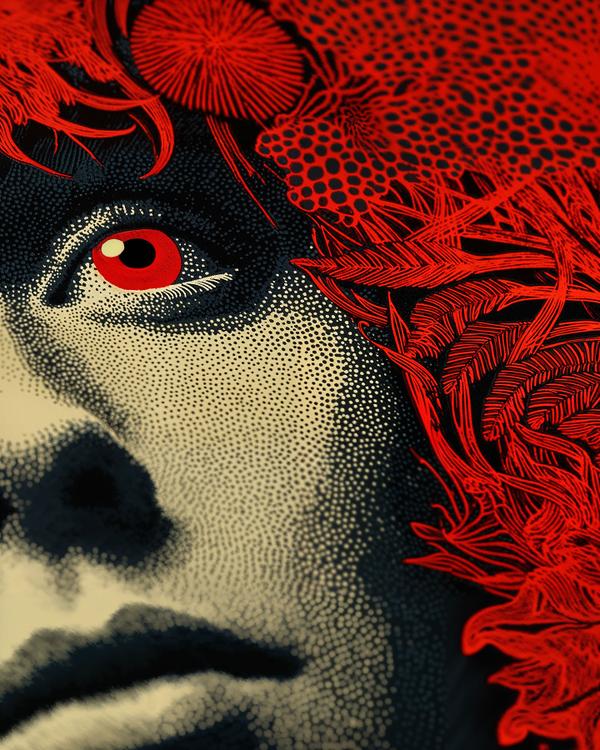
Silkscreen Dreams in Red & Dots
Welcome to a love letter to one of my favorite mediums: silkscreen printing (aka screen printing). It’s bold, it’s graphic, and it loves a good dot. Swipe your gaze across this piece — that lush red foliage, that hypnotic gaze — and thank silkscreening for the drama. From Andy Warhol’s soup cans to rock posters that melt your face off, this technique has seriously iconic roots. Fun silkscreen facts to impress your arty friends: — Silkscreening dates back over 1,000 years to ancient China (yep, the OGs). — The “silk” part? Originally, the mesh was literally made of silk. — Pop artists in the ‘60s embraced it for its ability to mass-produce images with wild colors and sharp lines — think Warhol, Lichtenstein, and Sister Corita Kent. — Each color in a silkscreen print = a separate screen and pass of ink = a meticulous, messy labor of love. It’s graphic art with grit, elegance with edge — and a medium that knows how to make a statement.
Skip Intro
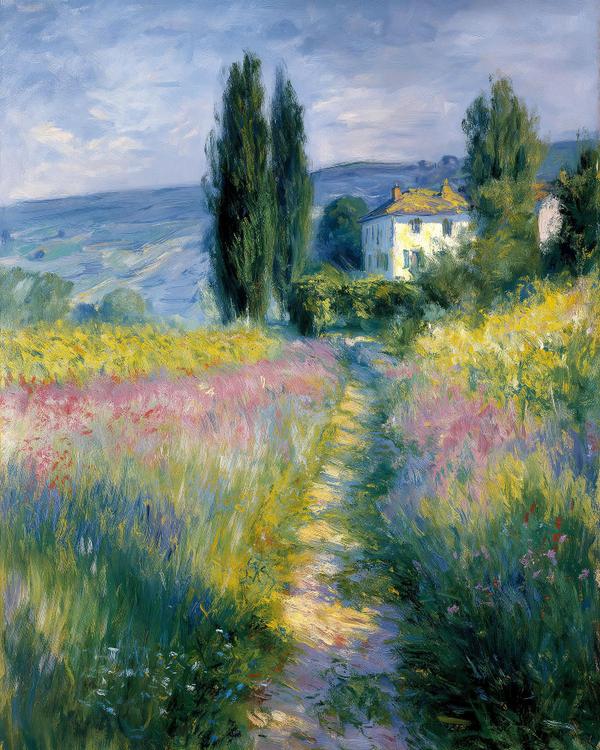
What you’re seeing here (vineyard fields, seaside strolls, Venetian shimmer, and that dreamy rowboat with lilies) is Impressionism in all its “caught in the moment” glory. Monet wasn’t trying to paint every leaf or stone; he wanted to capture how light felt at that instant. Morning haze? Sunset glow? A reflection rippling on water? He grabbed it before it slipped away, like an artistic paparazzo of sunlight. The Big Idea: Impressionists believed that reality wasn’t fixed—it changed with the hour, the season, the flicker of light. A meadow at noon is not the same meadow at dusk. Monet painted the same haystacks over 30 times to prove it (seriously, the man was the original “one more angle” content creator). Fun facts worth dropping at dinner: The term Impressionism came from a critic mocking Monet’s painting Impression, Sunrise—basically saying it looked unfinished. Joke’s on him: the “unfinished” look became the hottest style in art history. Monet’s eyesight got so bad later in life that some of his water lilies veer into abstract territory—like a preview of modern art before it even existed. Those quick, choppy brushstrokes? They weren’t laziness. They were speed-painting lighting before it disappeared. So the next time someone says, “That painting looks blurry,” just tell them: Exactly. That’s the point.
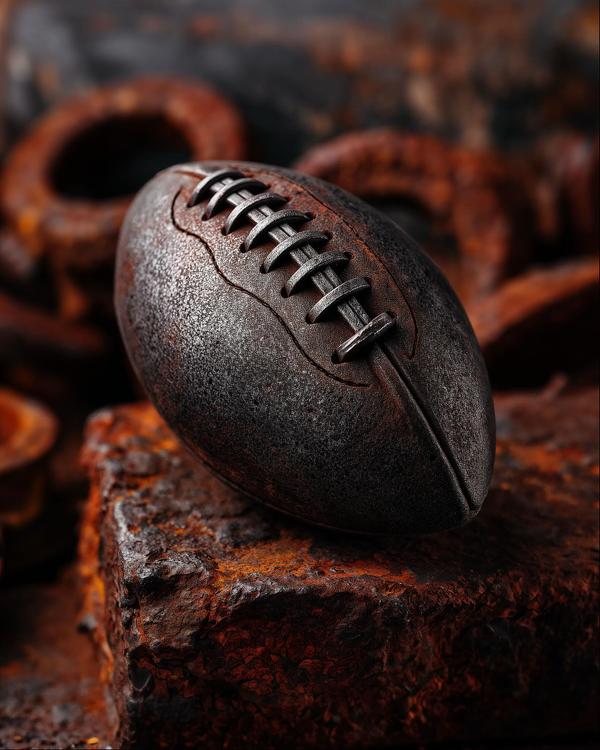
Steel Reception
A scarred football. Rusted slabs. A background that looks like the inside of Pittsburgh’s memory.
Available as a museum-quality print.
Request this print