
Florals for the Afterlife?
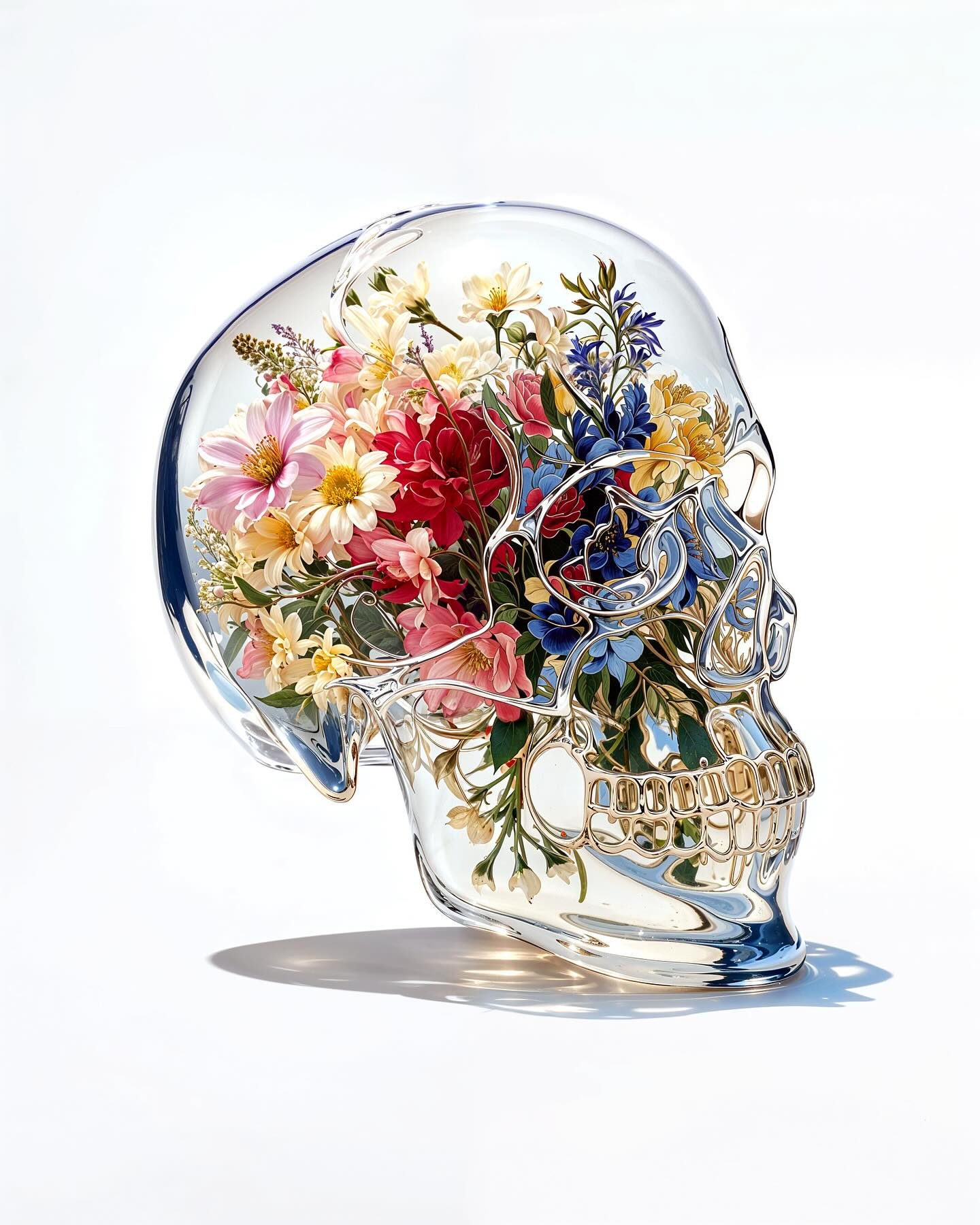
This piece looks like Damien Hirst finally embraced spring cleaning and traded formaldehyde for flower food.
It’s an optical illusion—a crystal-clear skull cradling a riot of blooms inside, where neurons once fired. Think vanitas still life meets luxury perfume ad. It whispers, “Yes, mortality is inevitable, but at least it can smell like jasmine and peonies.”
Stylistically, it’s a love child of hyperrealism and surrealism. The glassy precision nods to artists like Audrey Flack and Ralph Goings, who painted reflections so real they made cameras jealous. But the concept—life blooming within death—harks back to 17th-century Dutch vanitas paintings, where skulls, fruit, and flowers symbolized time’s relentless micromanagement of beauty. Here, though, we update the message: the flowers aren’t fading—they’re flourishing. It’s mortality with better lighting.
Visually, it’s a lesson in contrast: fragility vs. abundance, transparency vs. chaos, anatomy vs. nature. The clear skull acts like a greenhouse for what’s left of us—a metaphor for memory, legacy, and the compostable nature of ego.
Fun fact: The tradition of skull-and-flower pairings goes back to the Baroque era, when artists would sneak tulips into skulls as secret nods to the Dutch “tulip mania,” the first recorded economic bubble. Yes, people once went bankrupt buying bulbs. Humanity’s been ridiculous for centuries.
So next time life feels short, remember: it’s not about avoiding decay—it’s about blooming through it.
Related works

Available as a museum-quality print.
Request this print