
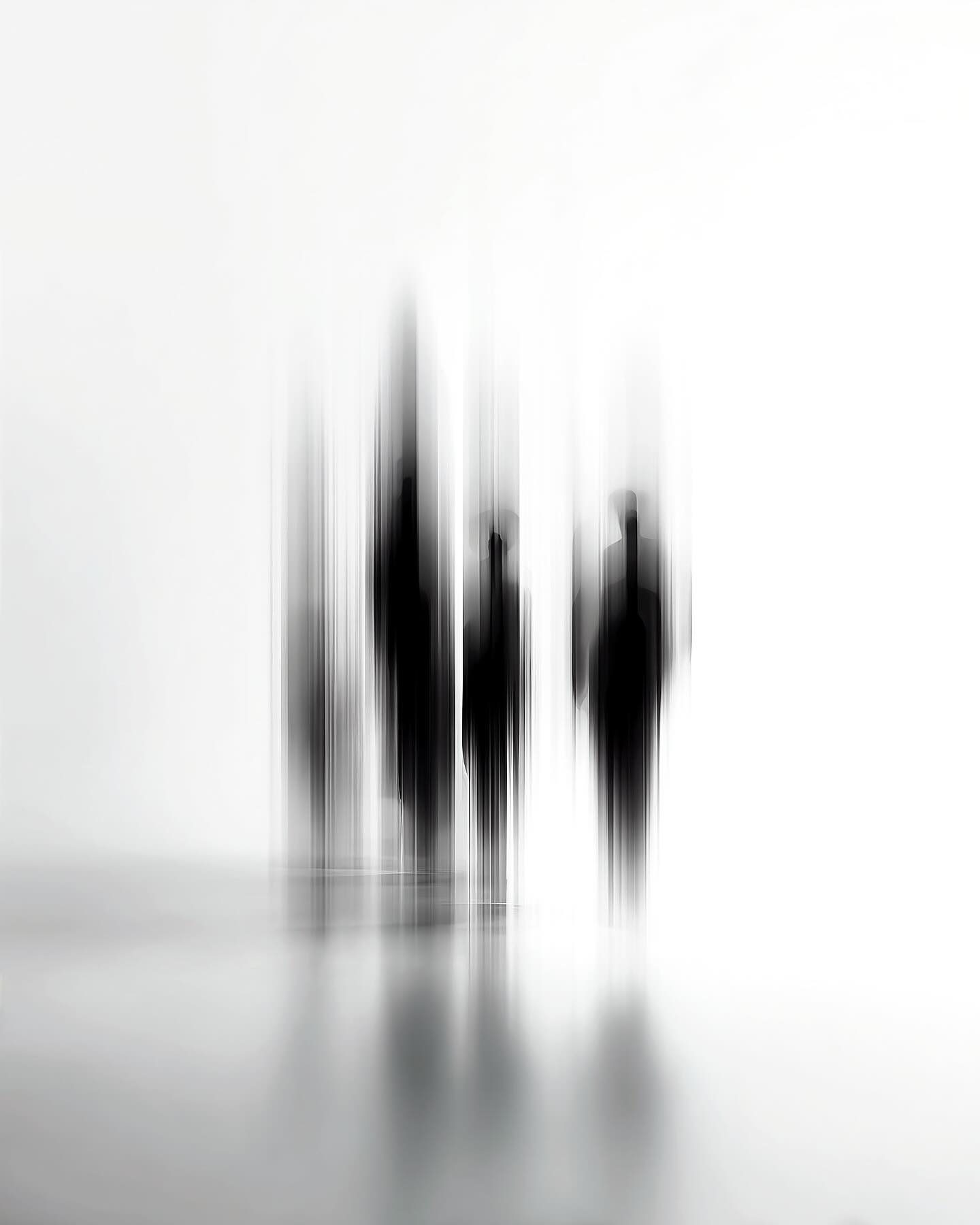
Ghosts Between Meetings
If a group chat tried to manifest IRL, it would look like this—everyone present, nobody fully here.
What you’re seeing is motion turned into paint, a monochrome shimmer where figures stretch like taffy and time gets smudged. Stylistically, it’s where Futurism (Giacomo Balla’s love of speed) shakes hands with Gerhard Richter’s blur, high-fives Giacometti’s elongated souls, and nods to photographers like Hiroshi Sugimoto and Alexey Titarenko, who sculpt silence and crowds with time.
The trick isn’t filters—it’s duration. A longer “shutter” (or its digital cousin) lets the subject move while the sensor keeps watching. Translation: one frame, many instants. That’s why these people read as echoes instead of portraits. Notice the huge negative space: the bright field isn’t empty; it’s a stage that lets tiny value shifts and ghost-reflections carry the drama. Your brain finishes the forms using Gestalt closure—we see “people” from very little information because we’re wired to connect the dots.
Mini lesson:
* Motion blur = compressing time into a single image.
* Figure/ground: the more breathing room around the subject, the louder the subject feels.
* Vertical streaks cue “up/down” movement, adding tension even when the figures barely drift.
Fun fact: Movies run ~24 frames per second because of persistence of vision—your visual system stitches still images into motion. Blur taps the same quirk: your eyes love linking moments that never actually overlapped.
So, mood check: it’s not loneliness—it’s liminality. That in-between place where you’re leaving one moment and not quite in the next. Hover there for a second. Let the edges soften. The calendar can wait.
Related works
Available as a museum-quality print.
Request this print