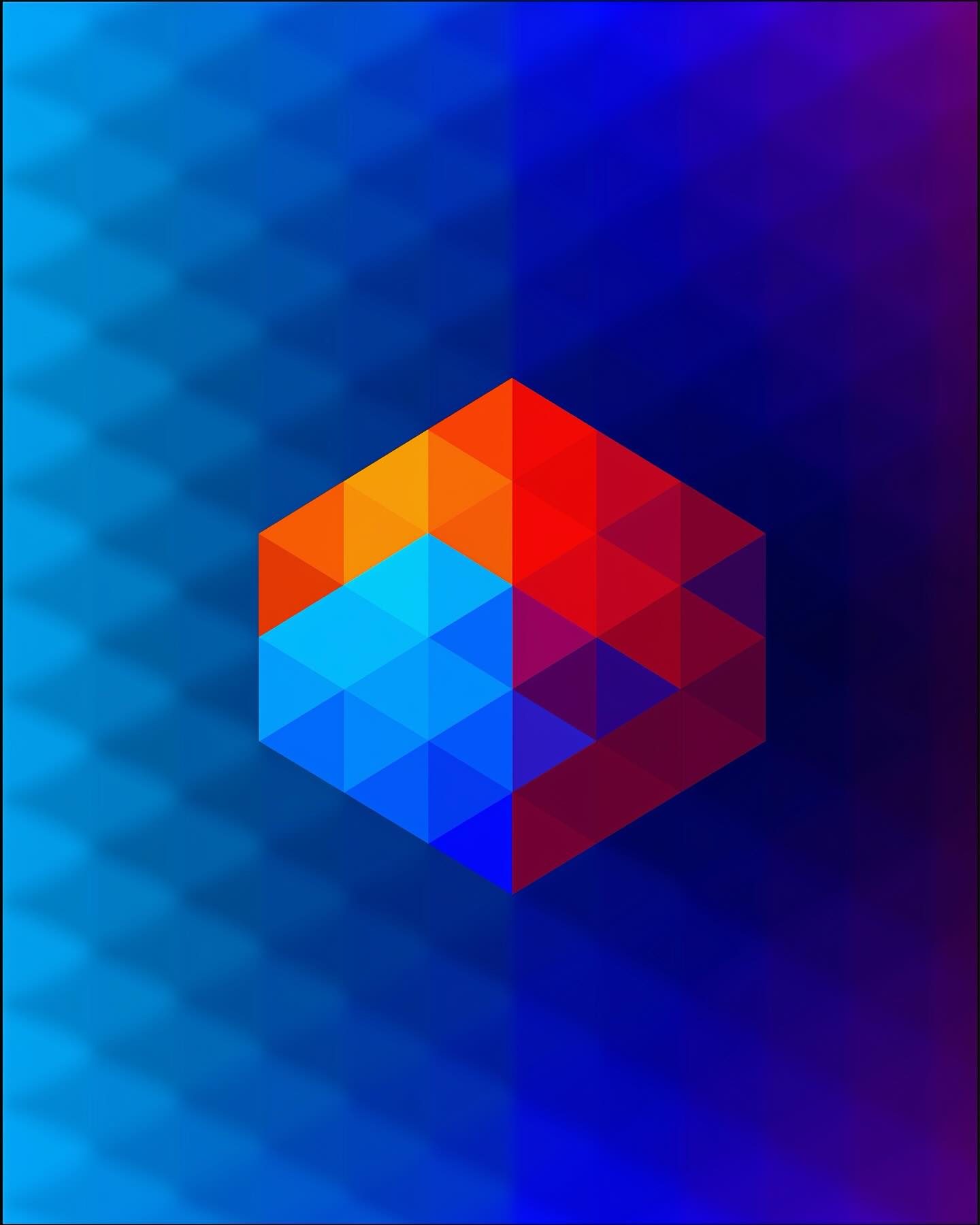
Hexagonal Zen
What you’re looking at sits squarely in the Op Art and geometric abstraction tradition—think Victor Vasarely, the “father of Op Art,” who made whole careers out of hypnotizing people with color-shifting grids, or Josef Albers, who basically proved that colors are moody little liars, changing their personality based on who they’re sitting next to.
Here, the illusion comes from triangular tessellations—tiny repeating shapes that give the cube a sense of depth and motion. The background gradient? It’s the nightclub this cube decided to walk into: left wall lit in turquoise neon, right wall swimming in purple haze. That “split personality” backdrop doubles down on the drama, making the central cube feel like it’s levitating between two worlds.
Art concept alert: This is color theory doing its stand-up routine. Warm colors (reds, oranges) push forward; cool colors (blues, purples) recede. Your brain interprets this flat image as 3D because the hues are fighting for your eyeballs’ attention.
Fun fact: Did you know your eyes can process about 10 million different colors—but your brain immediately starts inventing depth, shadows, and volume where none exist? Basically, your visual cortex is the world’s greatest con artist, and Op Art artists love exploiting that.
So next time someone says “it’s just a bunch of triangles,” tell them: nope—it’s your brain playing mind games with geometry.
Related works
Available as a museum-quality print.
Request this print