
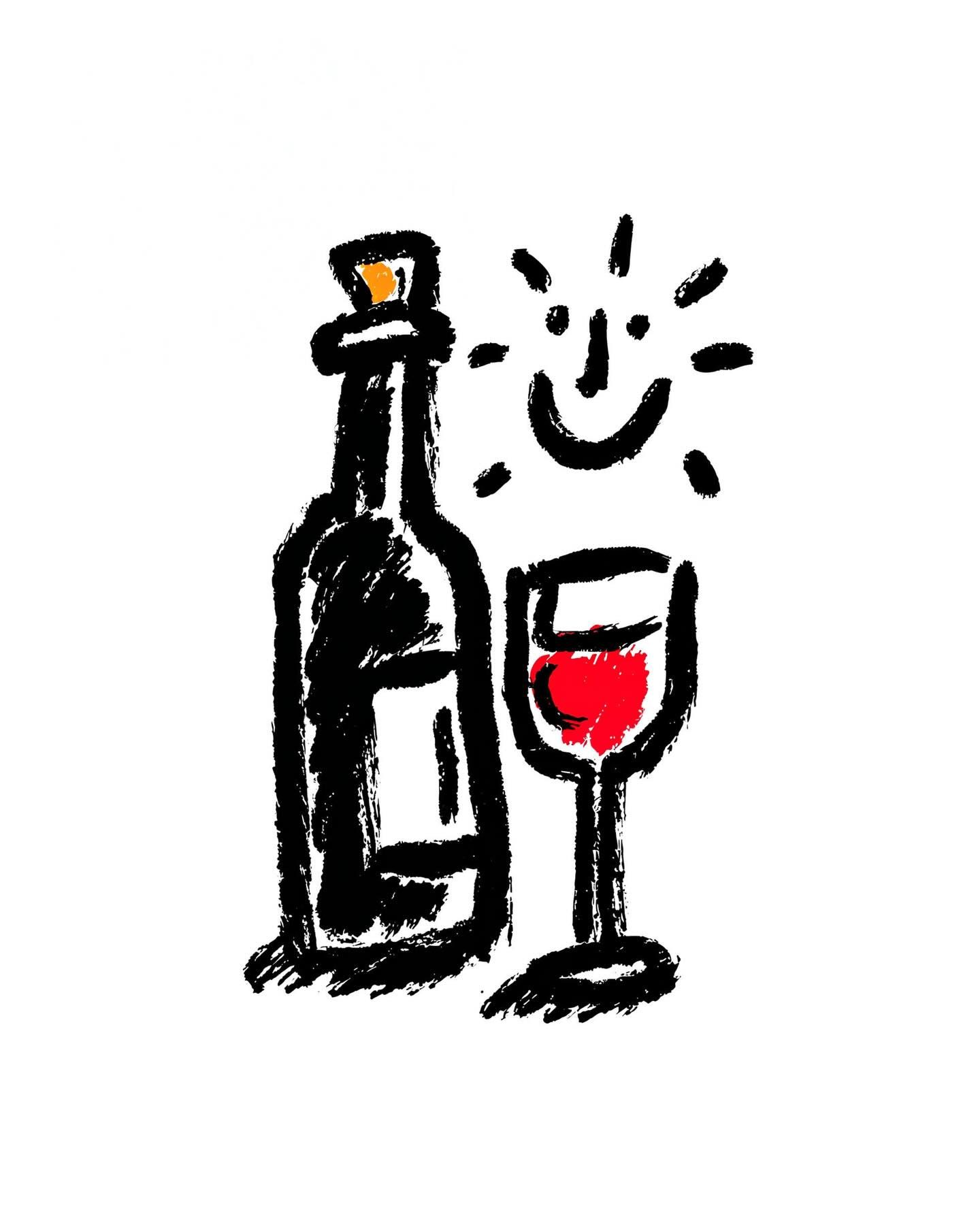
House Red, Good Mood
Like if a wine label had one great night, found a fat black marker, and made itself a self-portrait.
This is about as stripped down as it gets. A bottle. A glass. A hit of red. A smile hovering overhead like the evening just got cleared by management. It’s funny, loose, and kind of disarming. Nothing is polished. That’s the point.
What makes it work is how little it needs. The lines are rough, almost careless, but not really careless. More like confident. The artist knows exactly how much to give you and exactly when to stop. A few chunky black marks and suddenly you’ve got a bottle with personality, a glass with a pulse, and a whole mood built out of almost nothing.
It brings to mind Picasso’s late line drawings, where a handful of strokes could carry the whole image. There’s a little Basquiat energy too in the rawness—the sense that the hand moved fast and trusted instinct over cleanup. And that smile has a touch of Keith Haring in it, simple and direct and weirdly alive.
Quick art lesson, painless version: this is what people mean by economy of line. Using less to say more. It sounds easy until you try it. Most people add detail when they get nervous. Artists with confidence start taking things away.
And that small patch of red does a lot of heavy lifting. Without it, the drawing is charming. With it, the drawing has a pulse. Suddenly it’s not just a bottle and a glass. It’s a toast. A wink. A tiny sketch with a social life.
Fun fact for later: some of Picasso’s most loved works are the simplest ones. Also, the wine bottle shape people recognize today only became possible once glassmaking got strong enough to make sturdier bottles for storage and shipping. So yes, even this little doodle has ancestors.
Related works
Available as a museum-quality print.
Request this print