
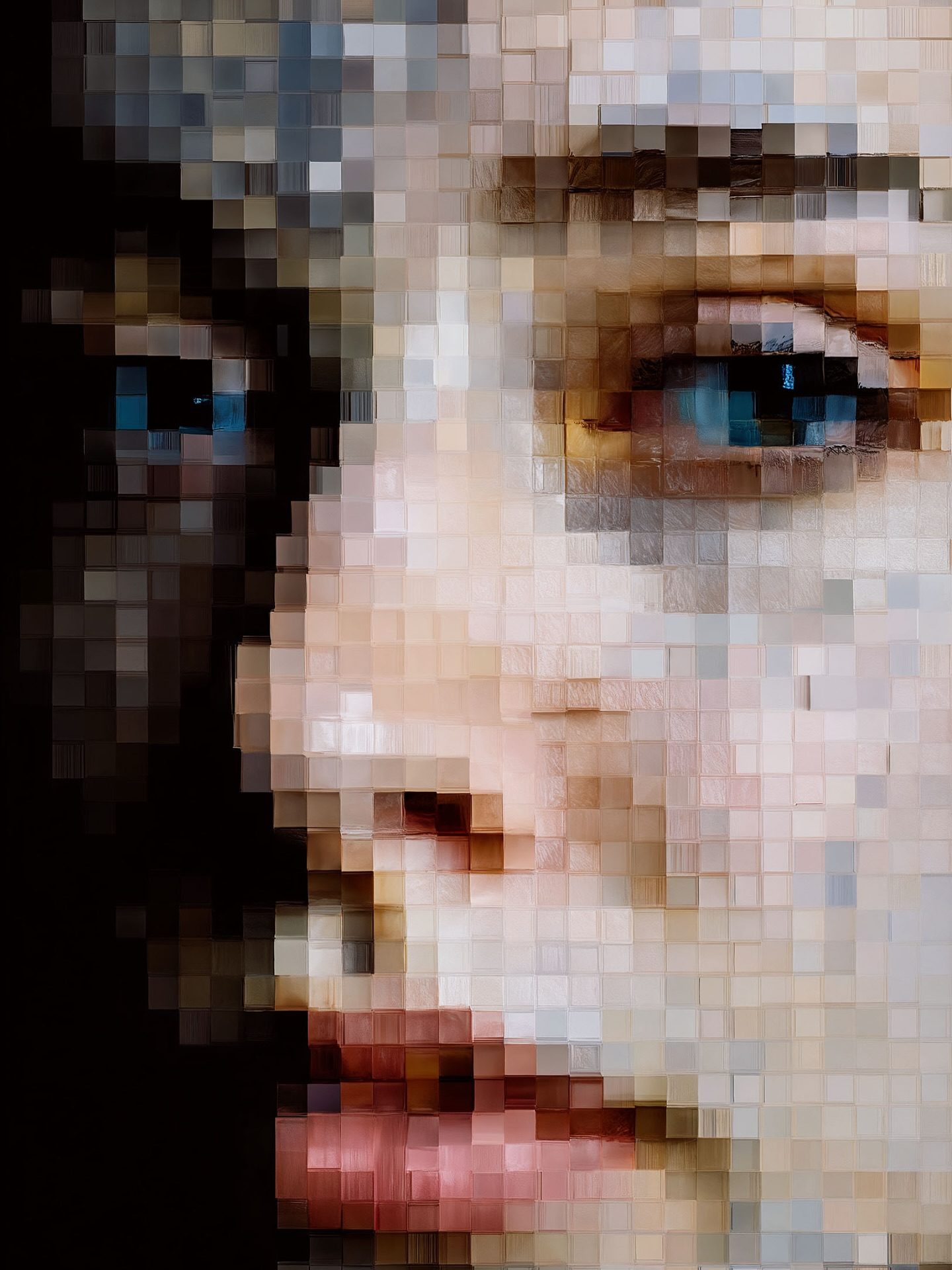
Pixels Before Pixels
From far away, this face feels soft, human, almost whispering its story. Step closer, and—surprise—it’s not skin at all. It’s hundreds of little colored squares, each one a pixel, working together like tiny digital bees making honey.
This is basically Pointillism’s glow-up. Back in the 1880s, artists like Georges Seurat and Paul Signac used thousands of dots of pure color, trusting your eyes (and brain) to mix them into a complete image. Today, pixels do the same—but instead of paint, it’s math and light.
Here’s the science-y magic: your retina has about 120 million rods (light sensors) and 6 million cones (color sensors). They don’t “see” the image whole—they send little packets of information to your brain, which stitches everything together in real time. That means every image you see—whether on a screen or in life—is basically a live Photoshop composite inside your head.
Fun fact to drop at parties: the word pixel comes from “picture element,” and the very first digital image was made in 1957—it was a photo of a baby, and it had a whopping 176 × 176 pixels. Your phone camera now laughs in 12 million.
Artistically, this piece could’ve been dreamed up by Chuck Close if he’d been born in the Instagram era—taking the grid obsession of modernism, mixing it with a bit of Op Art optical trickery, and letting the human eye do the final “painting.”
So, next time you’re staring at your screen, remember: you’re not looking at the image—you’re looking at thousands of tiny squares in a well-organized riot, and your brain is the world’s most overqualified art curator.
Related works

Available as a museum-quality print.
Request this print