
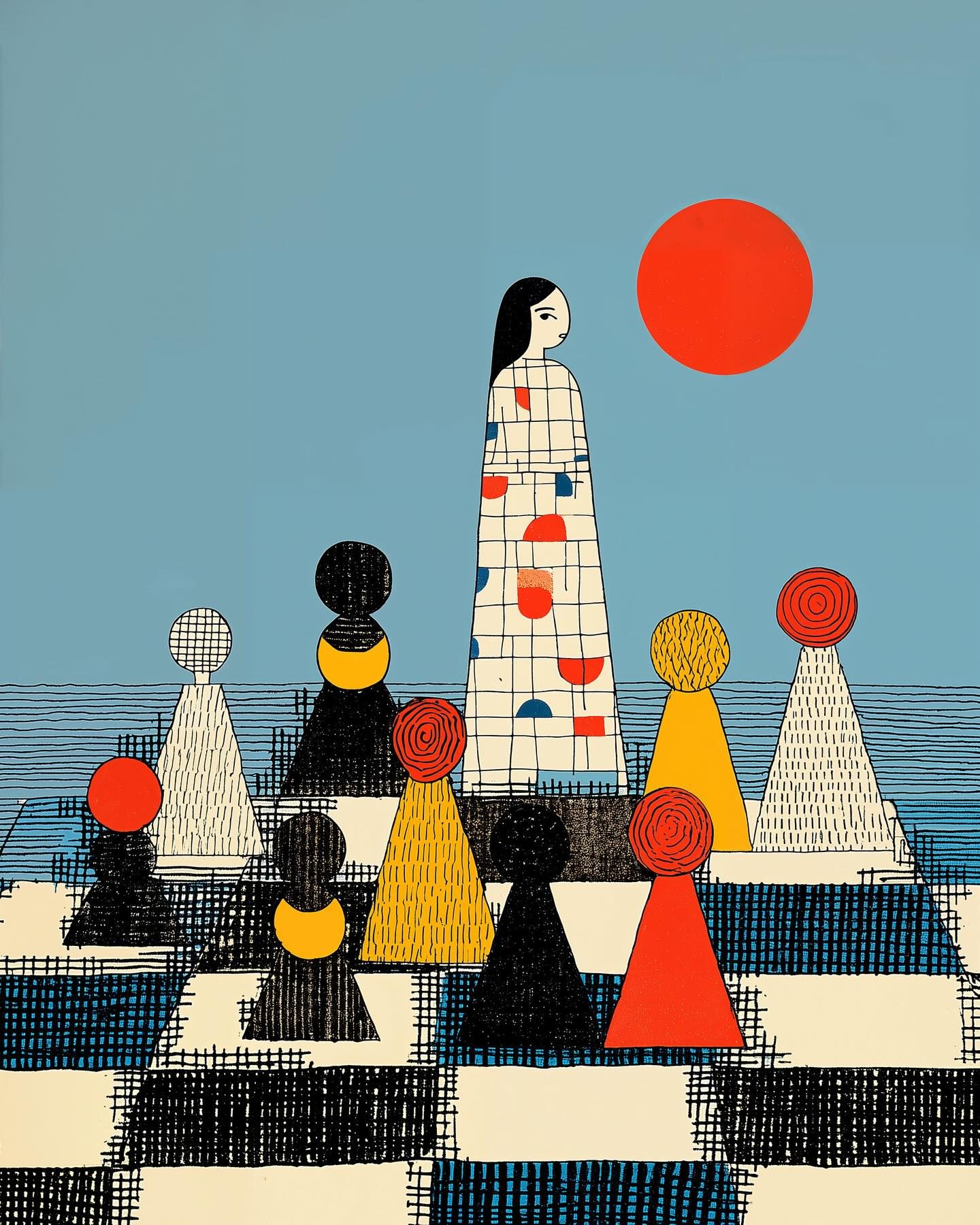
Queen’s Gambit, Sort Of
Like if a chess set hired a Scandinavian designer and then got existential at sunset.
At first glance, this looks like a game board. Look again and it starts to feel more like a tiny society. Cone-shaped pieces stand in clusters like villagers, witnesses, maybe rivals. And then there’s the tall central figure—calm, patterned, slightly mysterious—rising above the board like she knows exactly how this ends and is in no rush to explain it. The red sun hovering overhead doesn’t help. It turns the whole scene into a strategy match with a touch of myth.
The style pulls from folk illustration, mid-century modern graphic design, and the flattened dream logic of artists like Paul Klee and Charley Harper, with a little Marimekko boldness in the pattern play. The simple geometric forms do a lot of heavy lifting here: circles, cones, grids, stripes. Nothing fussy. Everything deliberate. It’s basically proof that shape can be drama.
Here’s the art lesson: this piece uses hierarchy of scale. That just means bigger things feel more important. The tall figure dominates not because she’s detailed, but because she’s taller, quieter, and placed dead near the center. In art, size is power. Placement is power too. Put something high, isolate it, and suddenly it feels like the main character. Hollywood does this. So does painting.
What makes this image sing is the contrast between play and seriousness. Chess is a game, sure, but it’s also theater. War with better posture. This piece leans into that beautifully. The bright reds and yellows keep it lively, while the black crosshatching and checkerboard ground give it structure, tension, and just enough visual grit to keep it from floating away.
Fun fact for dinner: the modern chess queen wasn’t always the most powerful piece. In earlier versions of the game, she moved much more modestly. Her glow-up happened in Europe around the late 15th century. Honestly? Historic rebrand.
A board. A queen. A red sun. And suddenly the whole thing feels like a fable about power dressed up as a parlor game.
Related works
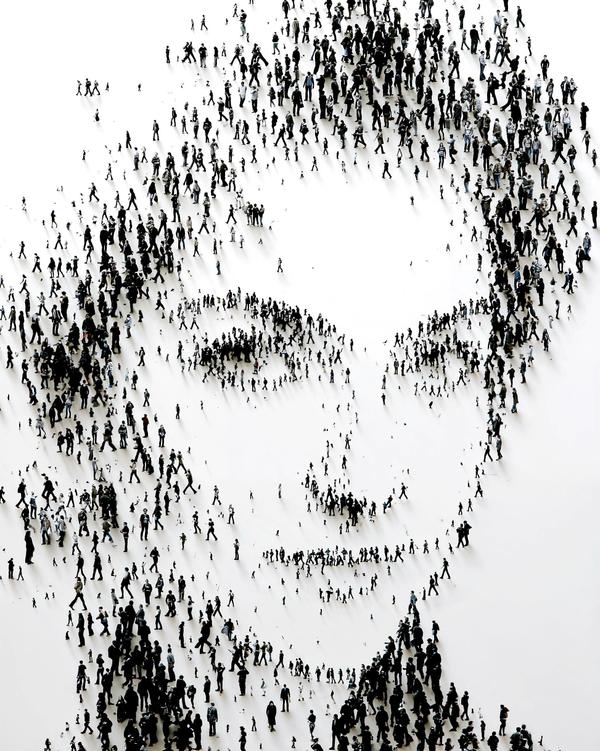
Group Chat
Humanity, seen from above, looks suspiciously like it forgot why it walked into the room.
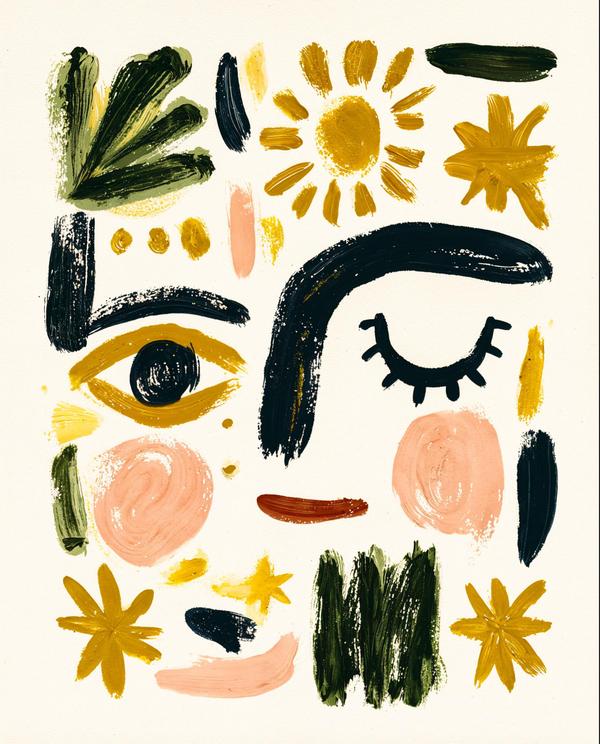
The Poster Forgot How to Spell
This poster tried to say “A Sky Full of Stars” and accidentally became one.
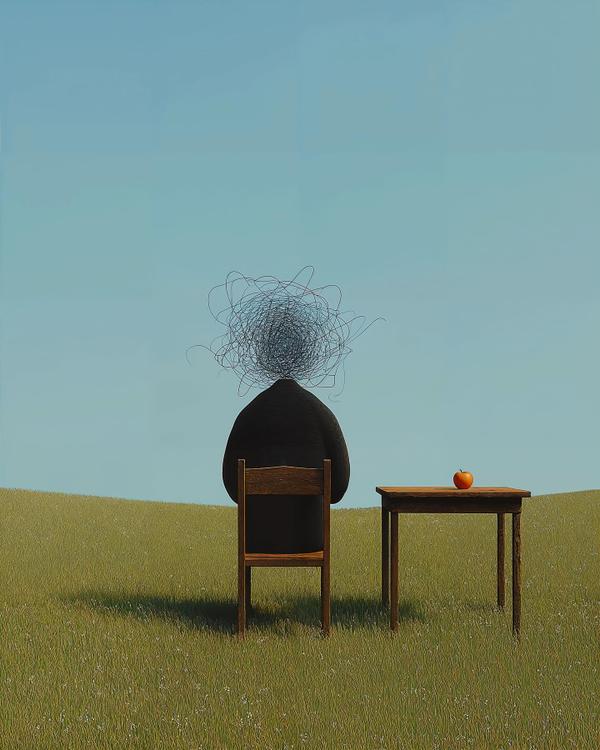
Quiet Spiral
This one is funny for about two seconds, and then it starts feeling a little personal. A lone figure sits in an open field, back turned, posture calm, while their head has become a frantic ball of scribbled pencil lines—part storm cloud, part doodle, part “nothing to worry about” from someone clearly worrying about everything. Next to them, on a plain wooden table, sits a single red apple, doing its best despite being hilariously underqualified.
Available as a museum-quality print.
Request this print