
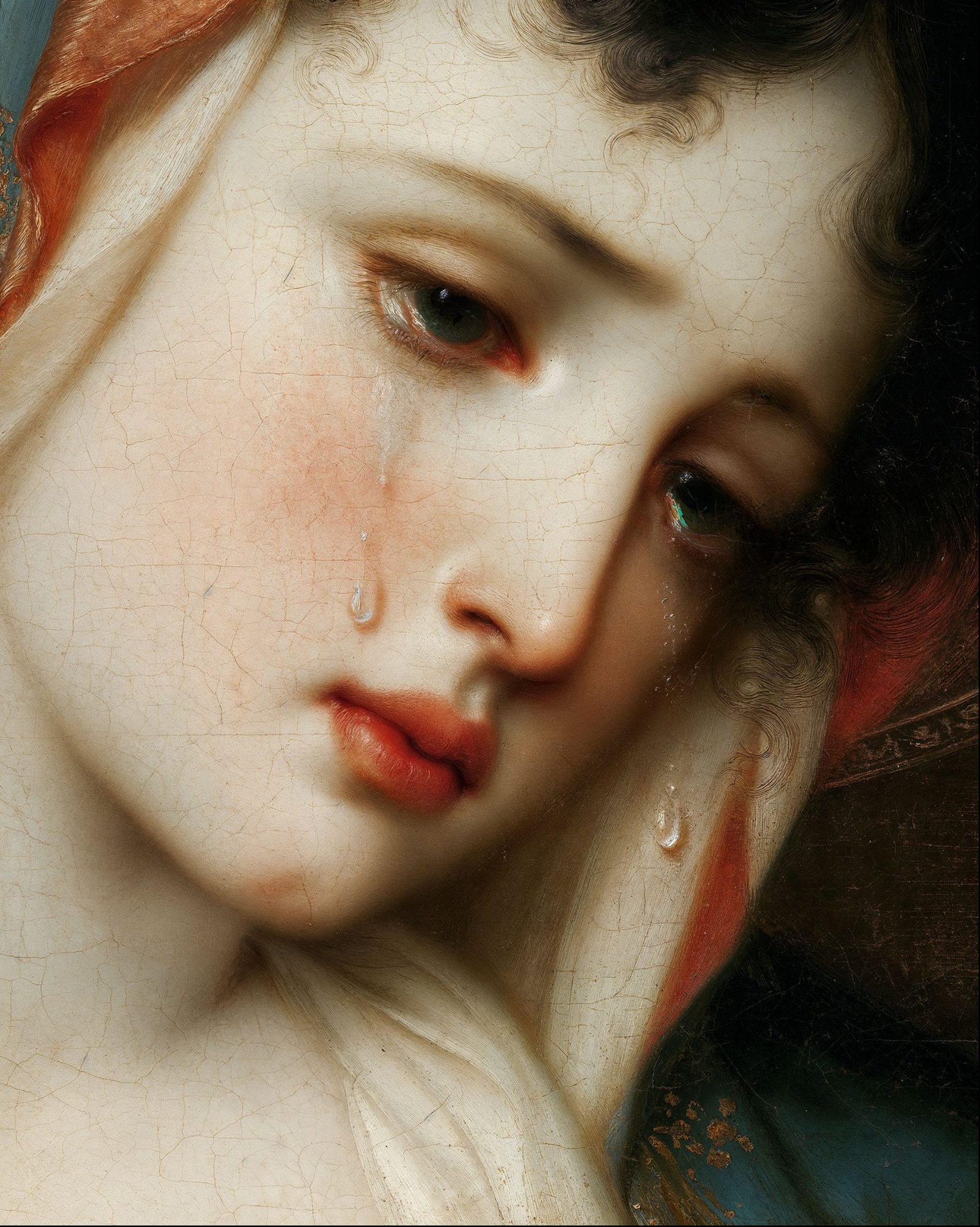
The Geography of Grief
Even the saints have days when holding it together feels like a full-time job.
A face so close we can practically hear the silence. Two enormous, glassy eyes. A flushed cheek. Lips parted around something that will never quite become words. And tears rendered with such exquisite precision they seem to have their own tiny gravitational field.
There’s something of Rogier van der Weyden here, particularly his extraordinary ability to make sorrow feel physically present. Giovanni Bellini comes through in the tender modeling of the face and the quiet dignity of grief. And the dark, curling hair and delicate features recall the idealized beauty of Sandro Botticelli, whose figures often seem suspended between earthly experience and spiritual longing.
Notice the extraordinary intimacy of the crop. The forehead disappears beyond the frame, and the chin nearly follows. There’s nowhere for our attention to wander. Those green-brown eyes become the entire emotional landscape.
The fine network of cracks across the pale skin resembles the surface of an aging oil painting. Art historians call this craquelure, and here it lends the face an almost archaeological quality, as though the sadness itself has survived centuries.
The soft ivory complexion, deep shadows, and flashes of vermilion create a remarkable tension between fragility and permanence. Even the hand resting against the head feels like a small attempt to steady an overwhelming thought.
And then there are those tears.
One has barely escaped. Another has already made the journey.
Grief, apparently, keeps its own schedule.
FUN FACT
In medieval and Renaissance devotional painting, tears were often painted as distinct, glistening droplets. They helped viewers practice compassio, the act of emotionally sharing in sacred suffering, particularly that of the Virgin Mary.
Related works
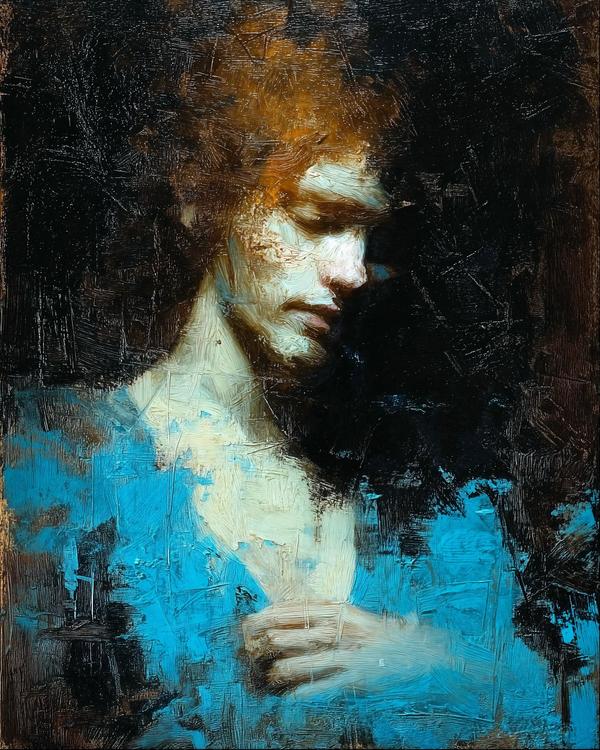
Blue Period, Bad Wi-Fi
This guy looks like he just remembered every password he ever forgot.
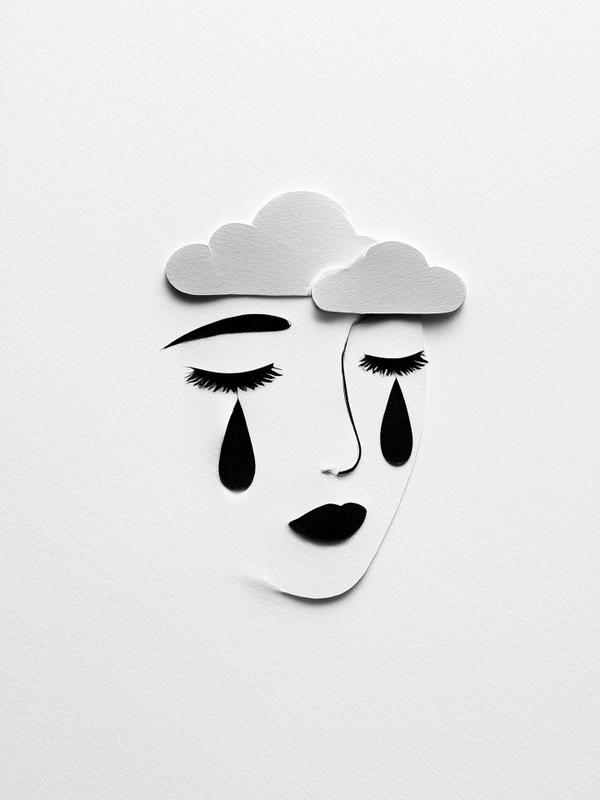
Brain Weather
Sometimes the heaviest storms happen in the lightest materials. This minimal cut-paper-and-ink face channels the spirit of modernist collage, with a dash of surrealism’s emotional punch. The clouds-as-thoughts motif could have strolled right out of a René Magritte dreamscape, while the clean, sculptural paper cuts nod to contemporary paper artists like Eiko Ojala, who carves shadows as precisely as lines. The beauty of this style is how it thrives on less. By stripping color and detail, the artist forces your brain to fill in the emotional atmosphere. This is a cousin to “negative space” art—where what isn’t drawn is just as important as what is. Here’s the fun science bit: your brain is a champion pattern matcher. Within milliseconds, it turns a few black shapes into a face (this is called pareidolia—the same reason you see animals in clouds or a face in your toast). But it doesn’t just see the face—it feels it. We’ve got specialized neurons called mirror neurons that fire when we see expressions, making us “catch” the mood. That’s why this piece can tug your heartstrings with nothing more than clouds, lashes, and teardrops. Fun fact to drop: paper art isn’t just craft—it has deep roots in fine art history. Picasso and Braque pioneered papier collé (glued paper collage) in the early 1900s, and Matisse’s famous “cut-outs” in his later years were basically painting with scissors.

Bubblegum Armor
She looks like she just walked out of a dream, canceled everyone’s nonsense, and brought her own weather.
Available as a museum-quality print.
Request this print