
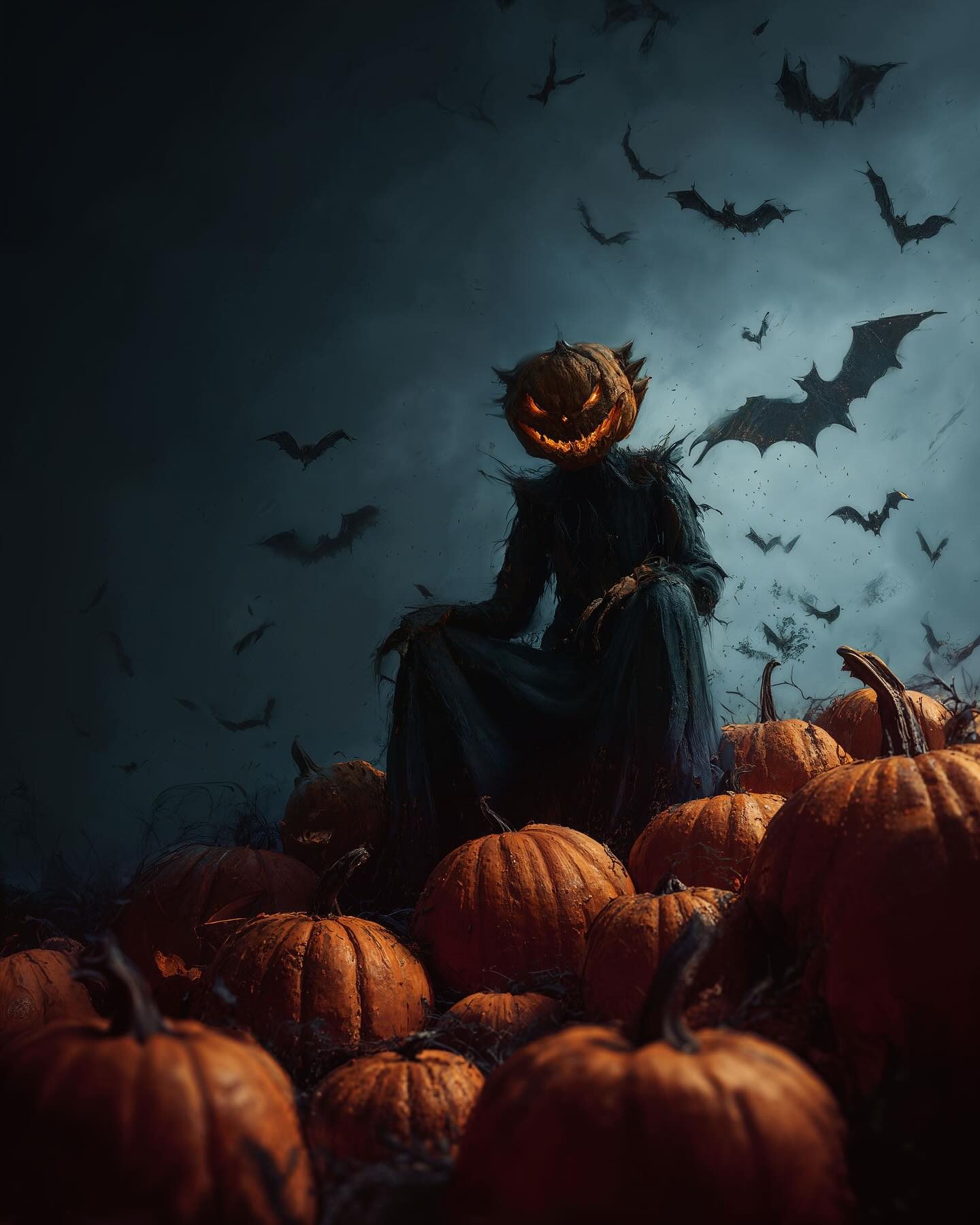
The Original Influencer: Jack O’Lantern
Ever wonder who the first guy was to stick a candle inside a vegetable and call it décor? Meet Jack — the moody influencer of the afterlife.
This eerie tableau feels like a collaboration between Tim Burton and Caspar David Friedrich, where Gothic romanticism meets cinematic lighting. The glowing pumpkin face burns against a stormy blue haze like a living chiaroscuro — think Caravaggio, if he’d discovered fall décor and fog machines. The bats, the decay, the drama — it’s all textbook sublime: beauty tinged with terror.
But here’s the trick and the treat: Halloween’s roots aren’t Hollywood at all. It began as the Celtic festival Samhain, marking the boundary between harvest and winter — when the veil between worlds was believed to thin. People wore masks to confuse wandering spirits, and carried hollowed turnips with embers inside to ward off “Stingy Jack,” a ghost cursed to roam the earth with only a carved lantern for light. Irish immigrants brought the tradition to America, where turnips were swapped for the native pumpkin — bigger, brighter, and way easier to carve after a few ciders.
So the next time you carve a face into a pumpkin, remember — you’re not just decorating your porch. You’re participating in a 2,000-year-old art form that started as supernatural pest control.
Fun fact: The word “jack-o’-lantern” originally meant a man with a lantern, not a pumpkin. The glow-up was purely American.
Related works



Available as a museum-quality print.
Request this print