
The Villa Has a Dress Code
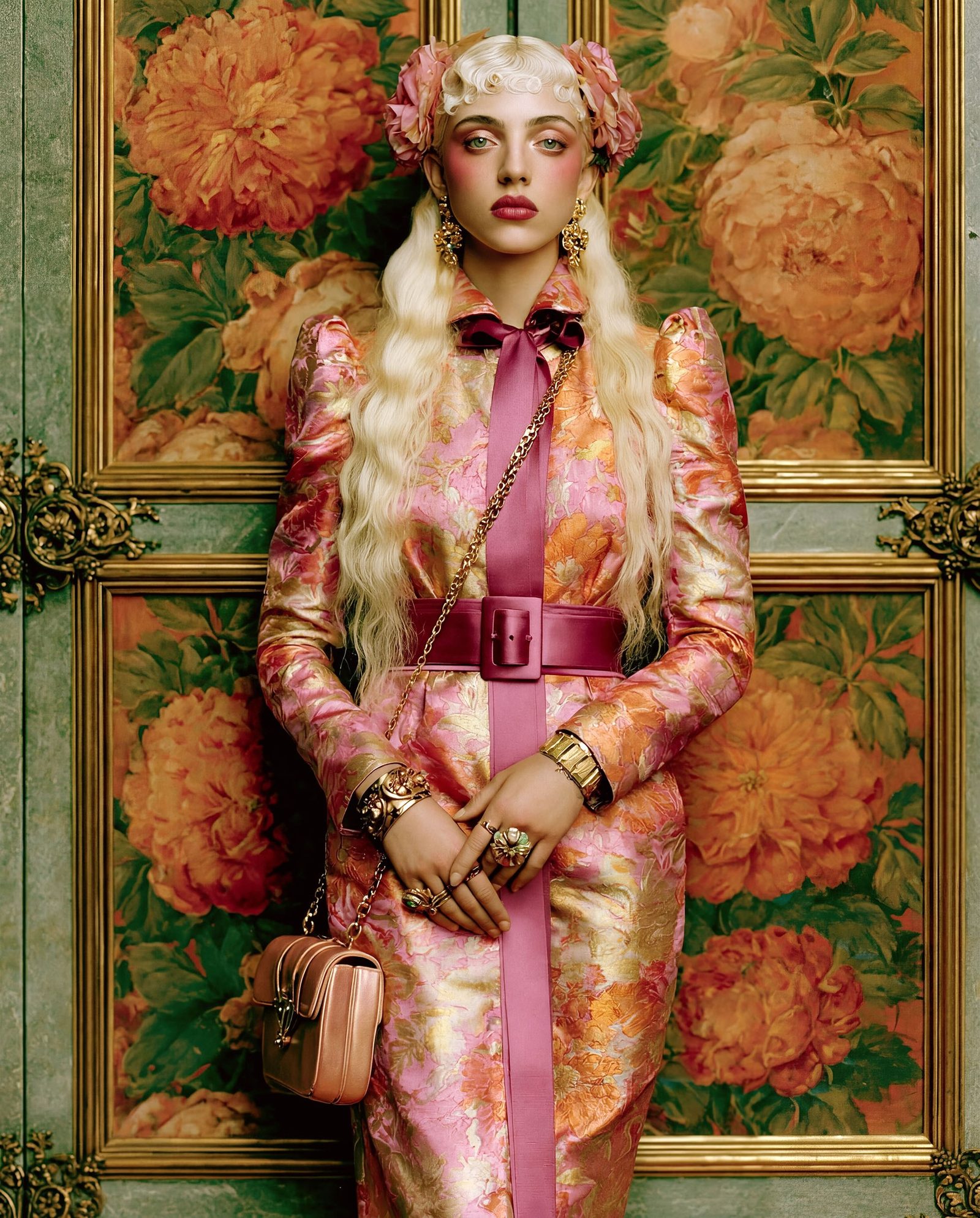
She looks like she arrived at breakfast dressed for a diplomatic summit between flowers.
This portrait is dripping in old-world drama: brocade, blush, gold hardware, floral walls, carved frames, and the kind of stare that suggests the villa belongs to her, even if she only got there twenty minutes ago. The whole image feels staged inside a Milanese fever dream where the wallpaper has opinions and the accessories came with a trust fund.
The fashion reference is doing serious work here. With its romantic excess, historic silhouette, and pattern-on-pattern confidence, this sits comfortably in the orbit of Alessandro Michele’s maximalist language — fashion as costume, memory, theater, and beautifully organized chaos. There’s also a clear echo of Rococo portraiture, especially Fragonard, where softness and status flirt shamelessly in the same room. Add a touch of Gustav Klimt in the ornamental richness and a wink of Kehinde Wiley in the regal figure against a blooming backdrop, and suddenly the whole thing starts behaving like a portrait with a passport.
Fun fact worth repeating: before photography, fashion portraits were basically social media posts for aristocrats. The outfit wasn’t decoration. It was the caption. Silk meant money. Embroidery meant taste. Jewelry meant “please notice my family owns several rooms.”
The brilliance here is the visual camouflage. Dress and wallpaper almost become one organism, a luxury greenhouse with cheekbones. But that face holds the center. Calm. Pale. Untouchable.
A flower in full command of the vase.
Related works
Available as a museum-quality print.
Request this print