The Weight of Wings
Apparently, heaven has a rather dramatic evacuation policy.
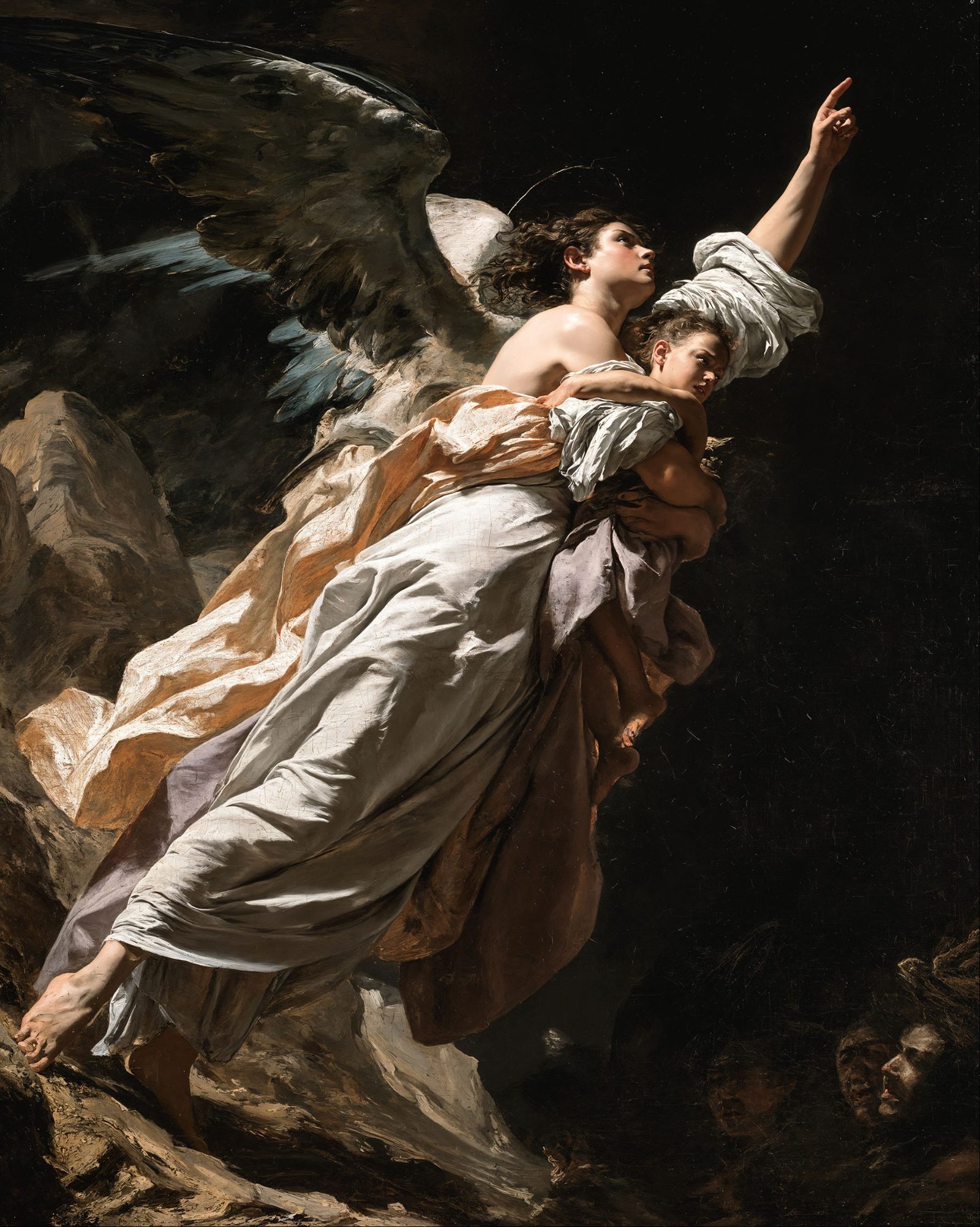
A magnificent tangle of feathers, flesh, and flying fabric. An angel carries another figure through the darkness, one arm wrapped tightly around the passenger while the other points toward something beyond the frame. The destination is anybody’s guess. The urgency is unmistakable.
There’s a wonderful collision of artistic traditions here. Giovanni Battista Tiepolo comes to mind in the airborne figures and extravagant, wind-whipped drapery. Peter Paul Rubens supplies the muscular choreography, bodies twisting together in a complicated embrace. And Caravaggio would certainly approve of the lighting: a theatrical shaft of illumination catches skin and silk while the surrounding darkness swallows almost everything else.
Notice how the composition climbs diagonally from the rocky lower left toward that outstretched finger. Even the enormous wing participates, pushing our eyes upward. The pale fabric becomes a kind of visual staircase, its folds catching light in alternating flashes of ivory, peach, and gray.
And look at the faces. One figure seems determined, almost defiantly hopeful. The other appears exhausted, perhaps frightened. There’s tenderness in that grip, but also the extraordinary physical effort of carrying another person.
The darkness below holds a few barely visible faces. Witnesses? Lost souls? An audience to something miraculous?
Perhaps the most moving detail is the simplest: someone is being carried because, for whatever reason, they cannot make the journey alone.
Even angels, apparently, understand the importance of showing up for somebody.
FUN FACT
In Baroque painting, dramatic diagonals were a favorite way to make a still image feel alive. Artists frequently arranged bodies, limbs, and fabric along sloping lines to suggest motion that seemed capable of continuing right out of the frame.
Related works
Alice, Unmoored
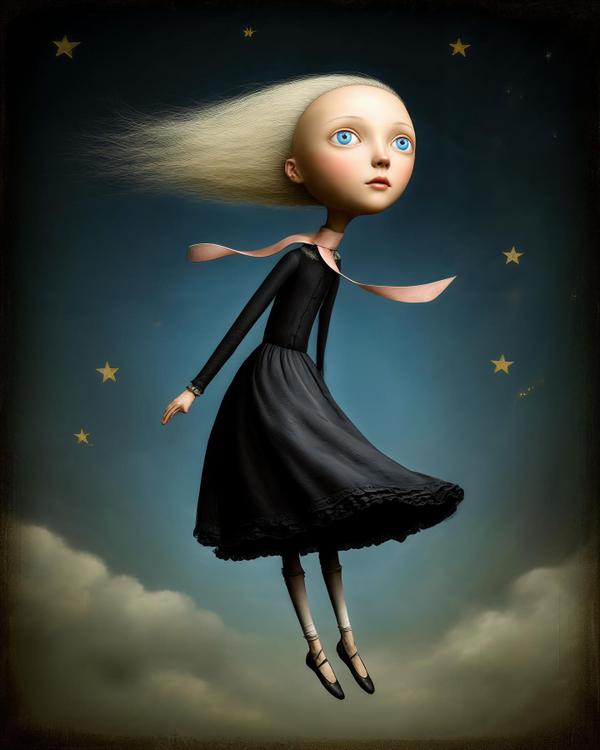
A bald little moon-head with electric blue eyes. Hair blown straight back like a comet tail. A pink ribbon scarf doing figure-eights in midair while gold stars just… hang there.
All-Seeing Kickoff
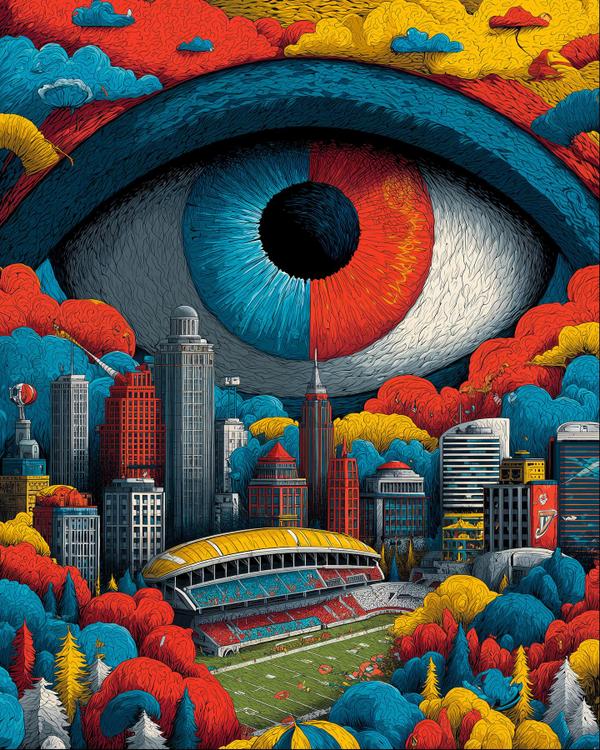
A colossal split-color iris hanging in the sky like a scoreboard for the gods. Cotton-candy storm clouds in red, blue, and gold, packed in like a parade float. And a stadium tucked beneath the skyline, tiny on purpose, like the city is holding its breath before the snap.
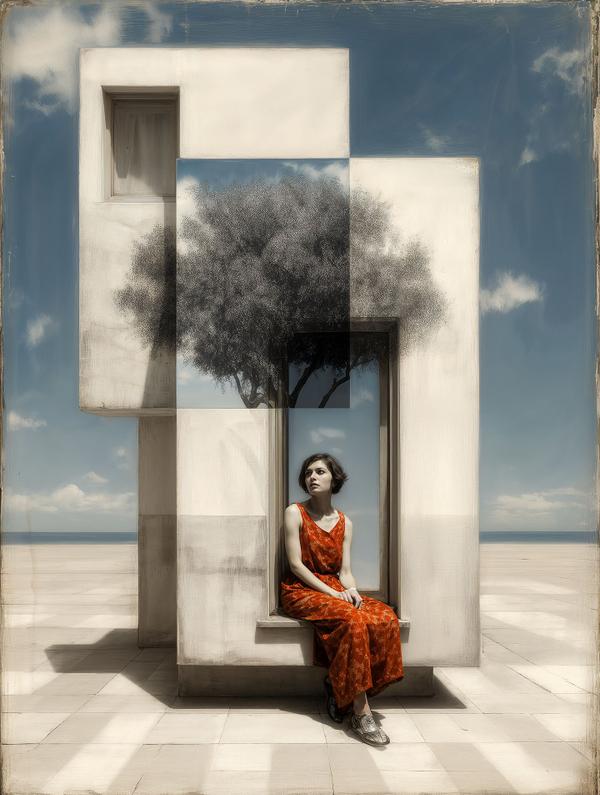
Architectural Fever Dream
Ah yes, behold—another architectural fever dream where gravity took a coffee break and geometry got artsy. We’ve got a surrealist daydream that feels like René Magritte accidentally binge-watched Minecraft tutorials. The woman in the bold red dress sits inside what looks like a half-finished monument to minimalism—part window, part sculpture, part existential waiting room. Above her? A tree that’s half-there, half-not, like it’s auditioning for a role in Inception. Here’s the fun bit: This style riffs on Surrealism—think Magritte’s impossible juxtapositions (“is that a tree in the wall or the wall in the tree?”) and Giorgio de Chirico’s dreamlike plazas where time feels paused at 3 p.m. forever. But it’s also got a clean, modern edge, like contemporary architectural minimalism smashed into the uncanny calm of hyperrealist digital art. The shadows are crisp, the sky is too perfect, and the whole thing whispers, “Yes, life is confusing, but at least it’s well-composed.” Fun fact you’ll want to drop at brunch: Magritte once painted an entire series of windows where the “view” lined up perfectly with the scene outside—making you question whether you were looking through glass or at a painting. This piece feels like a cheeky nod to that trick, but with a modern twist: it’s Photoshop for the subconscious. The red dress is the wild card here—it cuts through all the beige and blue like a punctuation mark, a reminder that amid all this dream-logic geometry, there’s still a human stuck waiting for… well, something. (Godot? Wi-Fi? Who knows.) So, is this art about isolation, perspective, or just the world’s fanciest bus stop? Doesn’t matter—it caught you trying to figure it out.
Available as a museum-quality print.
Request this print