
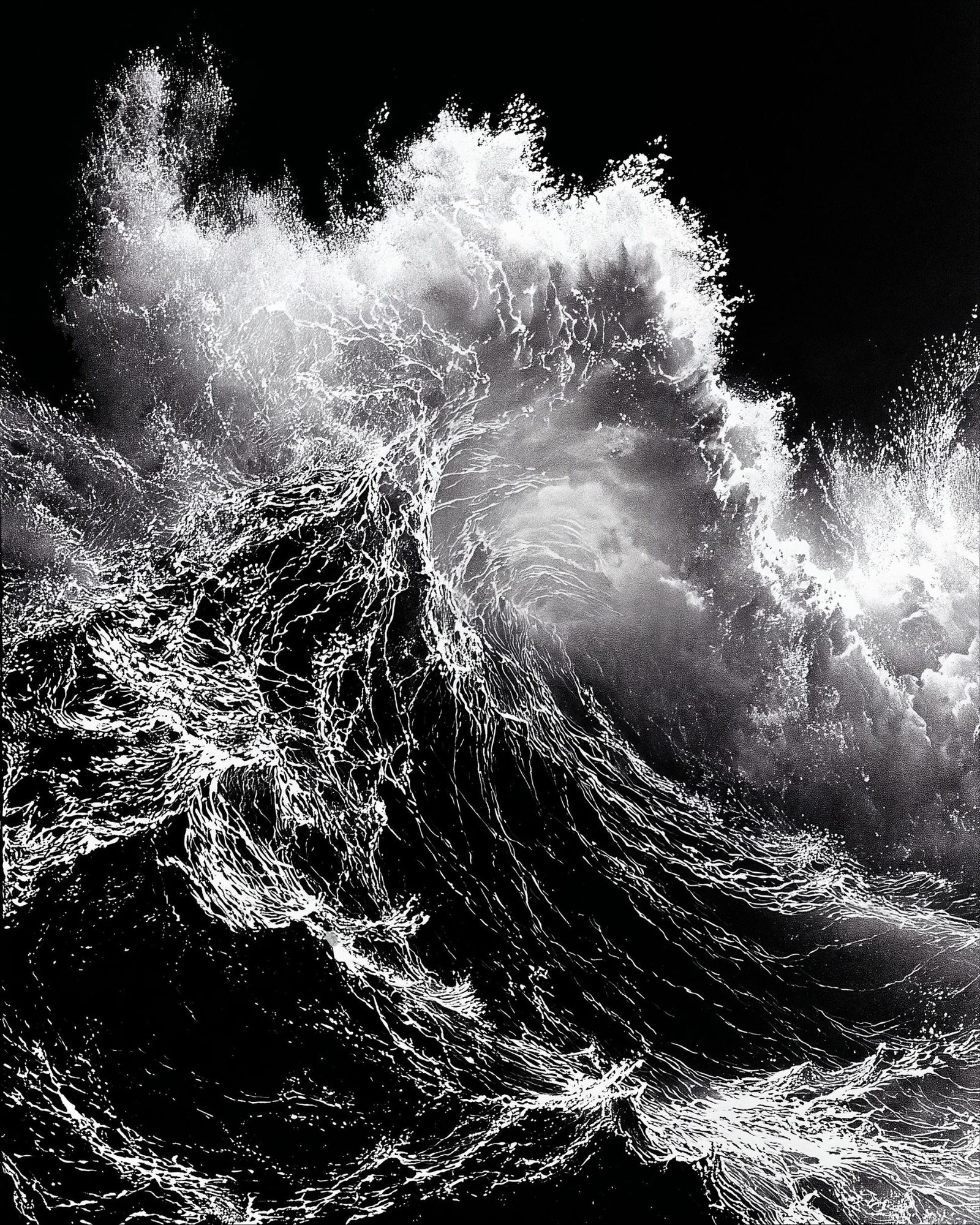
White Noise, Black Water
This wave looks like it’s about to give humanity a very short performance review.
What hits you first is the contrast. No soft landing here. The sea arrives in black and white, all nerve endings and impact, with foam flashing across the surface like lightning got trapped in water. The crest explodes upward, the center caves inward, and that dark hollow inside the wave feels less like space and more like appetite.
The composition does something especially effective: it gives you almost no horizon and nowhere comfortable to stand. That means scale slips away. You’re not politely observing the ocean from shore. You’re inside its mood.
There are a few strong lineages meeting here. Hokusai lives in the surge and the claw-like bursts of foam. Vija Celmins comes to mind in the way surface becomes the whole subject, where repetition and density turn water into something meditative and faintly unnerving. And the white-on-black mark-making carries the force of scratchboard and woodcut, where every line has to earn its keep.
That’s why monochrome matters. Color might have made it picturesque. Black and white makes it elemental. Just force, velocity, and light. A liquid sermon on humility.
FUN FACT
Hokusai’s Great Wave is a woodblock print, not a painting. Its fame spread partly because prints could be reproduced and circulated widely, making it one of art history’s earliest truly viral images.