Advantage, Lake Como
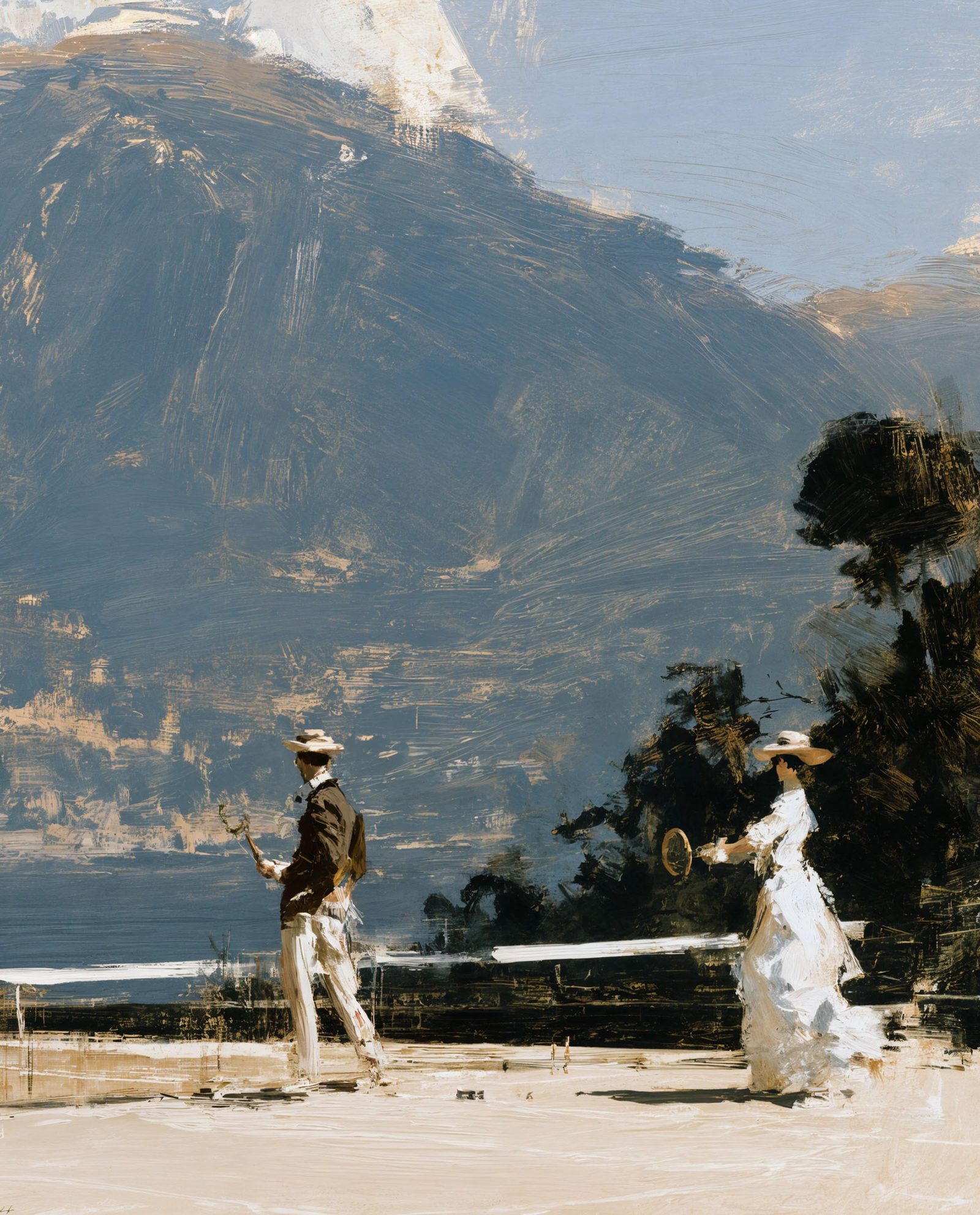
Tennis whites, mountain air, and a view so dramatic nobody seems concerned about keeping score.
Two players share the near side of a sunlit court beside Lake Como, caught somewhere between a doubles match, a leisurely warm-up, and an exceptionally well-dressed afternoon outdoors. The man holds his racket loosely while the woman waits near the baseline in a long white dress, apparently prepared to return serve without disturbing a single pleat.
The brushwork brings to mind John Singer Sargent and his gift for suggesting an entire world with a few confident strokes. Faces remain loose. Clothing flashes into focus through blocks of cream, black, and white. The mountains dissolve into blue-gray sweeps, closer to atmosphere than geography. There’s also a little Joaquín Sorolla in the sun-struck fabric, along with echoes of the outdoor leisure painted by Berthe Morisot and Claude Monet.
The art lesson is hiding in the haze. Painters create depth by reducing contrast and detail as forms recede. The court is warm and crisp. The trees become dark, tangled masses. The distant mountains soften into cool blue air. This is atmospheric perspective, a technique that makes a flat surface feel miles deep.
Fun fact: tennis whites became fashionable partly because perspiration showed less on white clothing, an important concern for Victorian players determined to remain composed while sprinting around in several layers of fabric. A heroic era for athletics, tailoring, and laundry.
Loose brushwork creates movement because your eye finishes what the painter leaves open. A few swipes become a racket, a sleeve, a tree, or an entire Italian mountainside.
The whole scene feels like a vacation memory painted before anyone checked their phone.