
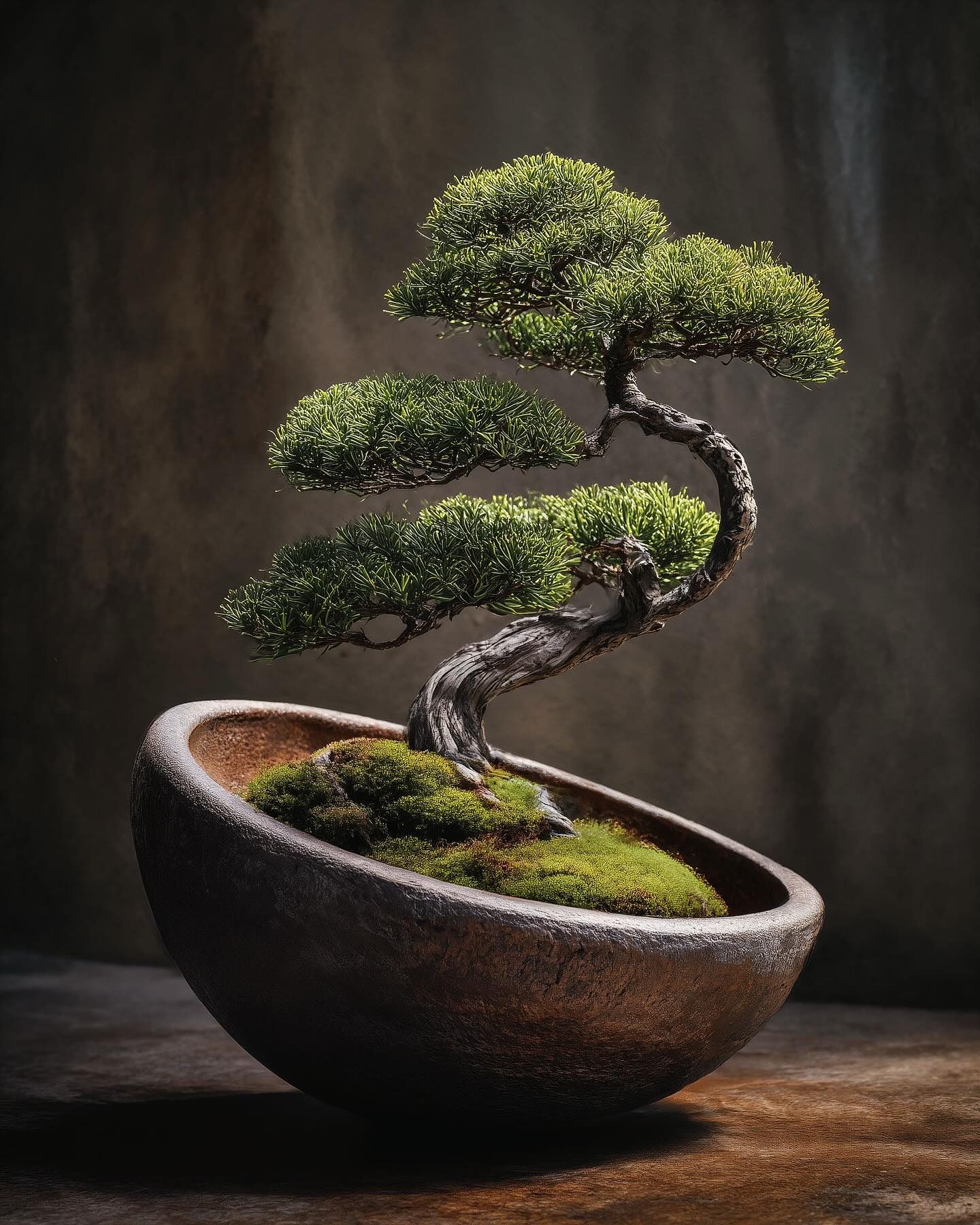
Bonsai Ballet
What you’re looking at is bonsai—literal translation: “tray planting.” It’s sculpture where the material is alive and the chisel is time. This little drama queen leans with an elegant S-curve, stacking “cloud pads” of foliage over moss like a tiered wedding cake with self-control. I’d call the style moyogi (informal upright): asymmetrical, rhythmic, and built around negative space—the Japanese concept of ma—so every gap feels as important as every branch.
Influences? Think the hush of Zen gardens, the misty pines of Hasegawa Tōhaku or Sesshū Tōyō’s ink landscapes, and the clean restraint you see in Isamu Noguchi’s sculpture. The half-bowl pot is the “frame,” the moss is the stage, and the trunk—gnarled, twisting, full of stories—is the lead actor who has seen things.
Quick bonsai primer (a.k.a. living-art secrets):
* It began as penjing in China over a thousand years ago, then Japan refined it into a philosophy of scale, season, and patience.
* Artists shape trees with selective pruning, wiring, and root work, never by “shrinking genes.” It’s discipline, not genetics.
* Illusion is everything: taper in the trunk, nebari (root flare), and rough bark make a young tree read as a mountain elder.
* Display matters: in Japan a bonsai sits in a tokonoma alcove like a poem on a pedestal—rotated through the seasons to show character in different lights.
Fun fact: a five-generation Japanese white pine that survived Hiroshima was later gifted to the U.S. and still lives at the National Arboretum—proof that bonsai is resilience in miniature. Also, some specimens are 800–1,000+ years old. Your houseplant could never.
Moral: patience is a power tool. Clip a little, wait a lot, and let the empty spaces do half the talking.
Related works



Available as a museum-quality print.
Request this print