
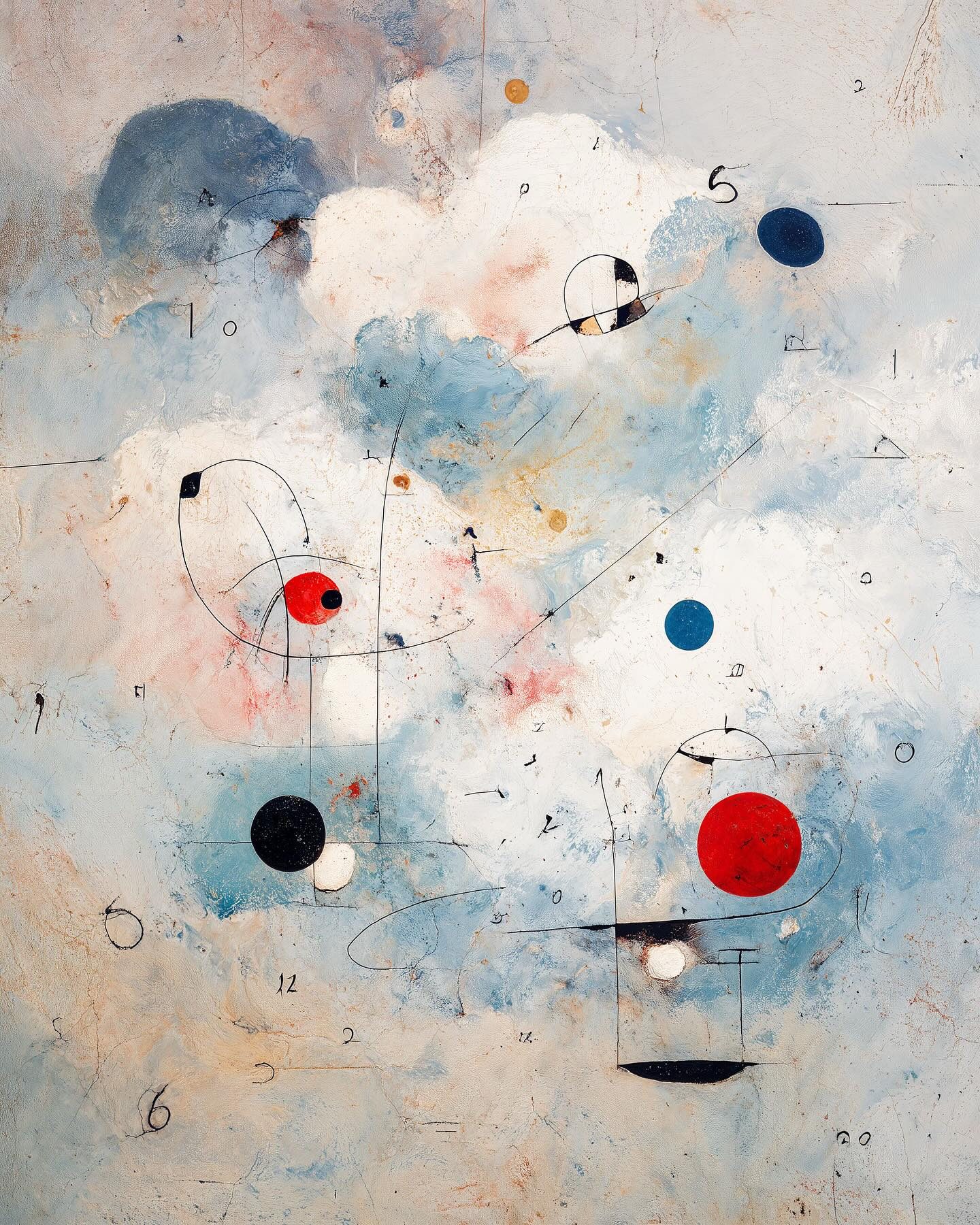
Constellation Grammar
Today’s piece floats in that sweet Miró zone: an airy sky of chalky blues and milky whites, pricked with primary-color planets (those hot red and deep navy disks) and stitched together by hairline, wandering lines. The marks loop, pause, and double back like a curious bird’s flight path—classic Joan Miró grammar: dots, stars, moons, tiny ladders, and signs that feel half-alphabet, half-astronomy.
Here’s the trick he taught the 20th century: automatism. Instead of planning every detail, start with stains and smudges, then “discover” forms by following the line. That’s why the composition feels both playful and inevitable—like the picture drew you first. The limited palette (primary pops against soft sky tints) keeps the chaos musical rather than messy; call it biomorphic abstraction—organic shapes behaving like happy microbes in zero gravity.
Look closely at the micro-scratches, numbers, and notations. They read like a private star map: not scientific data, but the instructions for how to daydream properly.
Fun fact: Miró once said he wanted to “assassinate painting”—wipe out the old rules so something freer could breathe. During WWII he made his intimate “Constellations” series on small sheets he could carry while on the move—tiny universes that fit in a suitcase.
Moral: when life feels heavy, give your ideas less gravity. Let the line wander; the cosmos will meet it halfway.
Related works

Available as a museum-quality print.
Request this print