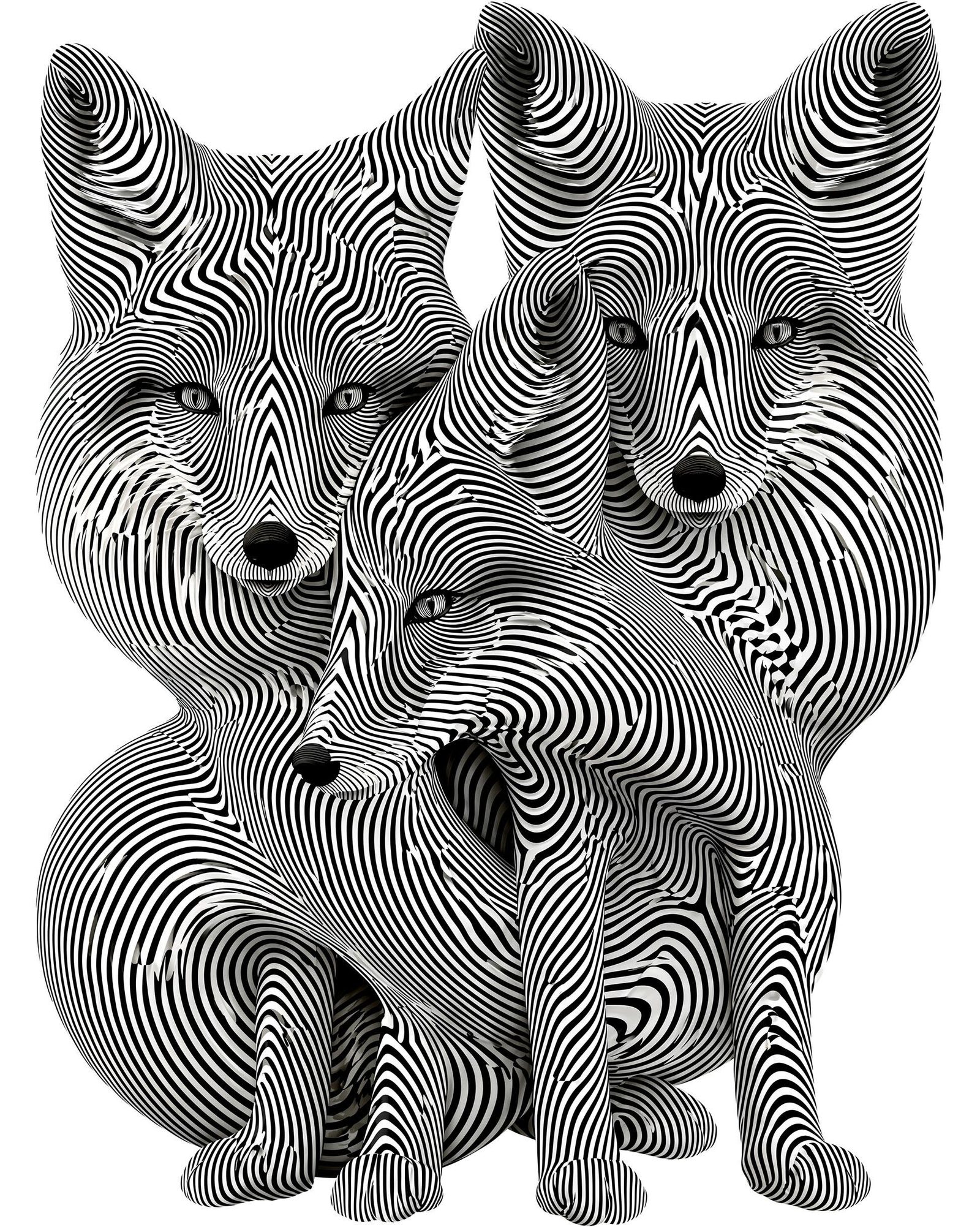
Foxes in Formal Wear
Three foxes, five suspicious eyes, and enough stripes to make a barcode question its career choices.
This piece has instant visual electricity. The animals sit together like a tiny woodland board of directors, but the black-and-white lines keep slipping, bending, and wrapping around their bodies until fur becomes motion. Look too long and the foxes almost vibrate. Very polite. Slightly hypnotic. Possibly judging your shoes.
The style pulls from Op Art, especially Bridget Riley’s dazzling use of repeated lines, with a little Victor Vasarely in the optical precision and a wink of M.C. Escher in the way pattern and form start wrestling for control. There’s also something wonderfully contemporary about it, like wildlife illustration wandered into a graphic design lab and came out with excellent cheekbones.
Quick art lesson: this is contour doing the heavy lifting. Contour lines follow the shape of an object, and here they help us read the curve of ears, snouts, paws, and tails. The tighter the lines get, the more intense the illusion feels. Your eye reads flat black stripes, but your brain builds volume. Sneaky little genius trick.
Fun fact: Op Art really took off in the 1960s, and some viewers claimed the paintings seemed to shimmer or move. No batteries. No animation. Just your visual system getting lovingly pranked.
That’s the joy here. The foxes feel calm, but the pattern is throwing a party. Quiet animals. Loud geometry. A whole den of optical mischief.
Available as a museum-quality print.
Request this print