
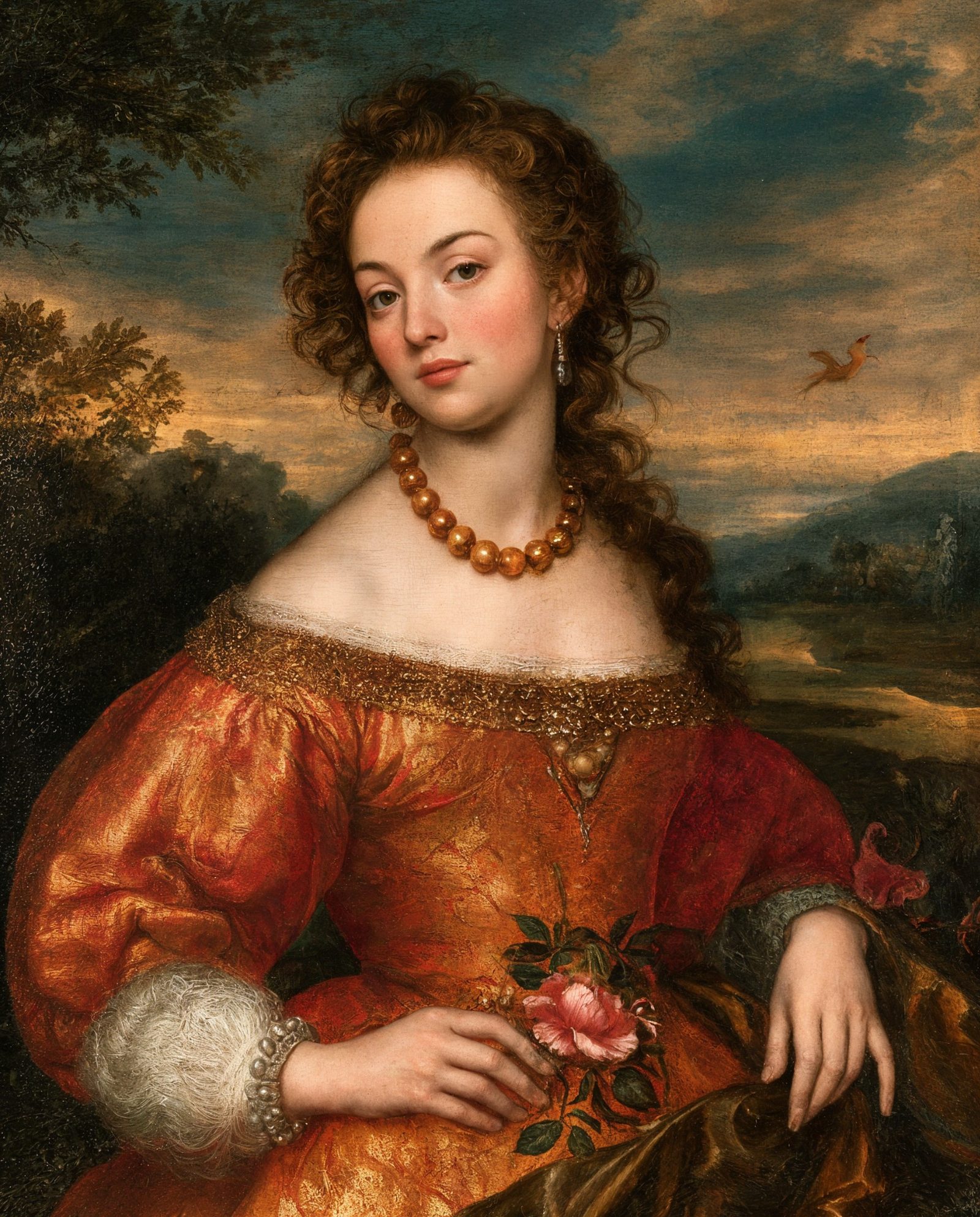
Lady With Excellent Patience
She has the calm expression of someone who has been sitting for six hours and has just been told, “One more tiny adjustment.”
Everything here is doing résumé duty. Luminous skin, elaborate red-and-gold fabric, pearls, flowers, landscape—before the sitter says a word, the portrait has already introduced status, refinement, and enough tailoring to require its own staff.
Anthony van Dyck comes to mind in the elongated elegance and aristocratic composure, while Rubens is present in the warm flesh, rich color, and theatrical abundance. Court portraiture was rarely casual. Pose, clothing, jewelry, and setting were carefully orchestrated to tell viewers exactly how important the sitter was.
The composition guides the eye with quiet precision. Her face catches us first. The glowing necklace pulls downward to the dress, then the hands and flower create a softer second center of attention. That is visual hierarchy: arranging contrast and detail so the viewer receives information in a deliberate order.
She looks poised. Expensive. Mildly aware that everyone else in the room is underdressed.
FUN FACT
In many historical portraits, clothing and jewelry could cost more than the painting itself, and studio garments were sometimes reused for different sitters.
Related works
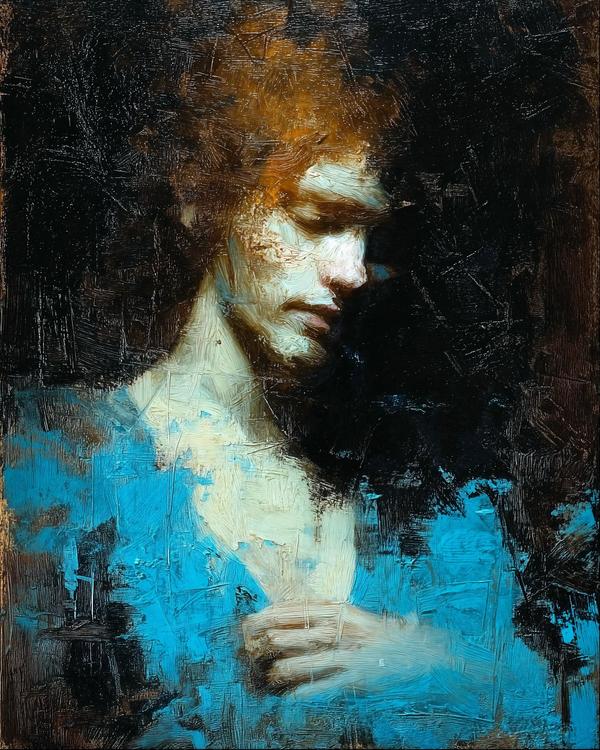
Blue Period, Bad Wi-Fi
This guy looks like he just remembered every password he ever forgot.
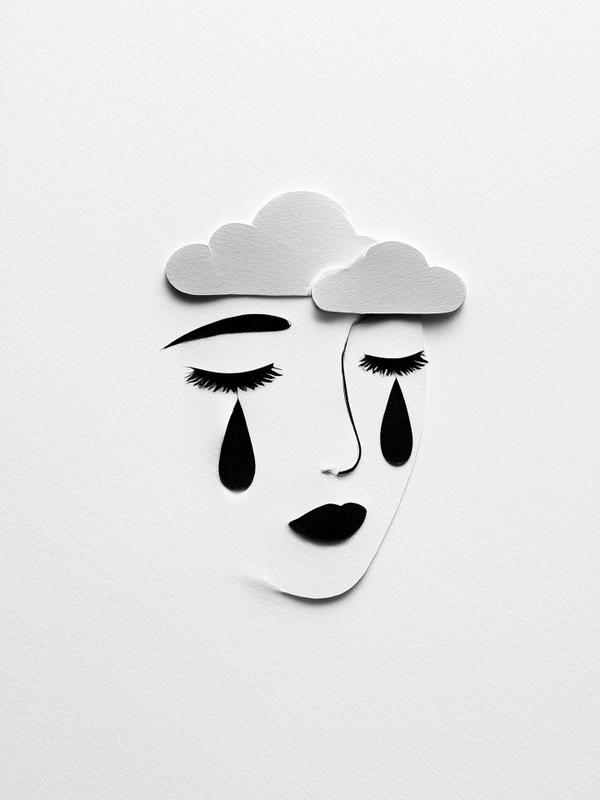
Brain Weather
Sometimes the heaviest storms happen in the lightest materials. This minimal cut-paper-and-ink face channels the spirit of modernist collage, with a dash of surrealism’s emotional punch. The clouds-as-thoughts motif could have strolled right out of a René Magritte dreamscape, while the clean, sculptural paper cuts nod to contemporary paper artists like Eiko Ojala, who carves shadows as precisely as lines. The beauty of this style is how it thrives on less. By stripping color and detail, the artist forces your brain to fill in the emotional atmosphere. This is a cousin to “negative space” art—where what isn’t drawn is just as important as what is. Here’s the fun science bit: your brain is a champion pattern matcher. Within milliseconds, it turns a few black shapes into a face (this is called pareidolia—the same reason you see animals in clouds or a face in your toast). But it doesn’t just see the face—it feels it. We’ve got specialized neurons called mirror neurons that fire when we see expressions, making us “catch” the mood. That’s why this piece can tug your heartstrings with nothing more than clouds, lashes, and teardrops. Fun fact to drop: paper art isn’t just craft—it has deep roots in fine art history. Picasso and Braque pioneered papier collé (glued paper collage) in the early 1900s, and Matisse’s famous “cut-outs” in his later years were basically painting with scissors.
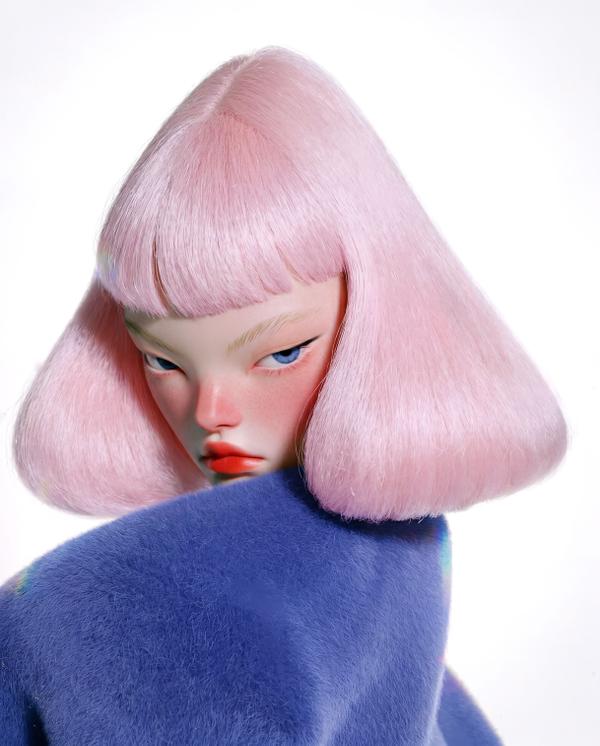
Bubblegum Armor
She looks like she just walked out of a dream, canceled everyone’s nonsense, and brought her own weather.
Available as a museum-quality print.
Request this print