Lines of Madness, Light, and Genius
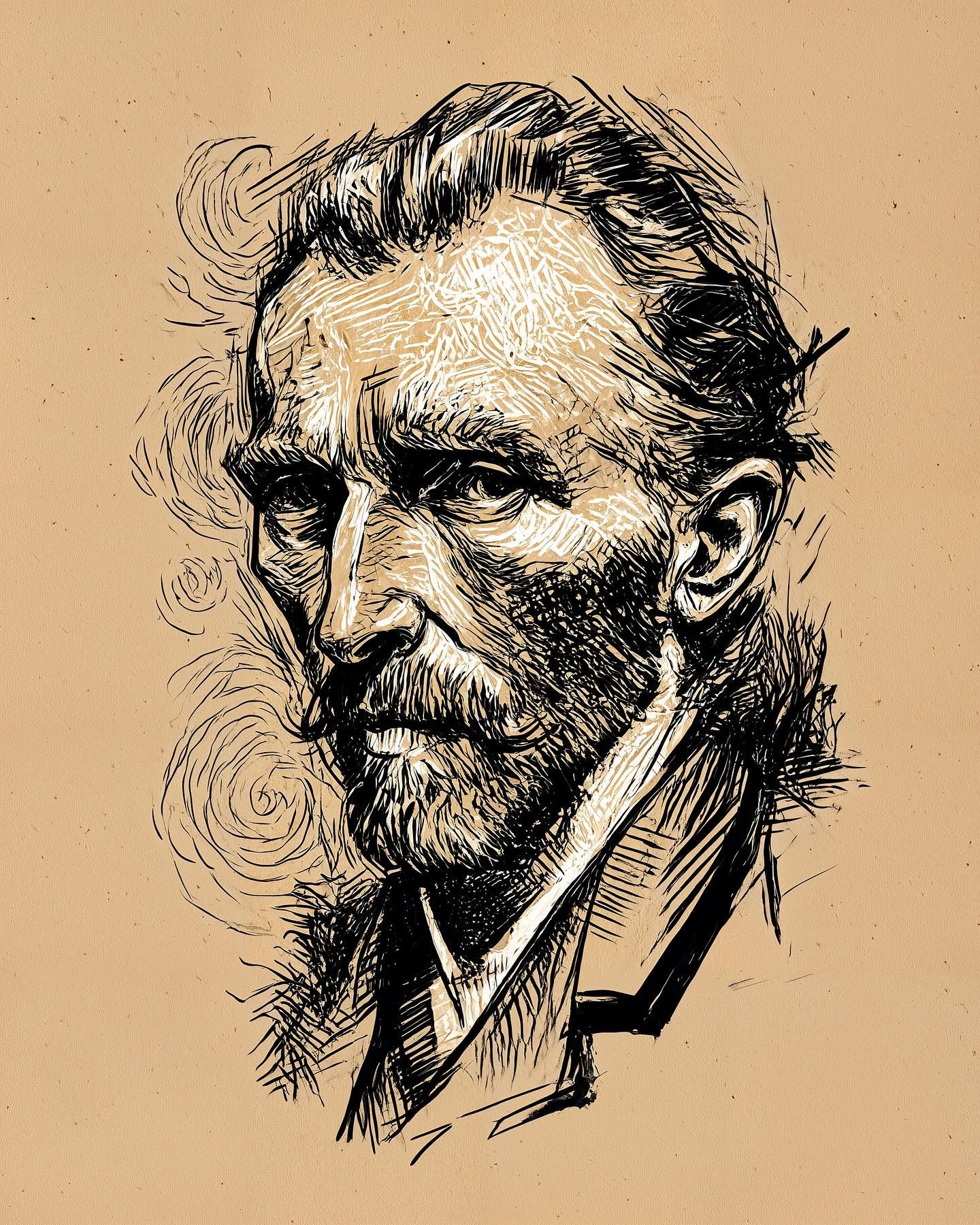
You can almost hear the scratching of the pen, like Van Gogh himself is trying to claw his way out of the page. Every stroke feels alive, half-drawn, half-screamed. If a soul could etch its own self-portrait, it might look like this: raw, fevered, and vibrating on the edge of revelation.
This isn’t your art school contour drawing, it’s Post-Impressionism meets graphic novel noir. The artist’s cross-hatching acts like emotional seismographs, mapping the turbulence behind those haunted eyes. The face doesn’t emerge smoothly but wrestles its way into view, born from conflict: black against tan, chaos against control.
It channels Vincent’s signature energy; those swirling lines in The Starry Night seem to rise again as psychic smoke curling from his temple. There’s a dose of Egon Schiele’s jagged expressiveness and a wink to the wild ink work of Ralph Steadman, who might call this portrait “Van Gogh after a thunderstorm in his mind.”
Art concept to admire:
This piece is a crash course in cross-hatching, the ancient trick of layering lines at different angles to create tone, texture, and mood. Renaissance masters like Dürer perfected it, and comic legends like Frank Miller weaponized it. Each slash of the pen builds volume, but also velocity. It’s not just shading—it’s storytelling through friction.
Fun fact:
Van Gogh often used a reed pen instead of a brush when sketching. He said it made his lines feel “alive,” and looking at this portrait, you can see why—the drawing hums like it’s still in motion.
Related works
Available as a museum-quality print.
Request this print