
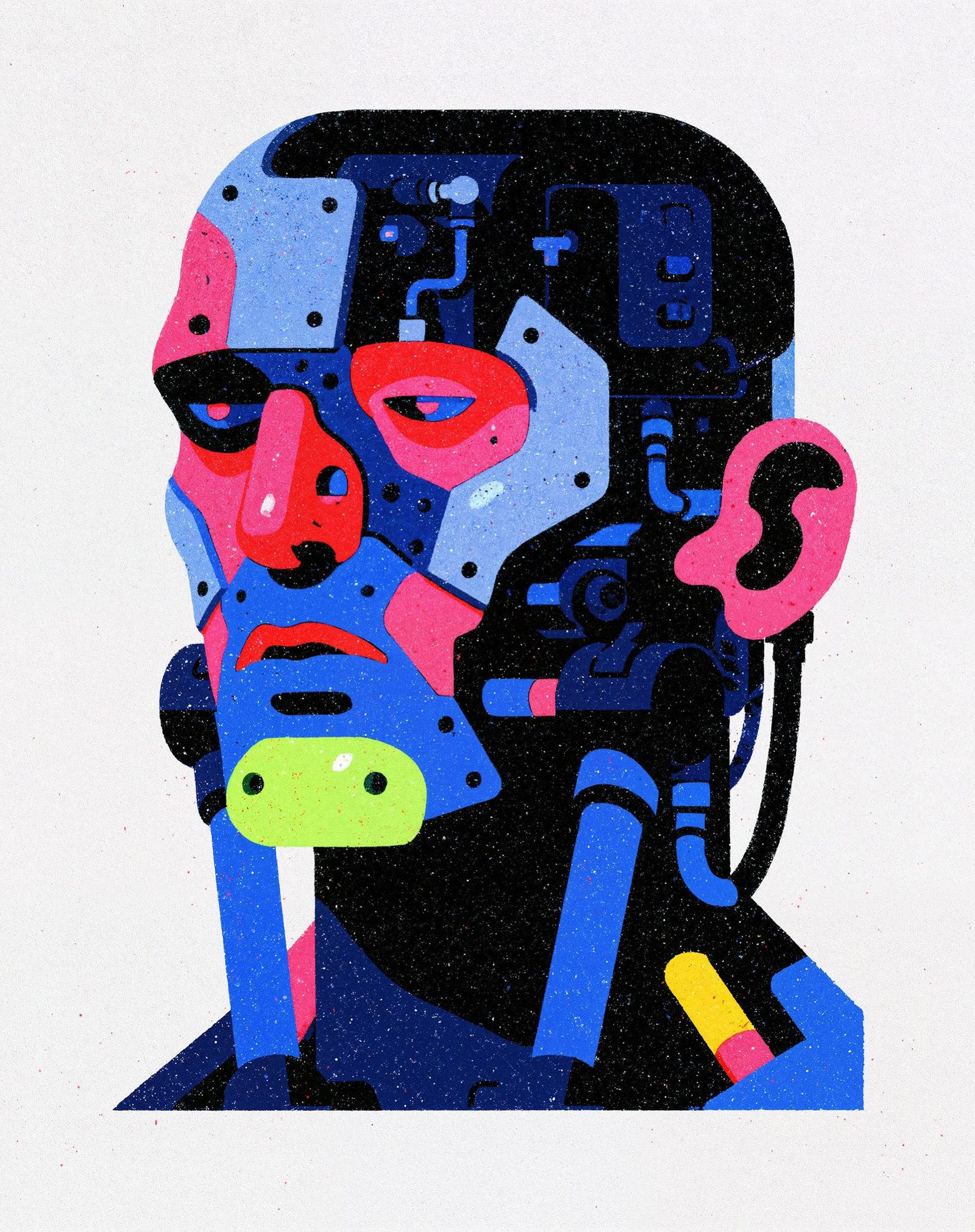
Parts Department
He has the expression of someone who just learned his personality is modular.
The face is still there. Barely.
Eyes, cheeks, nose and jaw have been rebuilt from plates, tubing, sockets and blocks of electric blue, hot pink and black. The whole portrait feels assembled rather than drawn, like somebody tried to manufacture a human being from memory.
There’s a strong Fernand Léger connection here. Léger loved turning people into cylinders, gears and polished mechanical forms, especially as modern industry began changing how artists thought about the body.
Then Eduardo Paolozzi pushed that idea further, pulling machines, circuits, advertisements and mass culture into collages that made technology feel almost biological.
And yes, there’s a little Frankenstein in him too.
Not the green face and neck bolts. Mary Shelley’s bigger question: if you assemble a human from parts, when does the collection become a person?
That question sits quietly underneath the whole image.
Your brain sees eyes, a nose, a mouth, roughly the right proportions, and immediately says, person. The machinery barely slows it down. We are incredibly good at finding humanity inside fragments.
FUN FACT
Humans are so tuned to faces that the brain has specialized regions devoted to recognizing them, which is why we see faces in everything from electrical outlets to car headlights.
Related works
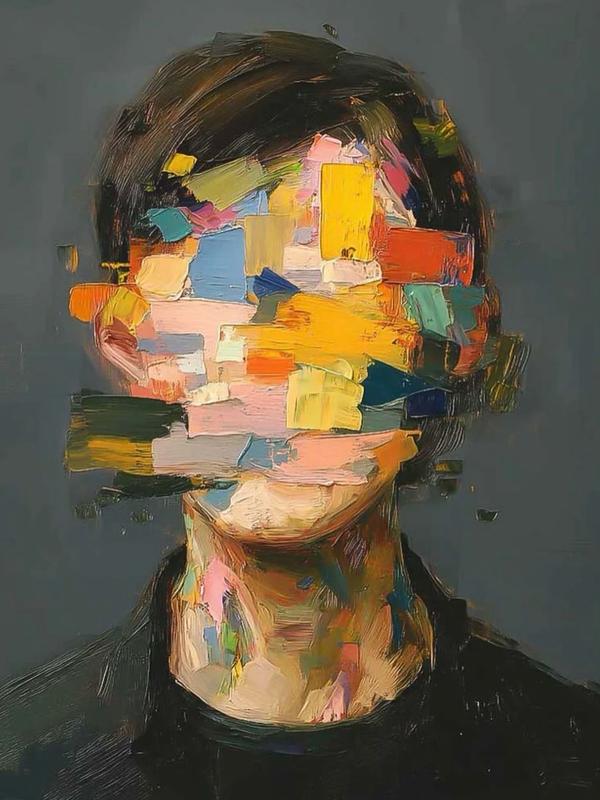
Face With Bad Wi-Fi
This portrait looks like it tried to remember its own password and gave up halfway through.
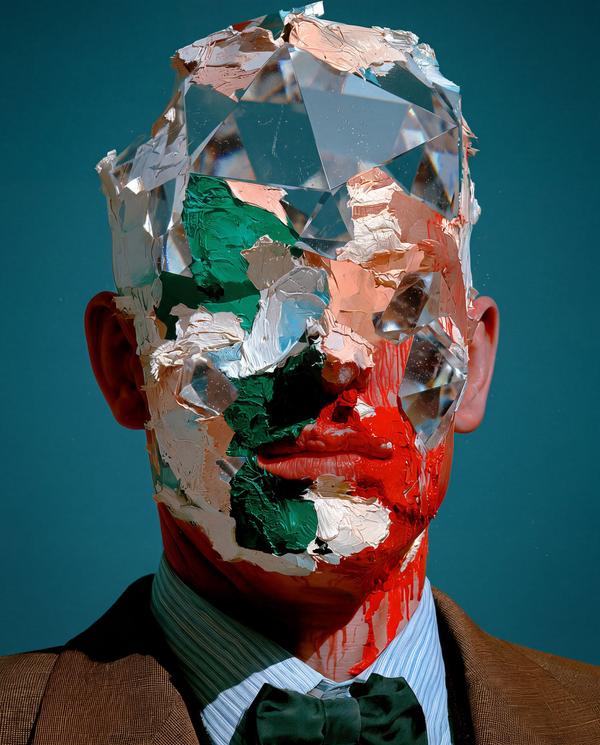
Facets of a Gentleman
This looks like a CEO who got dressed for the board meeting and then walked straight through a prism.

Girl with a Crown Earring
Vermeer’s quietest girl just discovered punk rock.
Available as a museum-quality print.
Request this print