
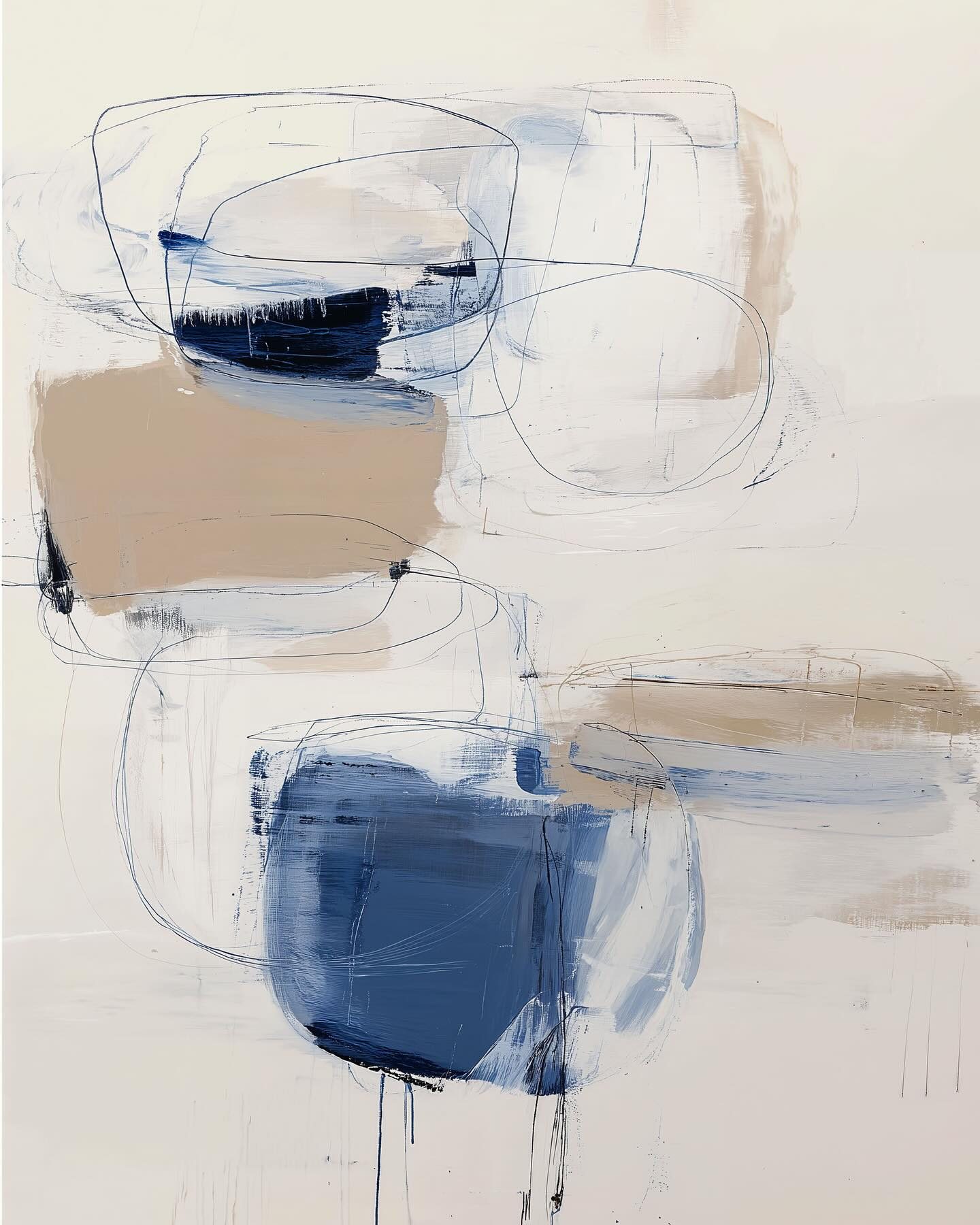
Quiet Commotion
Like a cocktail napkin sketch went to therapy and came back emotionally available.
This piece whispers in cream, sand, and powder blue, then sneaks in those deep inky navy forms like they own the place. Loose looping lines drift across the surface like someone drawing while thinking very hard about nothing and everything at once. It feels airy, but not empty. Calm, but not innocent. Like a room that looks tidy until you realize every object has a backstory.
What’s happening here is a beautiful tug-of-war between control and improvisation. The soft neutral ground gives the eye somewhere to rest, while those scribbled contours keep it moving, searching, circling back. That tension is the whole game. You can feel echoes of Cy Twombly in the restless line, Richard Diebenkorn in the architecture of open space, and a little Joan Mitchell in the emotional weight carried by brushstroke alone.
Here’s the art lesson: negative space is not “empty space.” It’s active. It shapes the painting just as much as the blue forms do. In strong abstraction, what’s left unsaid matters as much as what’s declared. That’s why this image breathes. The blankness isn’t passive. It’s doing push-ups.
Fun fact you can use at dinner: many abstract painters leave visible revisions, ghost marks, and scraped passages on purpose. That history on the canvas is called pentimento—basically the painting keeping receipts.
This one feels like memory works. Not in neat sentences. In fragments. In gestures. In soft blur and sudden certainty.
Related works
Available as a museum-quality print.
Request this print