
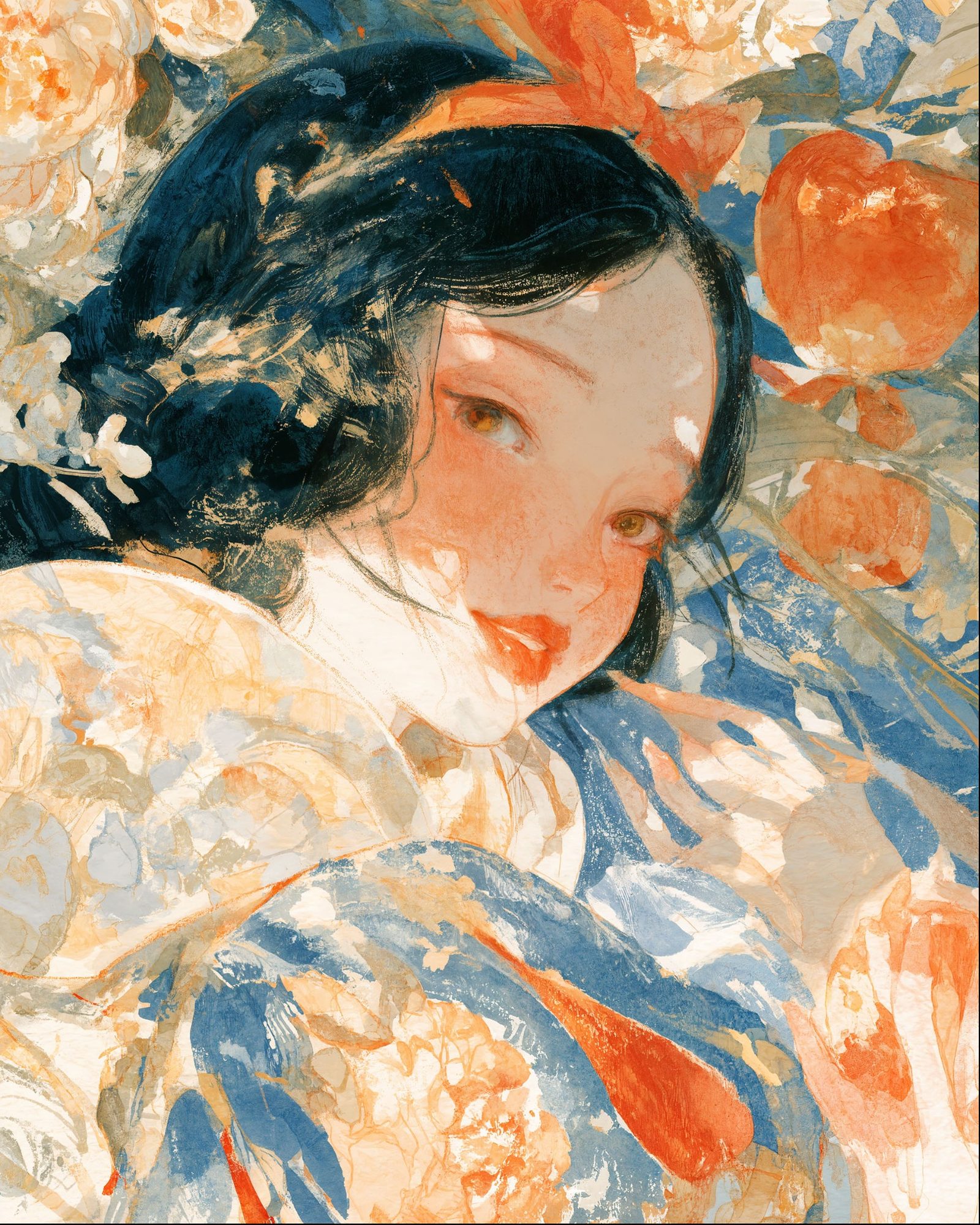
The Fairest in the Garden
Snow White has traded the seven dwarfs for a Japanese garden, and frankly, it's a considerable upgrade.
With porcelain skin, raven-black hair, and lips the color of a perfectly ripe persimmon, our heroine has stepped out of the Brothers Grimm and into an entirely different visual tradition.
Utamaro, the great Edo-period printmaker, specialized in portraits of beautiful women. His elegant faces, elaborate hairstyles, and intimate compositions find a distant echo here. Mucha contributes the decorative abundance: flowers, flowing curves, and ornamental patterns that seem determined to occupy every available inch.
Notice how her dark hair sweeps across the upper composition, anchoring a whirlwind of peach blossoms, blue-green foliage, and creamy fabric. The warm oranges and cool blues keep the picture moving, while her softly rendered face offers a quiet place to land.
And those eyes. She's looking directly at us with the expression of someone who already knows what happened to the poisoned apple.
There's a lovely tension between the delicacy of her expression and the exuberance surrounding her. Every flower seems to be competing for attention.
She's winning without trying.
FUN FACT
The Japanese term bijin-ga literally means “pictures of beautiful women.” During the Edo period, these prints celebrated fashionable hairstyles, elaborate textiles, and contemporary ideals of beauty. They also helped inspire Europe's fascination with Japanese art in the 19th century.
Related works

Neon Feedback Saint
That screaming orange backdrop. The red-and-white guitar slashing across the frame. And those fine, windblown lines whipping off his hair like the music has its own weather.

Neon Mind Bloom
Hot-pink background. A grayscale face, dead center. Firework eye makeup bursting in yellow and rainbow petals.

Neon Pulse
Like if elegance got struck by lightning and decided to enjoy it.
Available as a museum-quality print.
Request this print