
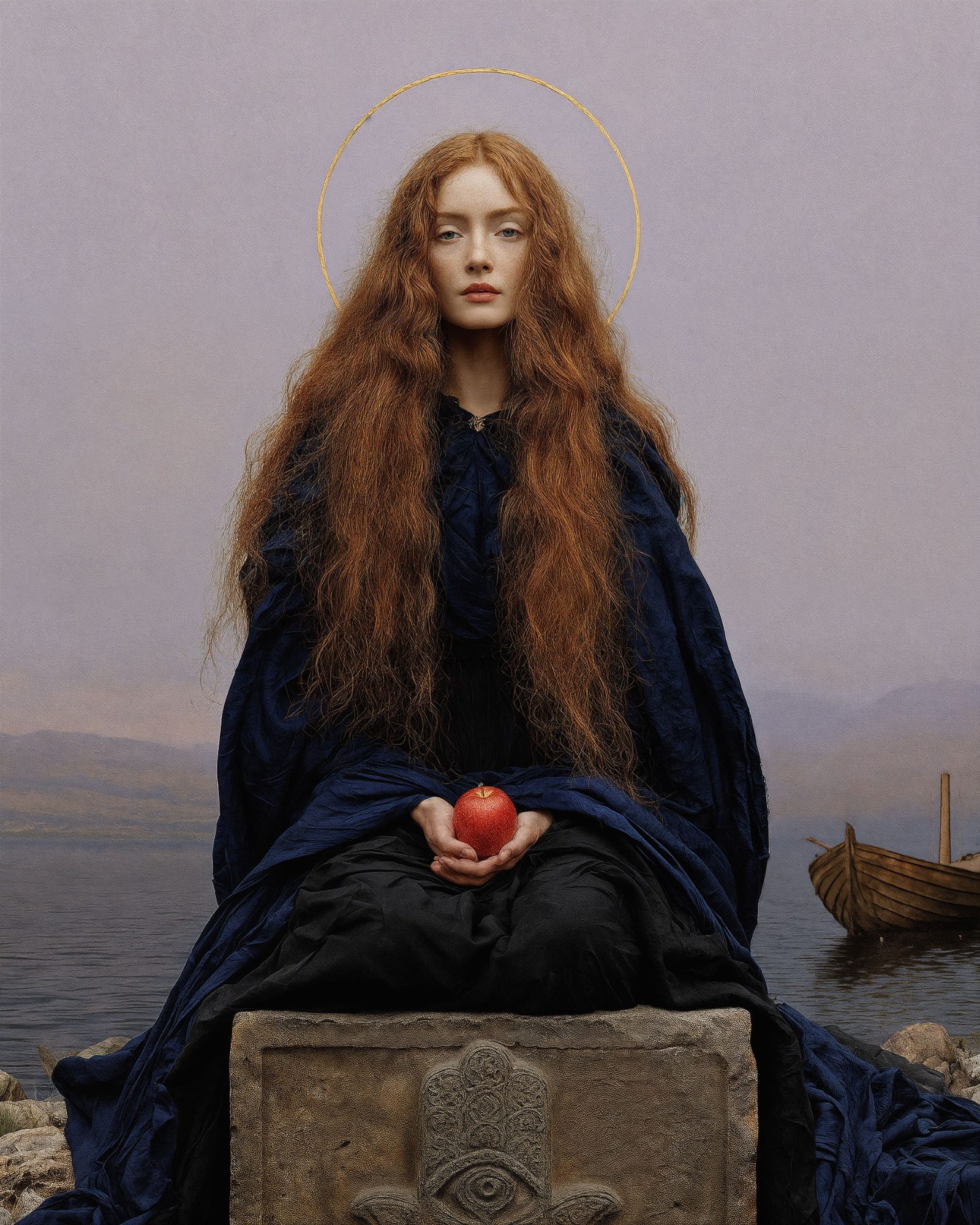
The Fruit She Kept
She has the calm expression of someone who already knows how the story ends.
Everything here is arranged with almost unnerving precision: the centered figure, the gold halo, the red fruit held at the body’s midpoint, the deep blue drapery falling in heavy folds. Even the boat off to the side feels less like scenery than a clue someone forgot to explain.
There’s a strong Pre-Raphaelite current running through it, especially Rossetti’s fascination with long hair, saturated color, beauty, and women who seem to occupy both the physical world and some private symbolic one. Julia Margaret Cameron comes through in the solemn, almost sacred treatment of the face, where portraiture edges toward myth. The frontal symmetry and halo reach further back to devotional painting, where position and gesture were rarely casual.
Color carries a lot of the psychology. That ultramarine-blue robe gives the figure gravity, while the pomegranate becomes a small red flare you cannot stop looking at. In art, pomegranates have carried a ridiculous résumé: fertility, resurrection, abundance, death, marriage. One fruit, apparently unwilling to specialize.
The composition also plays beautifully with stillness. She barely moves, the water barely moves, the horizon barely exists. That calm makes the symbols louder.
And that halo? It grants sainthood without explaining the charges.
FUN FACT
Pomegranates appear repeatedly in Renaissance religious art; their many seeds were often associated with fertility and resurrection, while the fruit itself could symbolize Christ’s Passion.
Related works
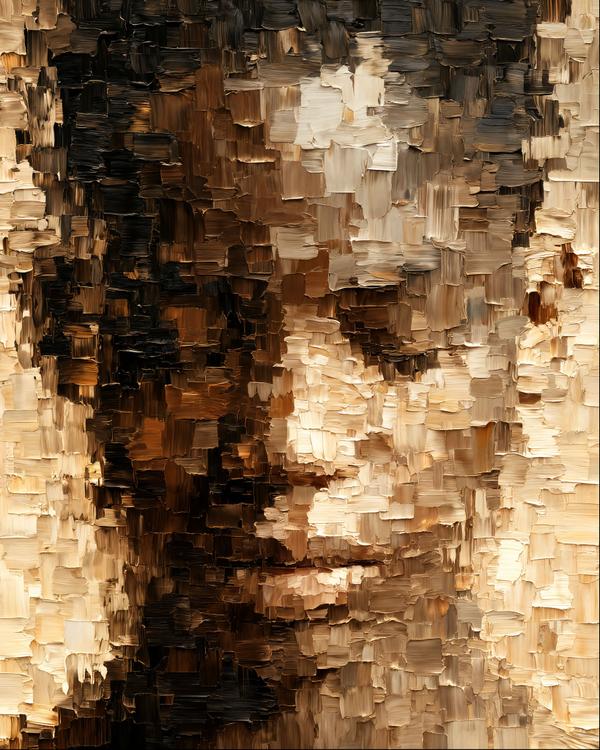
What the Walls Remember
Somewhere between a midnight espresso and a very expensive renovation, a face started appearing in the plaster.
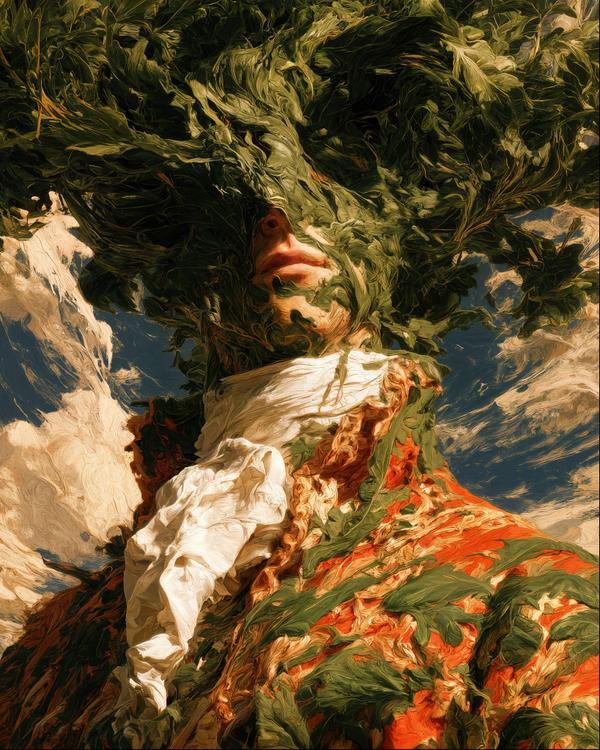
The Garden Has Taken His Side
Somewhere beneath that shrubbery is a man who clearly told the gardener he wanted privacy.

The Elephant in the Room
Finally, someone dealt with the elephant in the room. He seems pretty comfortable there.
Available as a museum-quality print.
Request this print