
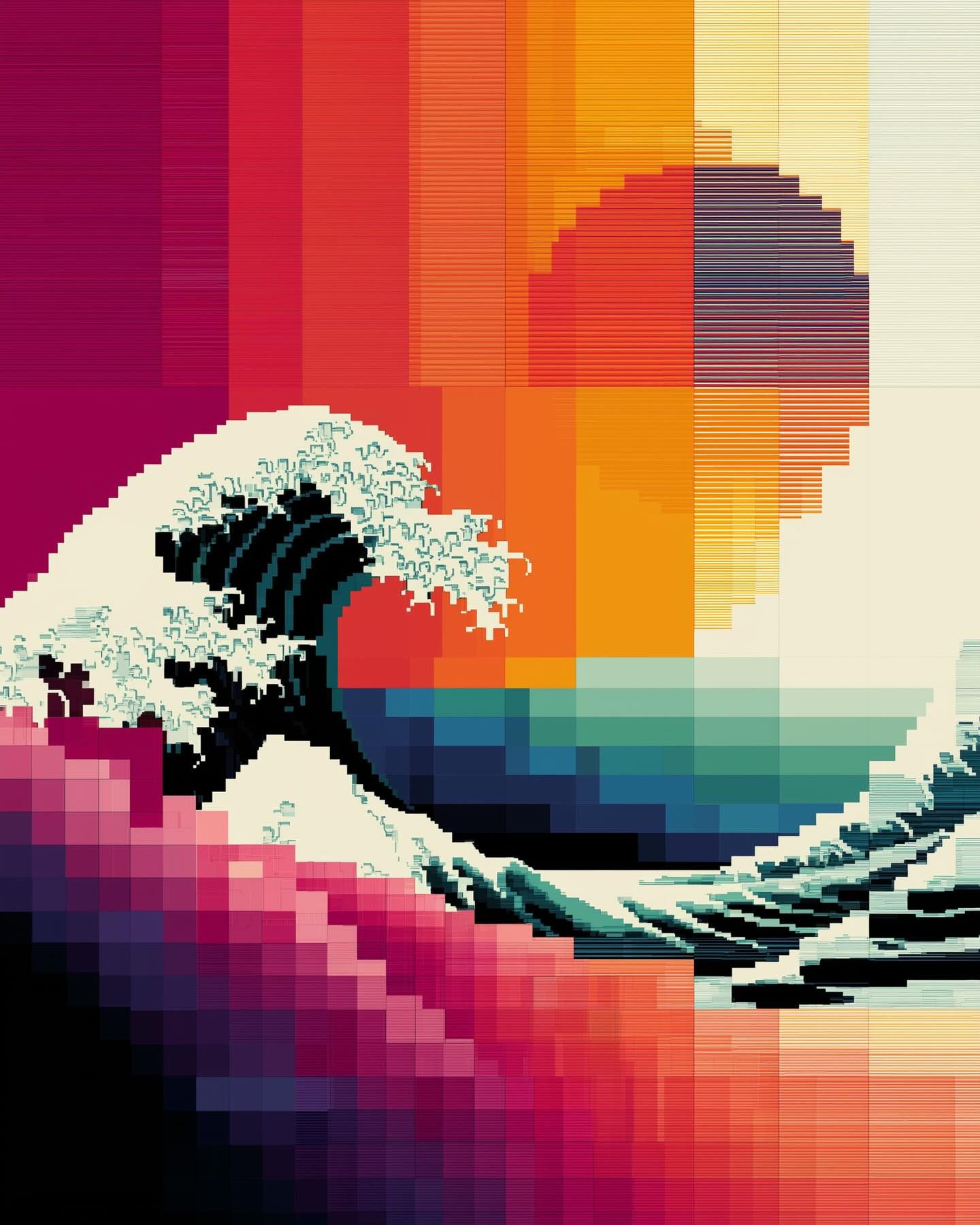
Wave.exe
Like if Hokusai got a graphics card and a little too much confidence.
Here, The Great Wave off Kanagawa doesn’t just crash — it renders. The famous claw of foam is still there, still curling like nature has a personal grudge, but now it arrives in blocks, bands, and glowing strips of sunset color that feel half woodblock print, half arcade fever dream. Hot magentas. Burnt oranges. Electric teal. The whole thing looks like a tsunami and a vintage monitor had a very stylish child.
What makes this image sing is the collision of two visual languages. On one side: Japanese ukiyo-e printmaking, where shape, rhythm, and flat color do the heavy lifting. On the other: pixelation, scan lines, and digital fragmentation — a reminder that even icons get remixed. Hokusai is the obvious ancestor, but you can also feel Op Art and geometric abstraction creeping in, turning repetition into motion and motion into tension.
Mini art lesson: this is translation through form. A strong composition can survive a change in medium if its structure is powerful enough. Strip away the original linework, rebuild it in chunky pixels and color fields, and the wave still reads instantly. Why? Because great art isn’t just detail. It’s silhouette, rhythm, balance, and emotional force.
Fun fact: Hokusai created The Great Wave in the early 1830s as part of Thirty-Six Views of Mount Fuji, and it became one of the most recognizable images in art history. Basically, he made the 19th century’s most successful visual logo before branding was even a thing.
Related works
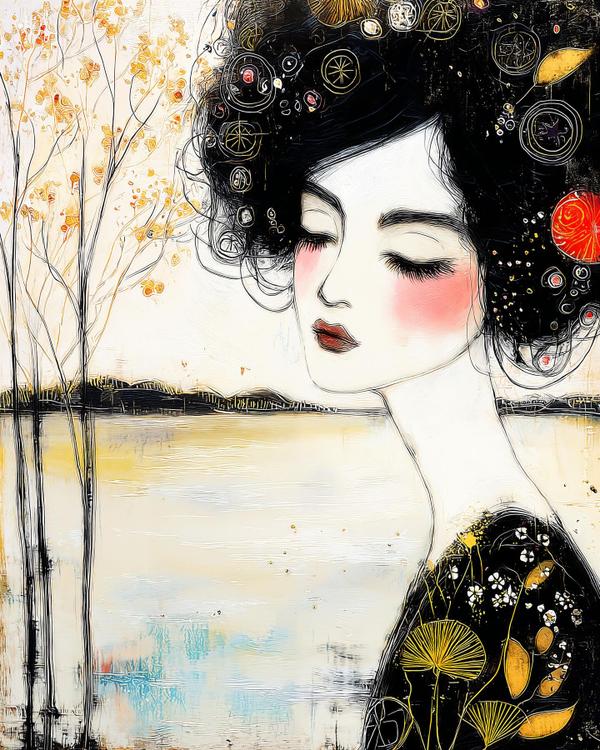
Orbiting Daydream
Inky black curls peppered with little gold “compass” wheels. One ember-red rose glowing like a signal flare. Skin so pale it reads like porcelain under soft, museum light.
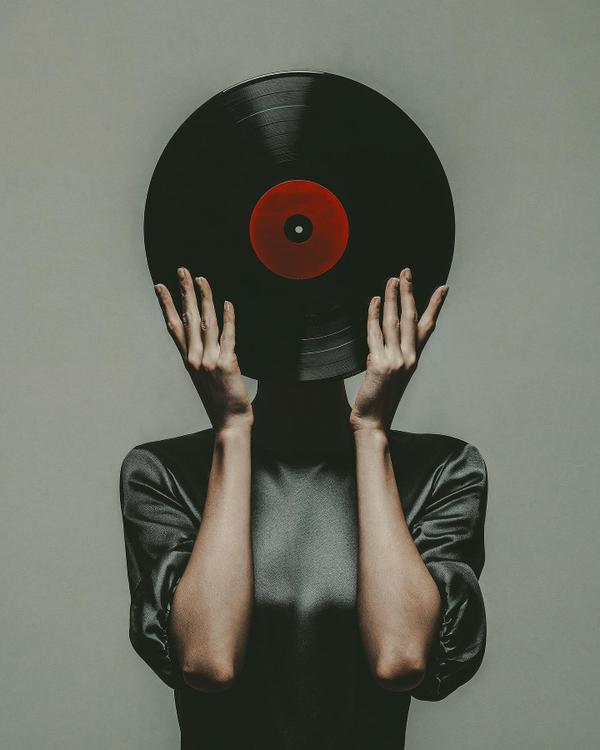
Playlist Face
Ever wonder what happens when your Spotify algorithm eats your face? Here it is. A body in satin sleeves, but where the head should be—bam, a vinyl record. It’s bold, absurd, and perfectly deadpan. Think of it as identity remixed: are you what you look like, or what you listen to? The aesthetic is sharp, high-contrast minimalism—just a figure, a disc, and a muted backdrop. It feels like a lost photograph from the 1930s avant-garde, when artists were obsessed with swapping out body parts for objects. The vibe: Man Ray had a baby with Vogue Italia. Art Influences This is pure Dada spirit—nonsense elevated to the profound. Artists like Man Ray and Hannah Höch loved mixing the human form with found objects, poking fun at modern life while making us rethink reality. Fast-forward to today, and you’ll see echoes in contemporary conceptual portraitists like Erwin Wurm (known for his “One Minute Sculptures” that turn people into objects) and even Cindy Sherman’s playful disguises. Fun Fact You’ll Want to Repeat The word “album” originally meant a blank book for autographs or drawings. When records started being sold in bound sets, they borrowed the name. So every vinyl record you’ve ever played is, technically, a kind of “portrait album.” This piece nails that idea: the face is gone, the record stands in, and suddenly you’re looking at music as identity—spinning endlessly, track after track.

Poolside, but Make It Botany
Like if a luxury resort got gently upstaged by two hibiscus flowers and just had to accept its fate.
Available as a museum-quality print.
Request this print