
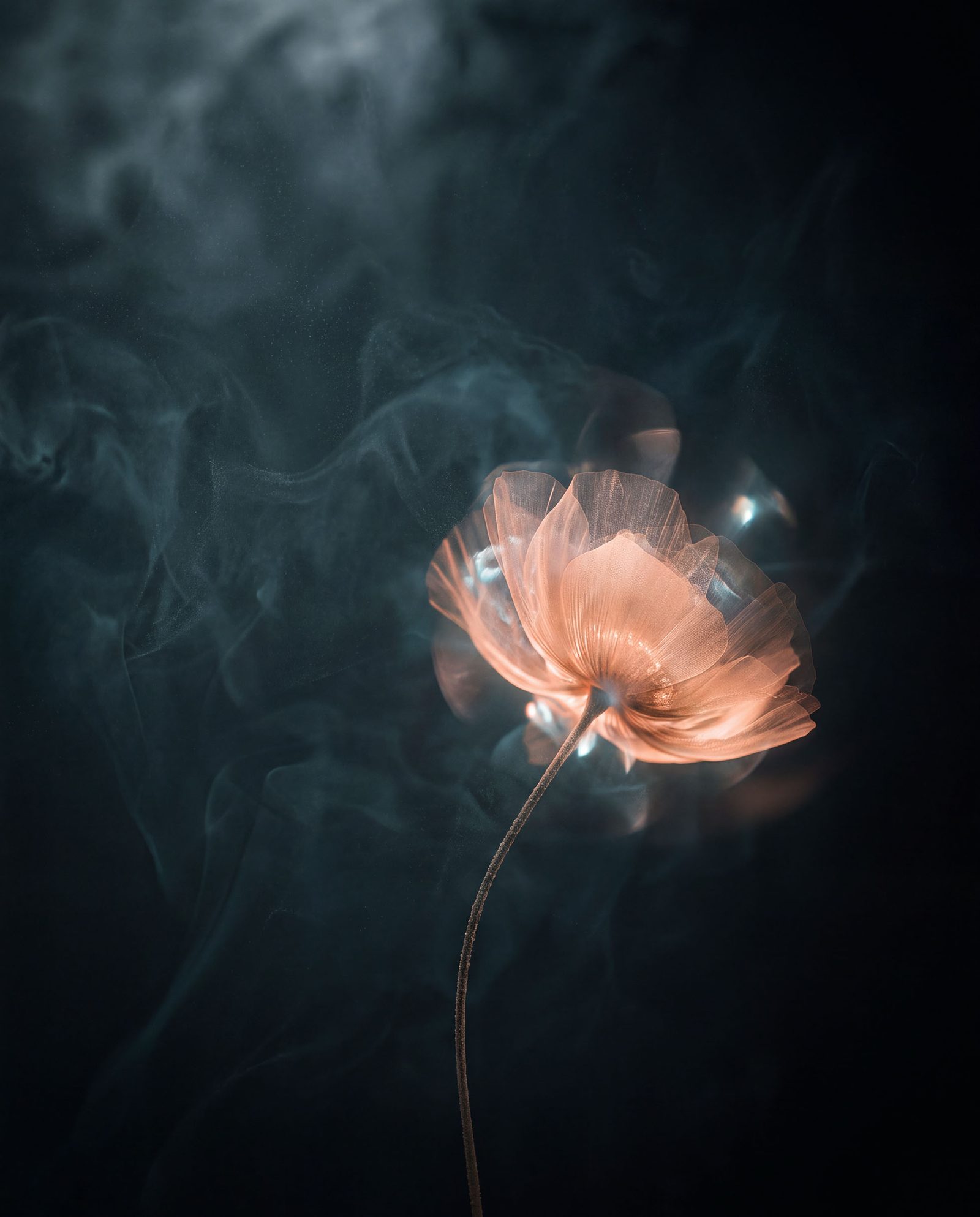
Weathering the Bloom
Some flowers sit politely in a vase. This one appears to have summoned weather.
The flower occupies surprisingly little of the frame, which is exactly why it owns the place. Suspended against that blue-black field, the pale coral bloom feels less arranged than discovered—something briefly illuminated in a room where the lights have otherwise gone out.
The color relationship does much of the emotional work. Warm peach against deep blue is a near-complementary pairing, so the flower appears to generate its own heat. Then the smoky veil softens the edges, obscures the background, and gives the image depth without giving us much actual information. Very cinematic. Slightly suspicious.
There’s some Mapplethorpe in the flower’s sculptural isolation and control, while Sarah Moon comes through in the dreamier atmosphere—the sense that the photograph might disappear if you stare at it too confidently. Behind both sits the much older tradition of Dutch flower painting, where beauty often arrived carrying a quiet reminder that beauty has an expiration date.
That long, delicate stem matters too. It leaves the bloom hovering improbably in all that darkness, elegant and a little vulnerable.
Apparently flowers have been lying to us for centuries.
FUN FACT
In 17th-century Dutch still lifes, flowers from different seasons were often painted together even though they could never have bloomed at the same time. The bouquet was partly observation, partly beautiful fiction.
Related works
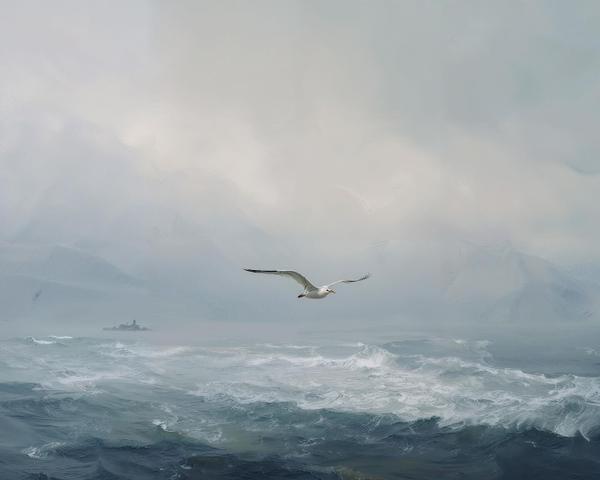
Wings Where Sea Meets Sky
This image feels like a hymn to solitude — a lone gull gliding above restless waters, a flicker of life stitched against an endless horizon. It echoes the Romantic tradition, where painters like Caspar David Friedrich and Ivan Aivazovsky tried to capture not just what the sea looked like, but what it felt like: vast, sublime, and slightly terrifying. The faint lighthouse in the mist is a whisper of human presence, almost embarrassed to exist in nature’s cathedral. The sea, frothing and alive, reminds us that water is both cradle and abyss — a theme Romantic artists adored. They believed the “sublime” was that paradoxical beauty we feel when confronted with something larger than ourselves: awe wrapped in a shiver. Fun fact to pocket: Friedrich often painted tiny figures gazing at vast landscapes, not to glorify them, but to remind us of our own fragile scale. In a way, this gull is today’s “tiny figure,” suspended between the storm and the sky. What makes this piece contemporary is its dreamlike smoothness — like the edges of memory softened by time. The sea becomes less about geography and more about metaphor: freedom, longing, and that eternal tug between staying ashore or taking flight. So next time you see a bird over water, remember: it’s not just flying. It’s sketching poetry across the sky.
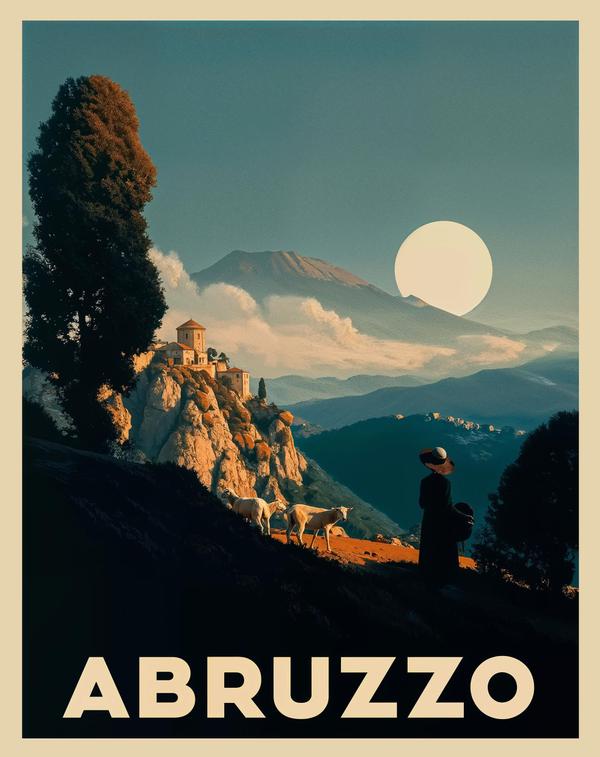
Wish You Were Dramatic
Abruzzo: where even the goats look like they’re waiting for a film score.
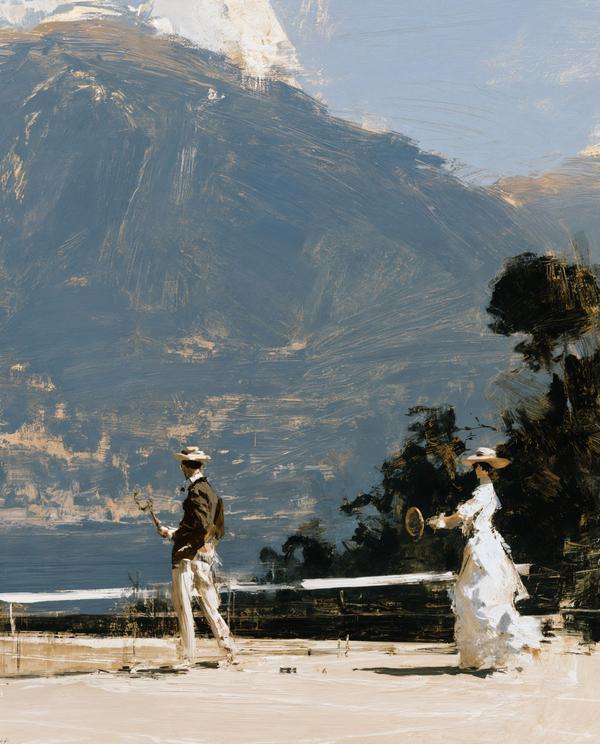
Advantage, Lake Como
Tennis whites, mountain air, and a view so dramatic nobody seems concerned about keeping score.
Available as a museum-quality print.
Request this print