
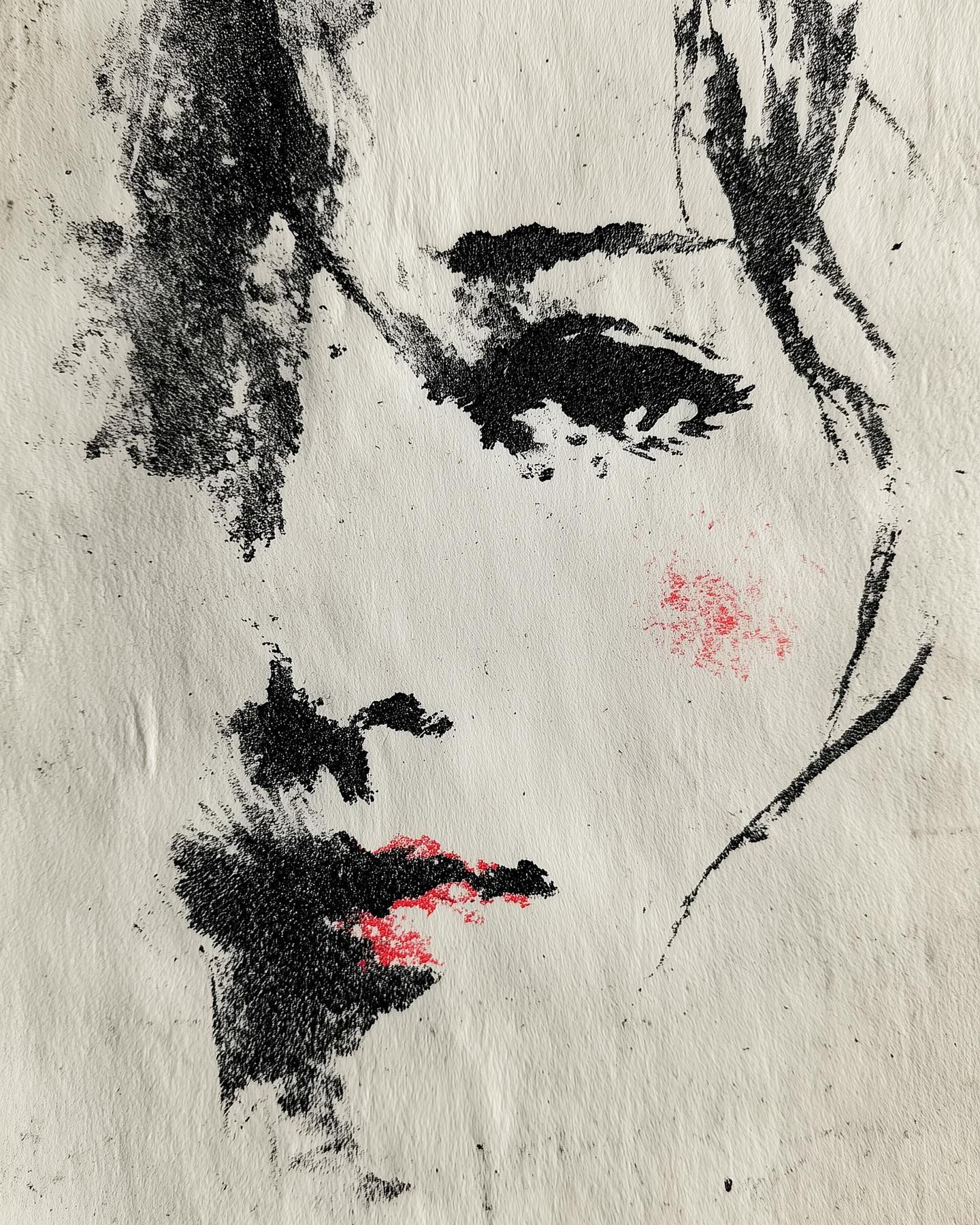
Whispered Face
This piece leans on the centuries-old Japanese art of sumi-e (ink wash painting). Think of sumi-e as painting’s minimalist cousin: a style that asks, “How few strokes can I use before the viewer fills in the rest?” Instead of piling on detail, sumi-e artists work with restraint—brush, ink, water, and the white silence of paper. The emptiness is as important as the mark. That’s why this portrait feels both airy and intense: the paper does half the storytelling.
You can see echoes of Zen calligraphy here, where the gesture matters as much as the image. In Western terms, imagine if Franz Kline (Abstract Expressionism) and Egon Schiele (expressionistic portraits) went out for sushi and sketched each other on a napkin.
Fun fact to drop at brunch: In sumi-e, the first brushstroke is considered the most alive—hesitate, and you lose the energy. That’s why the bold eye here feels so electric; it’s like the brush took a deep breath and nailed it in one go.
The little blush of red? That’s a classic trick too. Japanese and Chinese ink painters sometimes used cinnabar or vermilion for accents, to make the monochrome pop. It’s the visual equivalent of dropping chili flakes on a delicate dish—minimal but unforgettable.
So next time you’re doodling, try this rule: stop two strokes earlier than you want to. The space you don’t fill might be the most powerful part of the image.
Related works
Available as a museum-quality print.
Request this print