
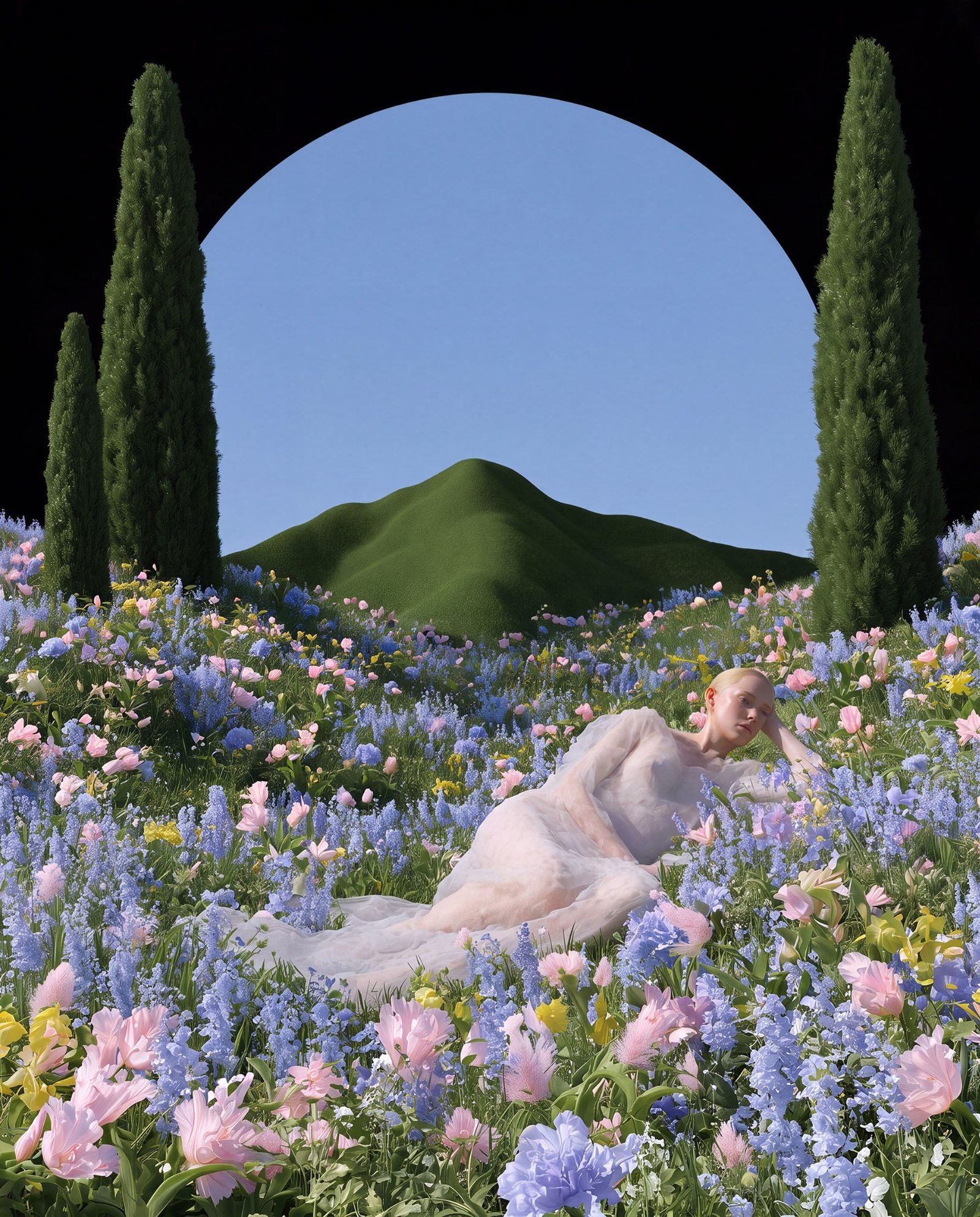
The Garden Keeps Her
Paradise, apparently, has excellent landscaping and absolutely no sense of urgency.
A woman reclines in a field so lush it feels almost indecent. Lavender blues, powdered pinks, flashes of yellow—and then the garden suddenly becomes geometry: tall cypresses, a manicured green hill, and an enormous blue arch cut into black.
That collision gives the image its strange calm. The foreground is soft, abundant, almost Rococo in its excess, while the background behaves like a stage set designed with a ruler. Your eye moves from botanical chaos to near-perfect order, with the reclining figure caught between the two.
Botticelli comes to mind in the idea of a woman absorbed into an impossible flowering landscape. Max Ernst is there in the dream logic, where nature and invention share the same ground. And the cypresses carry some of Böcklin’s emotional weight—beautiful, vertical, and just haunted enough.
The blue opening is the real hinge. Against all that black, it stops reading as ordinary sky and starts feeling like a portal.
She may be sleeping. She may be dreaming the whole place. Frankly, I’d let her.
FUN FACT
Cypresses have been associated with mourning and eternity since antiquity, which is why they appear so often in Mediterranean cemeteries.
Related works
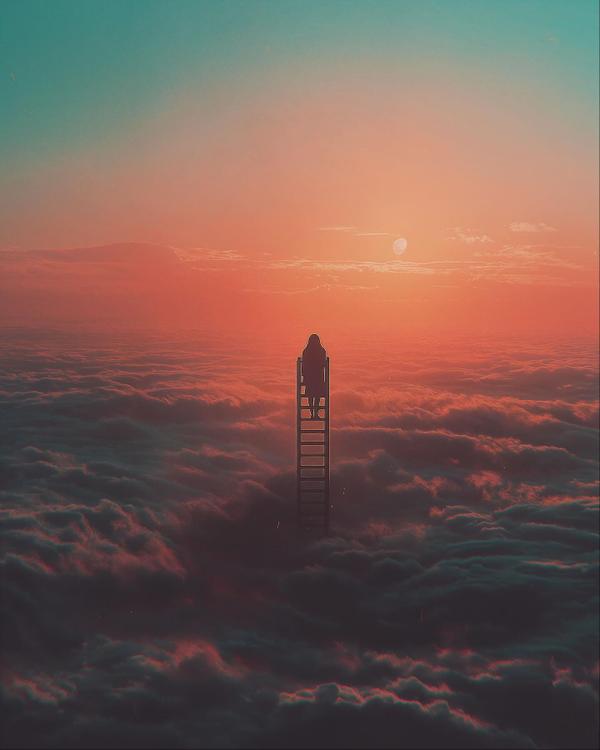
Cloud Maintenance
Like if the sky needed repairs and only one lonely ladder showed up for the job.
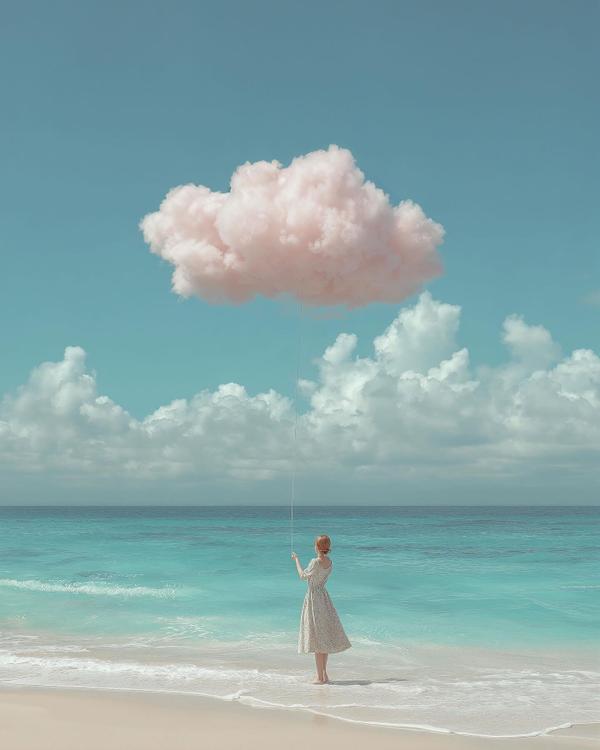
Cloud on a String
Some people bring snacks to the beach. She brought weather.
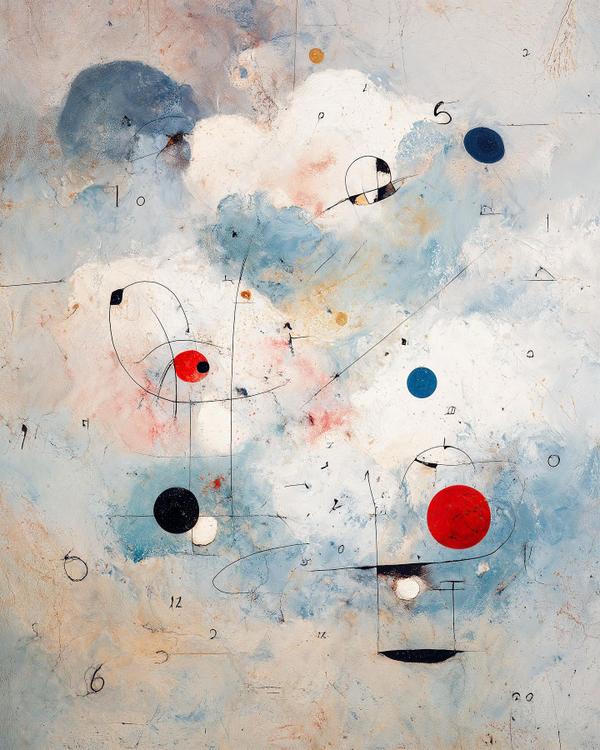
Constellation Grammar
Today’s piece floats in that sweet Miró zone: an airy sky of chalky blues and milky whites, pricked with primary-color planets (those hot red and deep navy disks) and stitched together by hairline, wandering lines. The marks loop, pause, and double back like a curious bird’s flight path—classic Joan Miró grammar: dots, stars, moons, tiny ladders, and signs that feel half-alphabet, half-astronomy. Here’s the trick he taught the 20th century: automatism. Instead of planning every detail, start with stains and smudges, then “discover” forms by following the line. That’s why the composition feels both playful and inevitable—like the picture drew you first. The limited palette (primary pops against soft sky tints) keeps the chaos musical rather than messy; call it biomorphic abstraction—organic shapes behaving like happy microbes in zero gravity. Look closely at the micro-scratches, numbers, and notations. They read like a private star map: not scientific data, but the instructions for how to daydream properly. Fun fact: Miró once said he wanted to “assassinate painting”—wipe out the old rules so something freer could breathe. During WWII he made his intimate “Constellations” series on small sheets he could carry while on the move—tiny universes that fit in a suitcase. Moral: when life feels heavy, give your ideas less gravity. Let the line wander; the cosmos will meet it halfway.
Available as a museum-quality print.
Request this print