Where the View Looks Back
This looks like someone hung a thought in the middle of a field and then dared us to step closer.
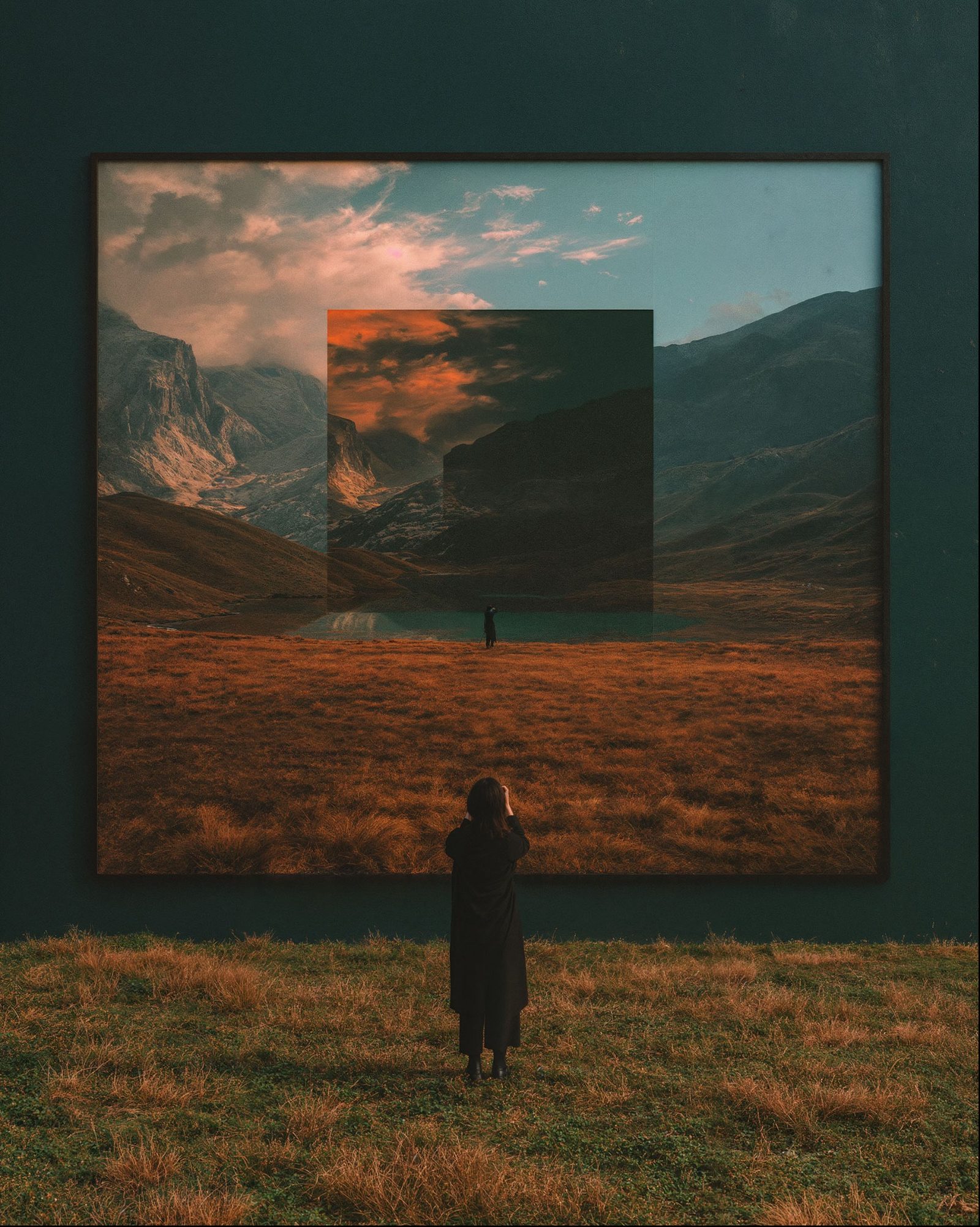
A lone figure stands in dry amber grass facing a giant framed mountain scene, and inside that scene sits another darker rectangle—as if the landscape has a memory, or maybe a secret. Then you notice the tiny person near the lake inside the image. Suddenly the whole piece starts folding in on itself. Viewer, picture, witness, subject. Everybody’s invited, nobody gets a full explanation. Very rude. Very effective.
What makes it work is scale. The mountains feel vast, but the oversized frame turns them into an object. Then that inner square compresses the view again, like a second thought laid over the first one. Your eye moves from the woman in the foreground to the small figure inside the picture, then outward to the cliffs and sky. It creates a quiet loop—looking becomes the real subject.
There’s a clear kinship with Caspar David Friedrich’s Rückenfigur tradition: the back-turned figure who lets us enter the scene through them. You can also feel a Magritte-like fascination with images inside images, where framing becomes part of the mystery. And the whole thing carries the meditative patience of contemporary conceptual photography, where placement and scale do as much emotional work as expression.
The color is doing heavy lifting too. Those rust-and-honey grasses warm the bottom half like held breath, while the blue-green mountains and sky cool the distance. The darker square in the center changes the emotional weather. Same place, different state of mind.
FUN FACT
Art historians use the phrase mise en abyme for an image nested inside another image—a visual echo that makes you aware of both the picture and your own act of looking.
Available as a museum-quality print.
Request this print