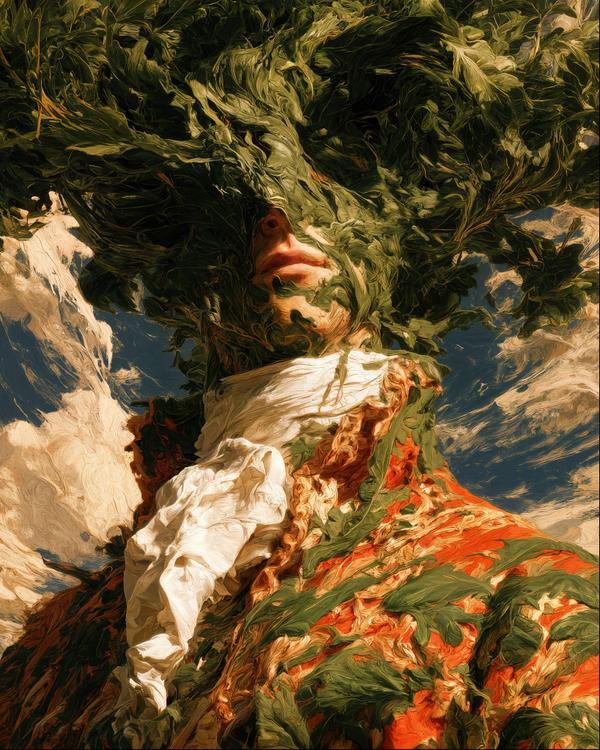
The Garden Has Taken His Side
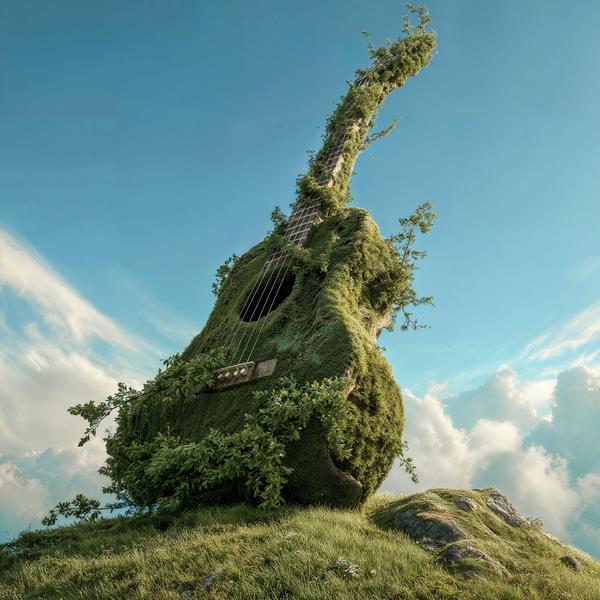
Somewhere beneath that shrubbery is a man who clearly told the gardener he wanted privacy.
Rooms, objects and weather behaving badly.
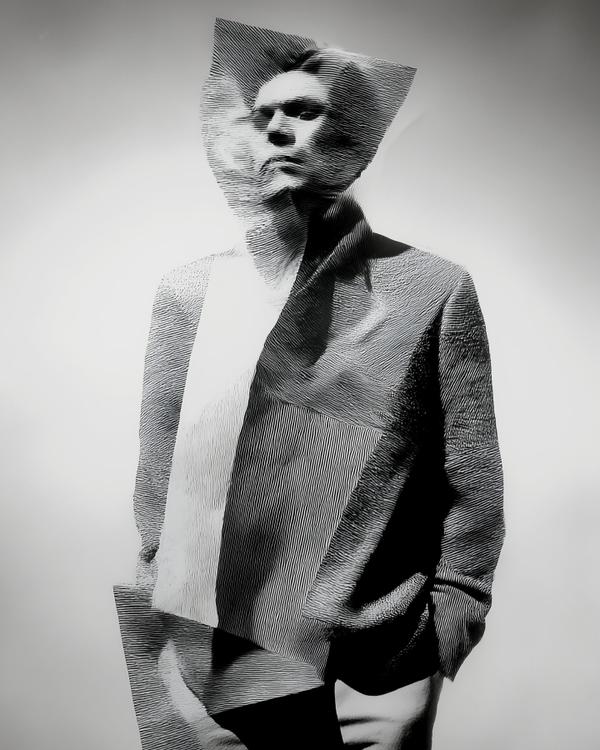
Somewhere beneath that shrubbery is a man who clearly told the gardener he wanted privacy.
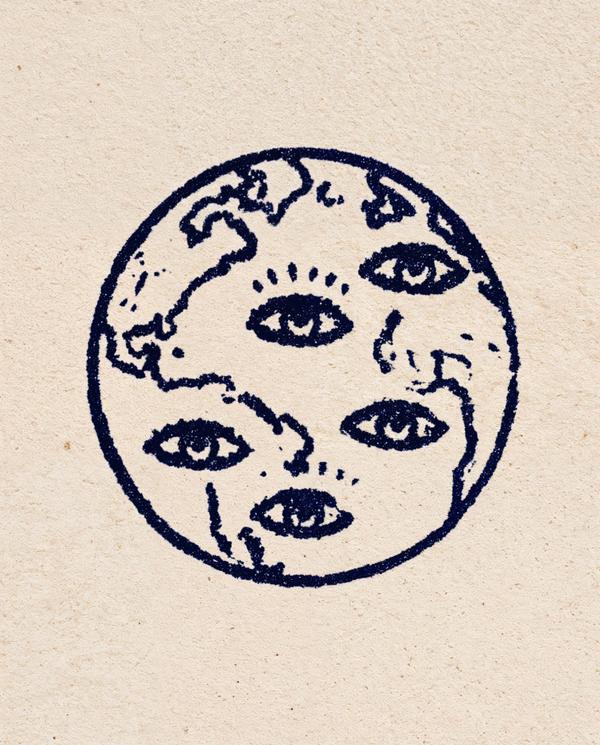
Apparently Earth has been paying closer attention than the rest of us.
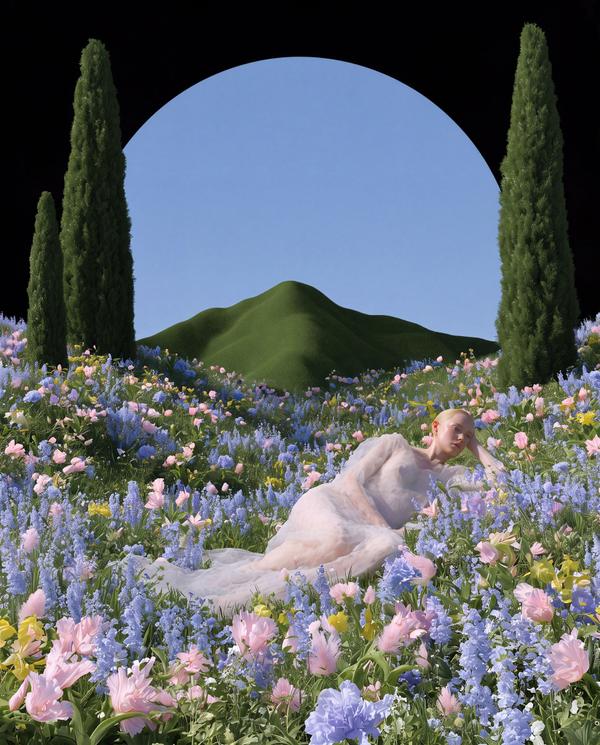
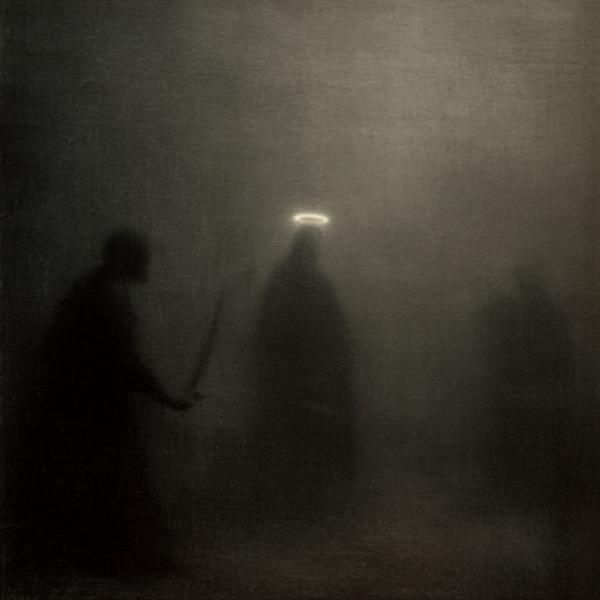
Paradise, apparently, has excellent landscaping and absolutely no sense of urgency.
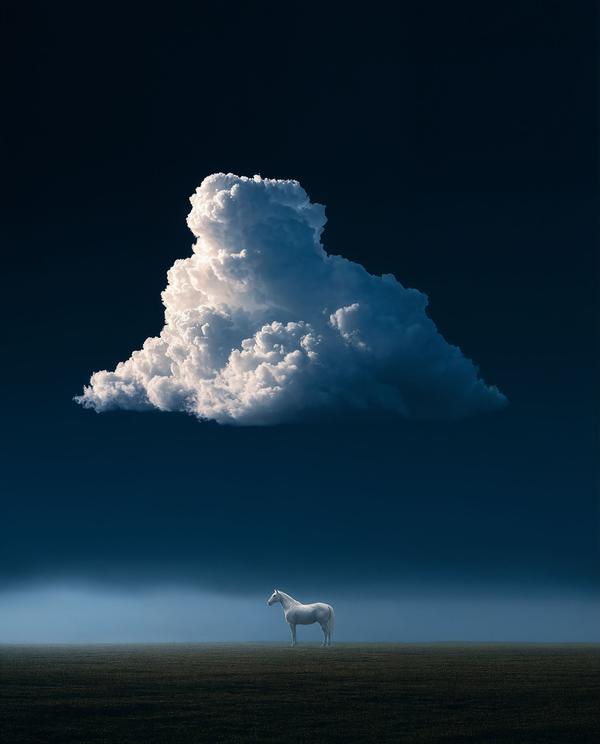
The horse has seen the forecast and chosen dignity. Alone in a dark field, he stands perfectly still beneath a cloud that looks less like weather and more like a mountain passing overhead. The light catches both figures—the bright edge of the cloud, the pale curve of the horse—while everything else slips into deep blue silence.
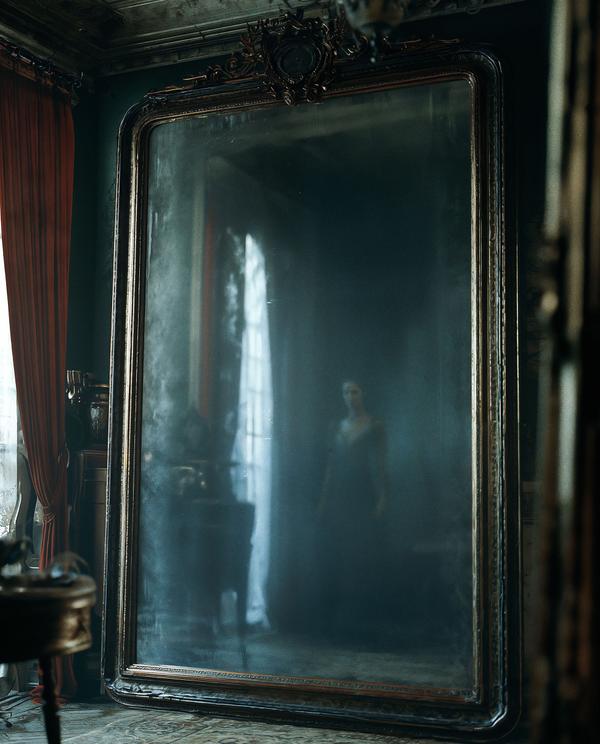
Apparently the ghost lives in the mirror. The furniture is just trying not to get involved.
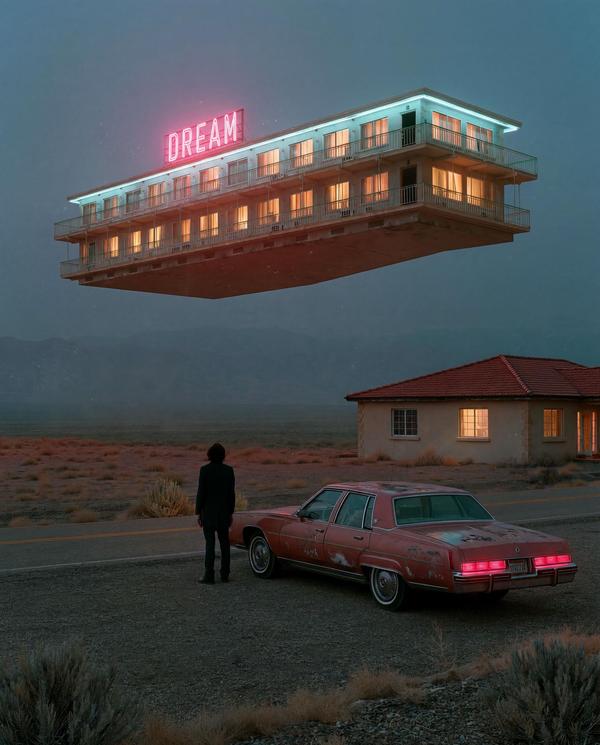
Even the dream is out of your price range.
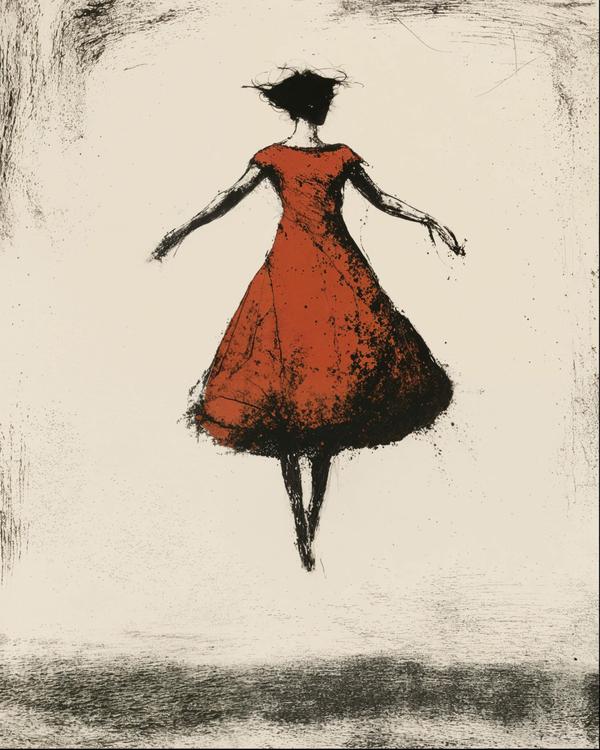
She looks like she left the party by levitating out of a bad conversation.
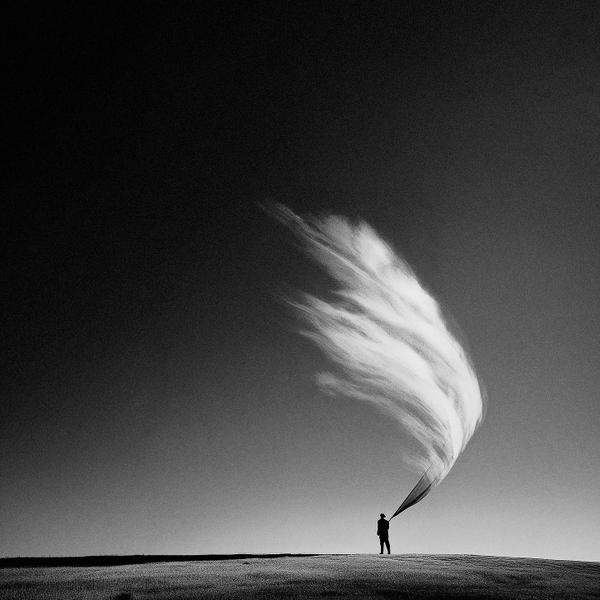
A simple assignment: make the invisible visible.
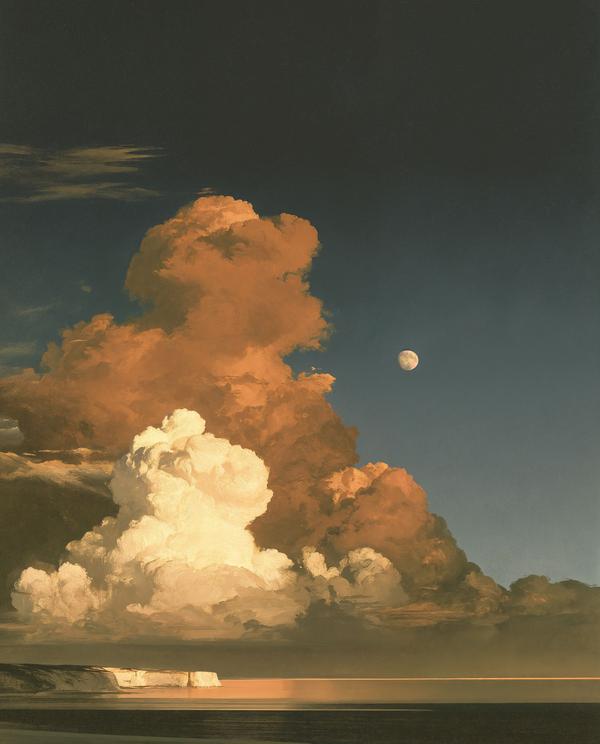
Imagine showing up for your big scene and discovering the clouds got all the lines.
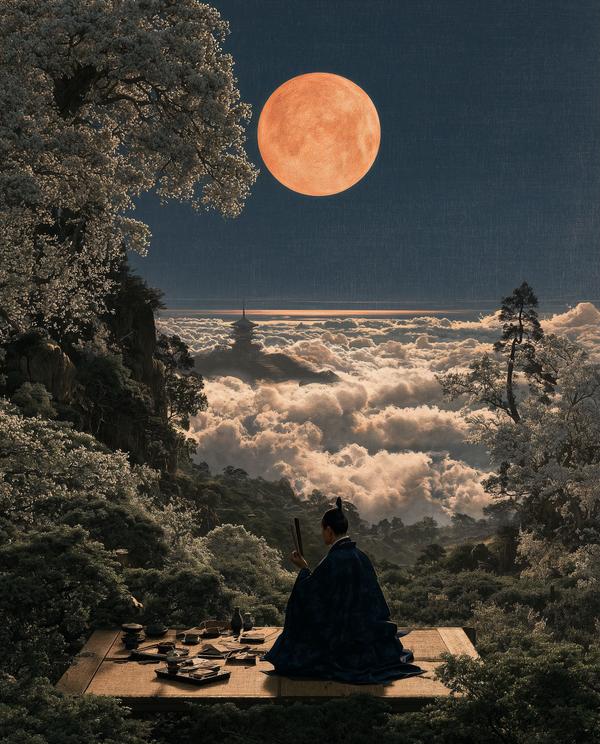
Some meetings could’ve been an email. This one apparently required a moon the size of a small country.
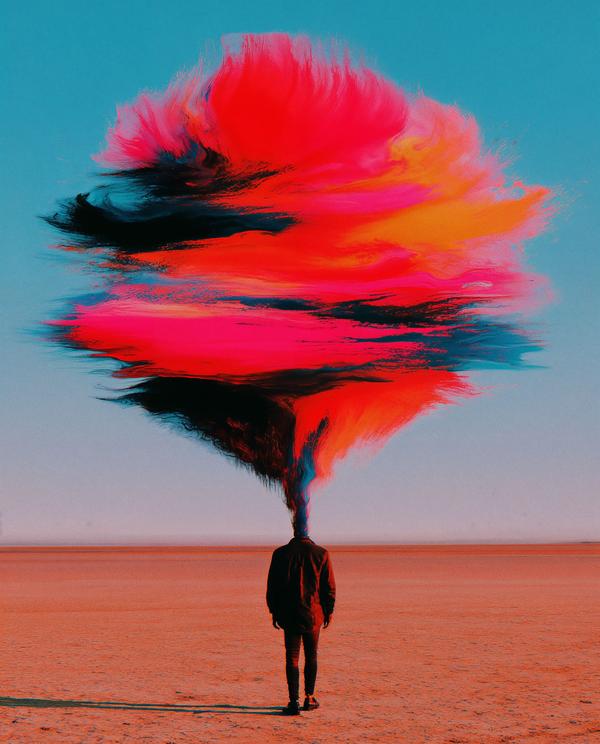
Imagine if every thought you were trying to keep to yourself suddenly required its own airspace.
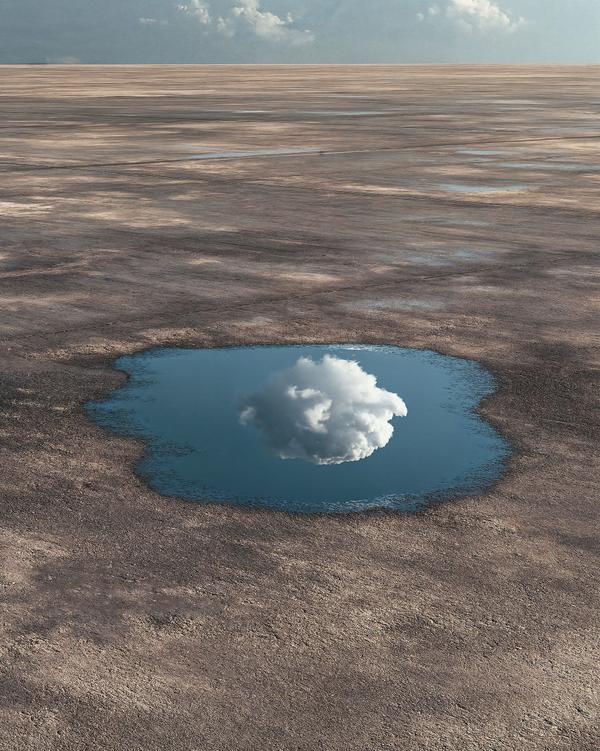
Some clouds drift majestically across the heavens. This one called an Uber and ended up in a parking lot.
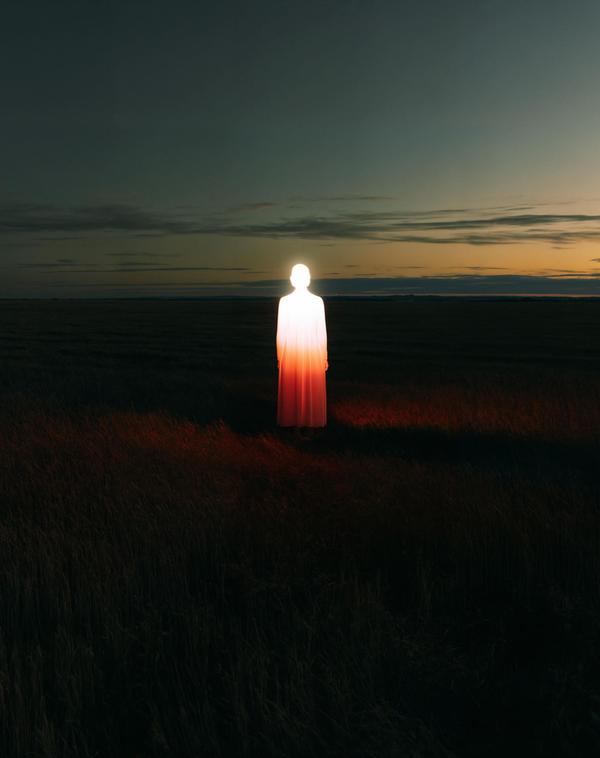
Well. That’s one way to make an entrance.

Somebody brought a feather boa to a firefight.
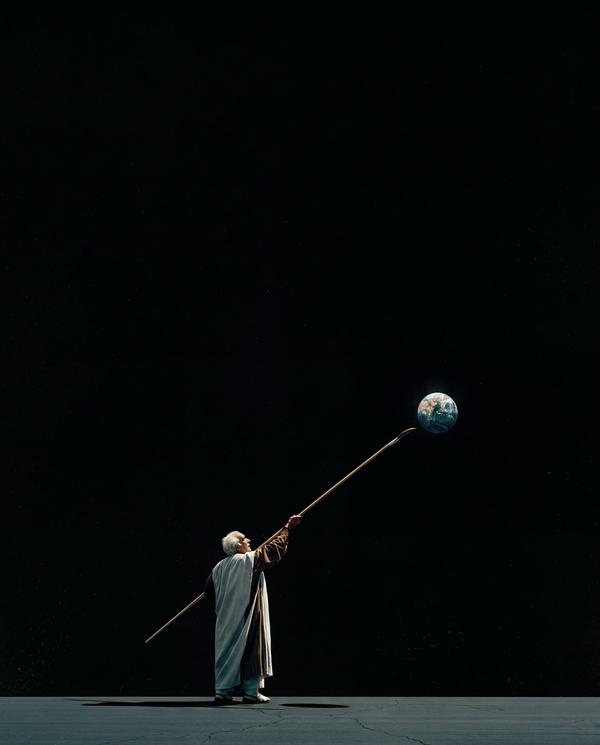
Apparently Earth needed a little freshening up.
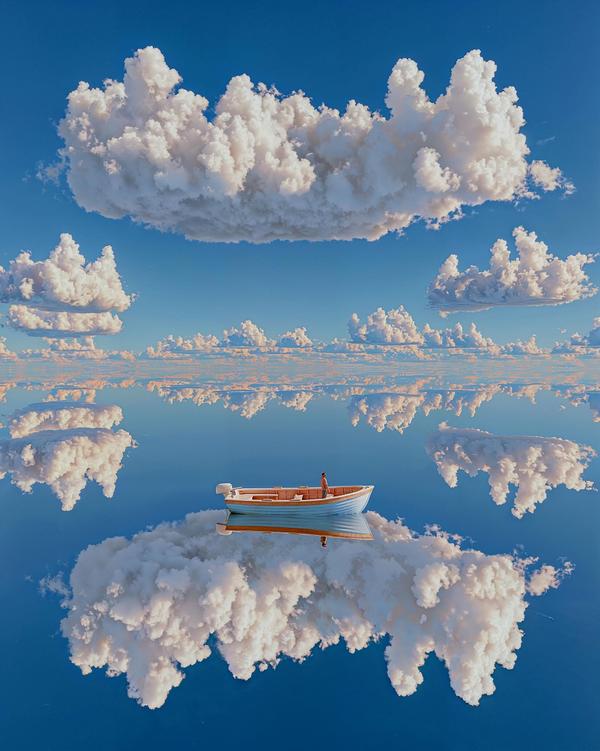
This is what happens when your vacation outgrows geography.
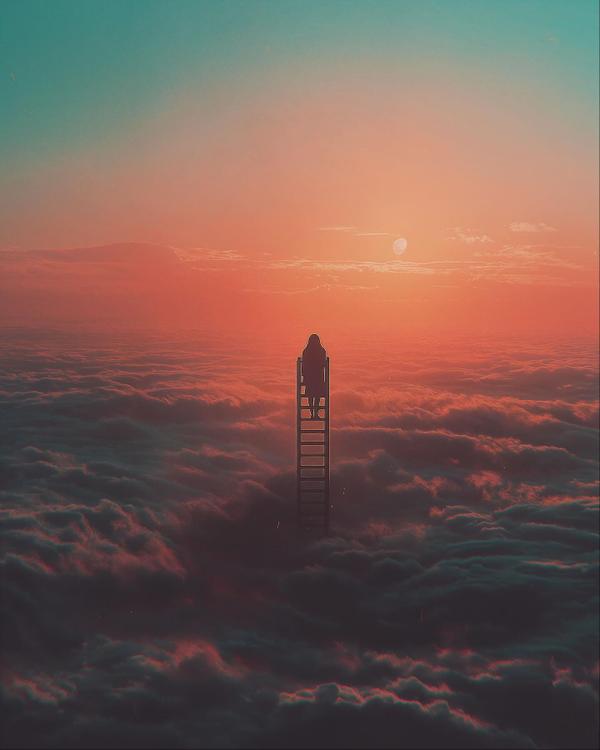
Like if the sky needed repairs and only one lonely ladder showed up for the job.
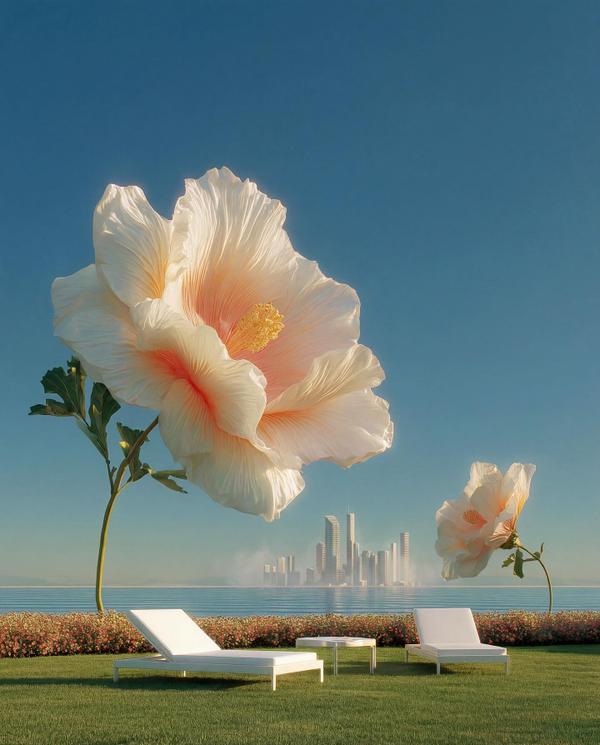
Like if a luxury resort got gently upstaged by two hibiscus flowers and just had to accept its fate.
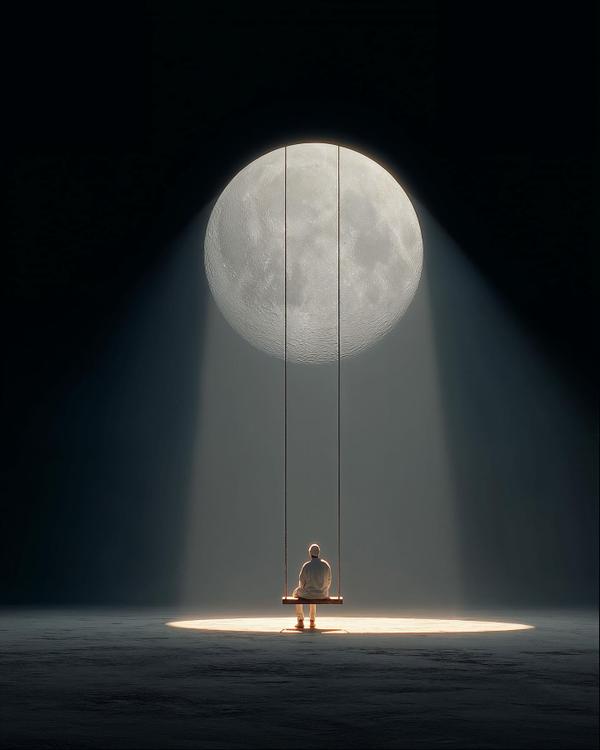
To celebrate the Artemis II moon mission—humanity’s bold new lap around our nearest celestial neighbor—this image feels less like a picture and more like a quiet standing ovation for wonder. NASA says Artemis II launched April 1, 2026, as its first crewed lunar flyby in more than 50 years.
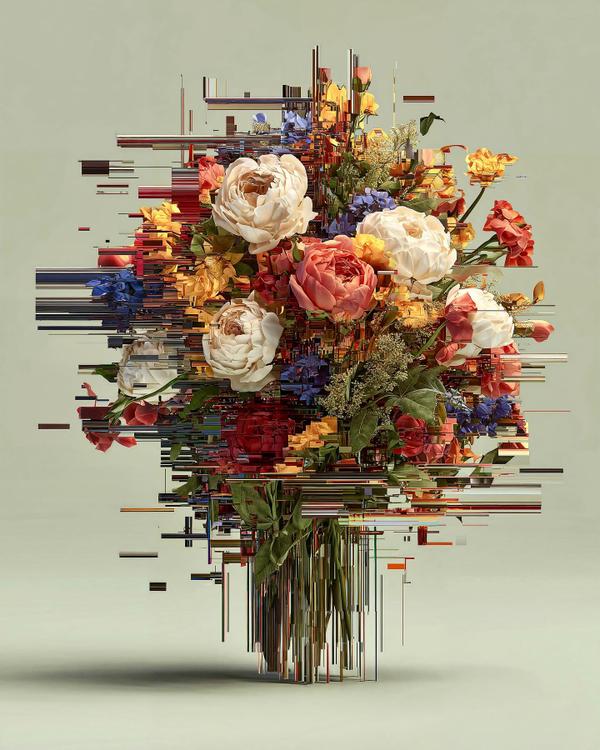
Like if a Dutch flower painting hit a Wi-Fi dead zone and decided to make it everyone’s problem.
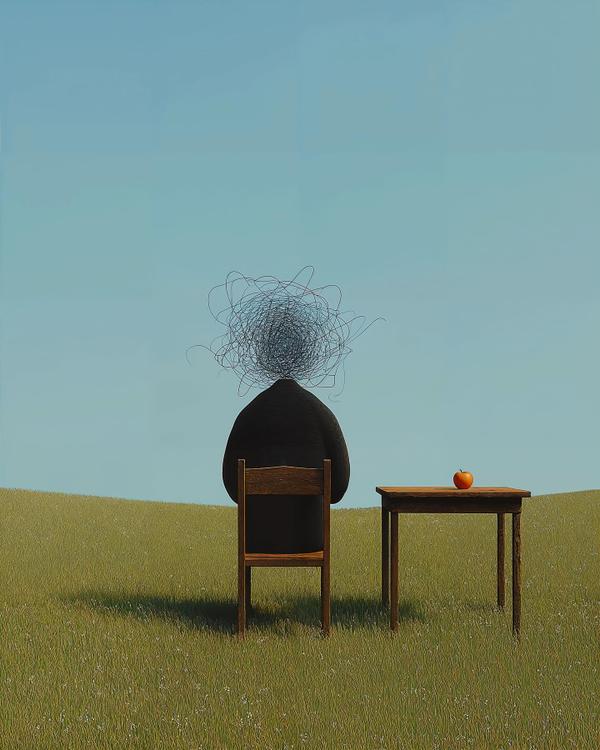
This one is funny for about two seconds, and then it starts feeling a little personal. A lone figure sits in an open field, back turned, posture calm, while their head has become a frantic ball of scribbled pencil lines—part storm cloud, part doodle, part “nothing to worry about” from someone clearly worrying about everything. Next to them, on a plain wooden table, sits a single red apple, doing its best despite being hilariously underqualified.
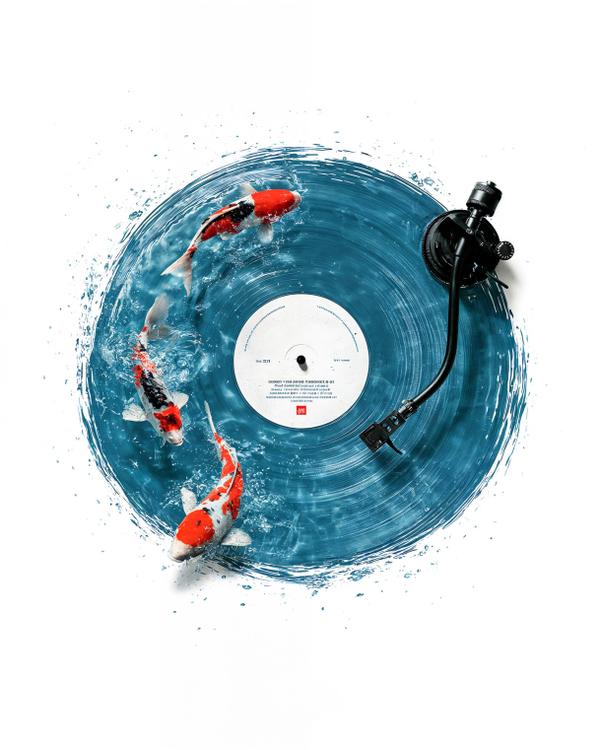
This is what happens when a record player dreams in water.
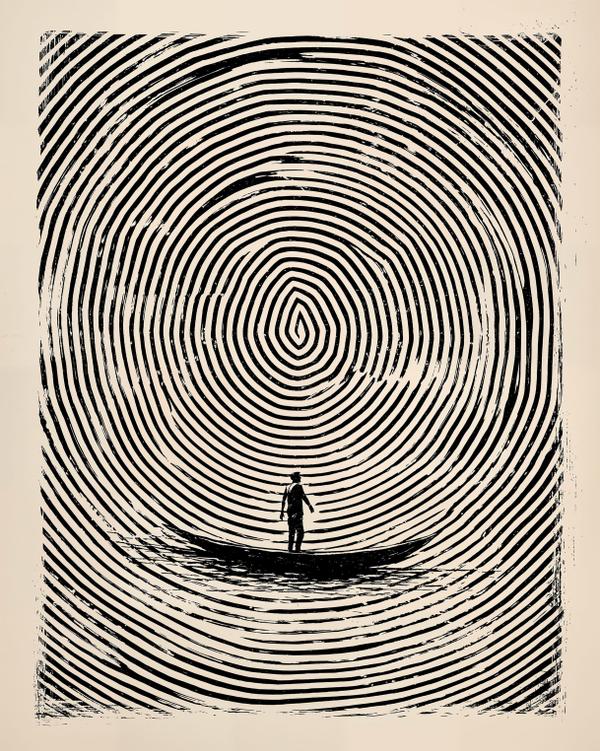
This image looks like someone asked a fingerprint where it sees itself in five years.
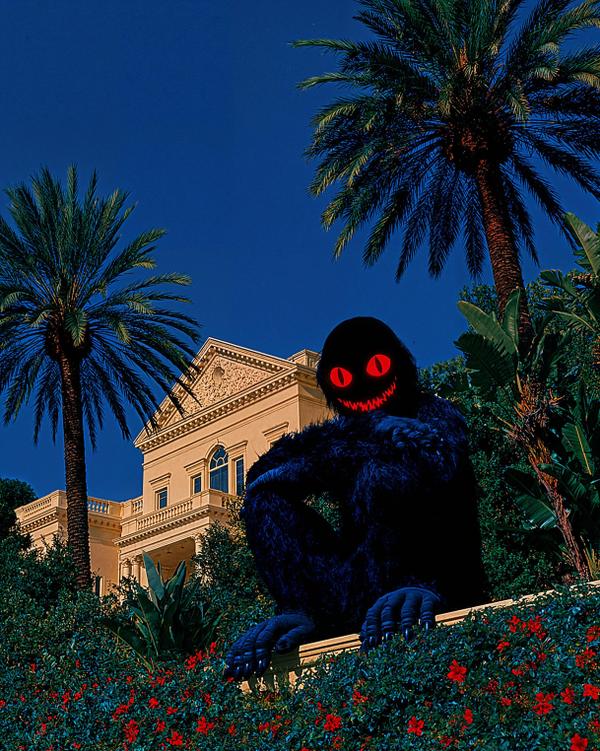
Nothing ruins a nice estate quite like a demon with excellent posture.
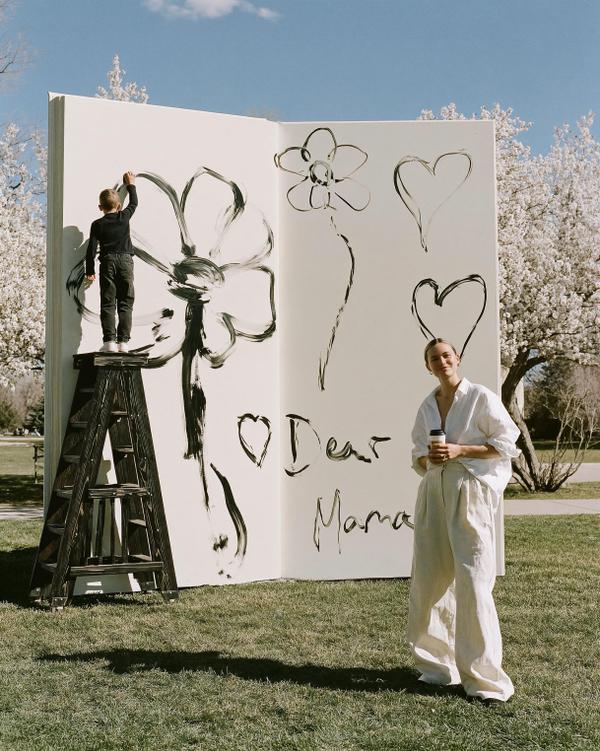
A giant open book. A child on a ladder. A flower so large it may need its own ZIP code.
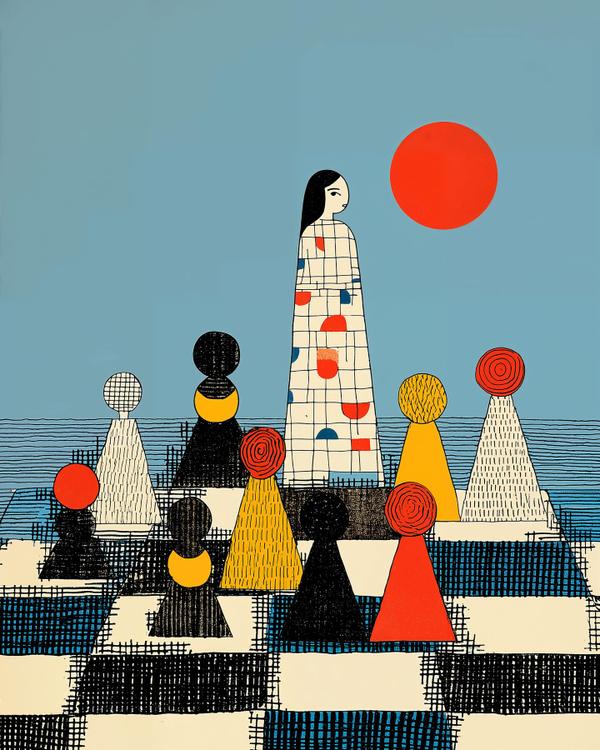
Like if a chess set hired a Scandinavian designer and then got existential at sunset.
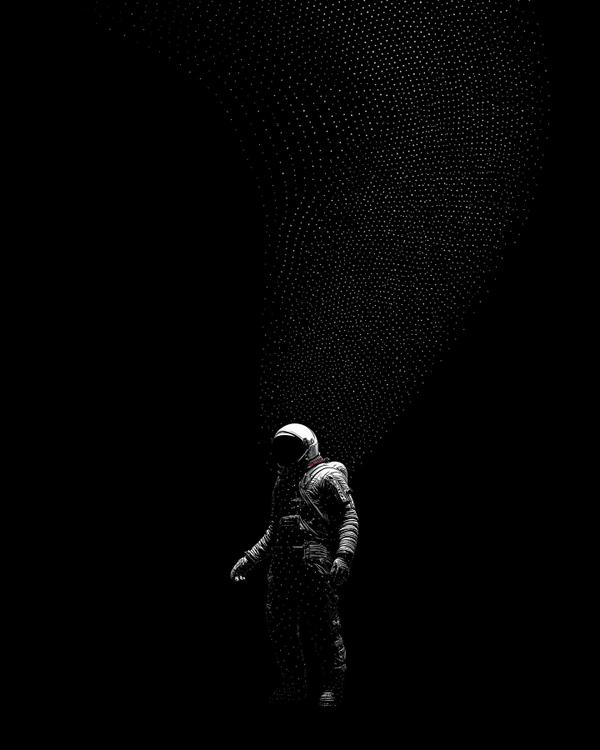
Like if solitude put on a space suit and went looking for answers.
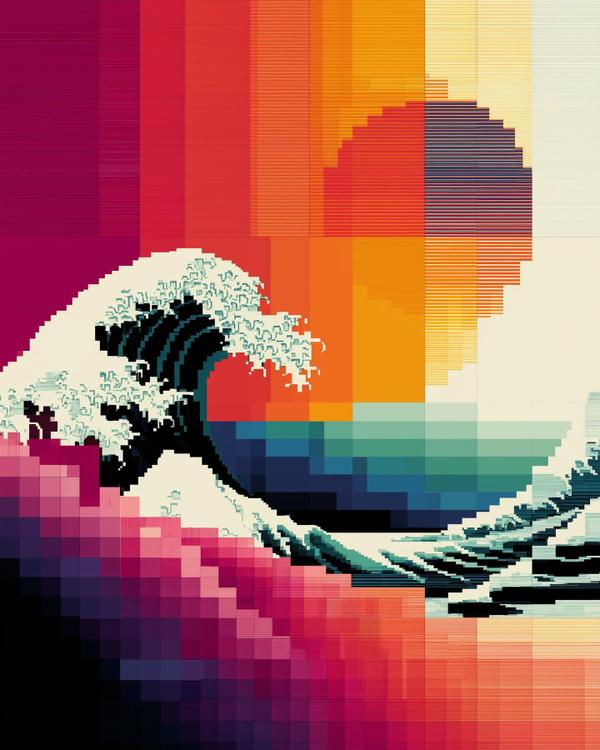
Like if Hokusai got a graphics card and a little too much confidence.
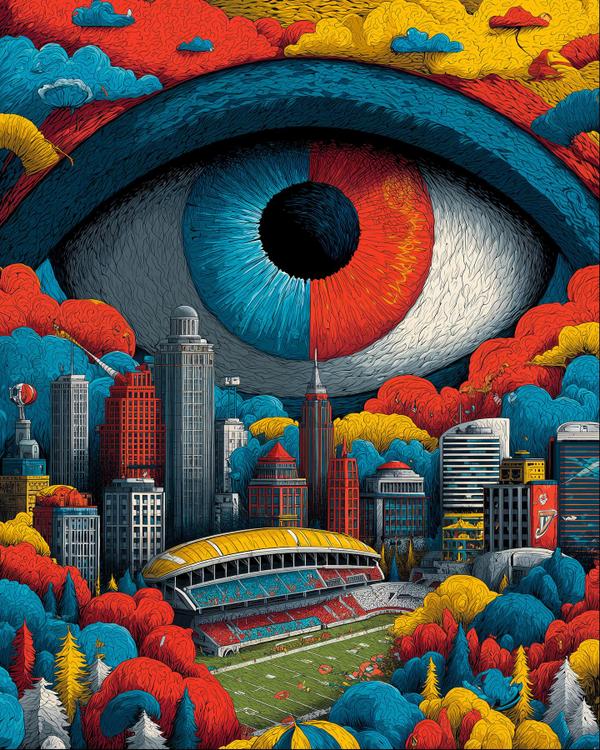
A colossal split-color iris hanging in the sky like a scoreboard for the gods. Cotton-candy storm clouds in red, blue, and gold, packed in like a parade float. And a stadium tucked beneath the skyline, tiny on purpose, like the city is holding its breath before the snap.
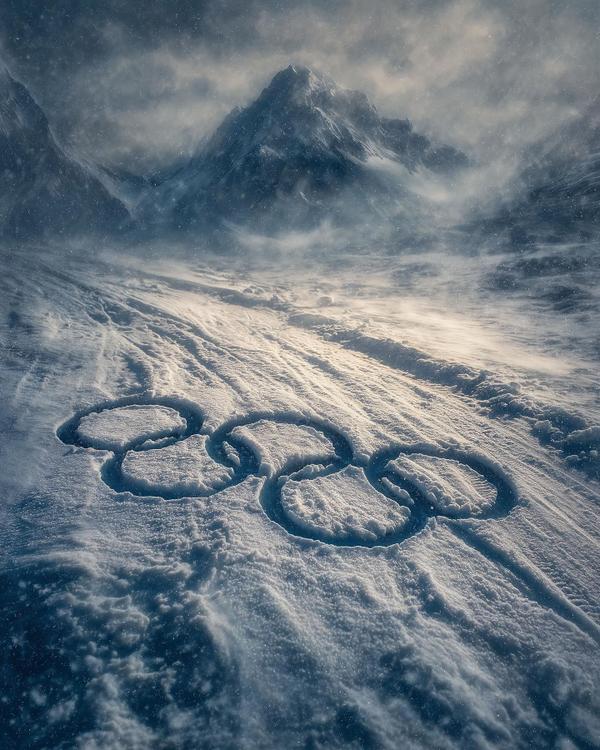
Blue-gray mountains swallowing the horizon. A blizzard of white specks like TV static. And five Olympic rings carved straight into the snow, crisp as a signature.
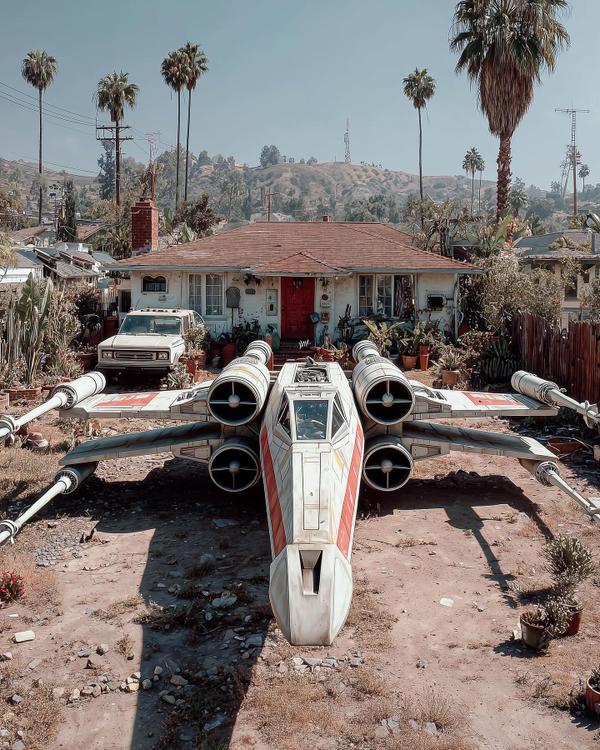
Sun-bleached white metal. Racing-red stripes. A cracked, dusty driveway with weeds doing their best. And right behind it all? A modest little house with a fire-engine red front door, flanked by potted plants like they’re trying to look unbothered.
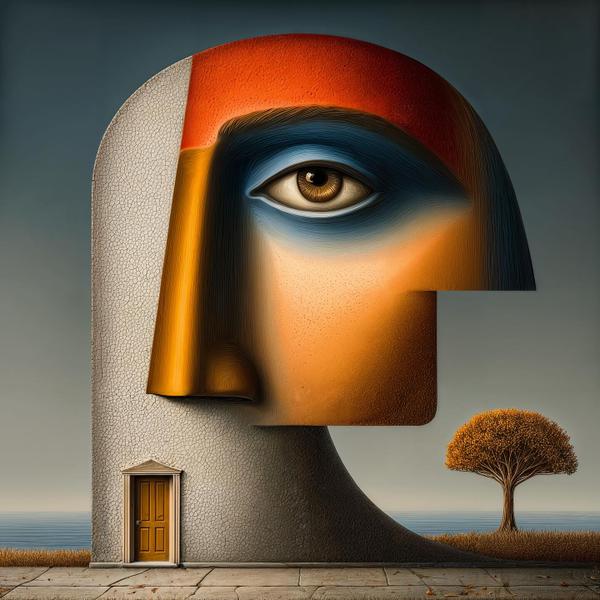
A burnt-orange crown. A single amber eye set in a bruise-blue socket. And a tiny mustard door, politely pretending it’s not the entrance to your entire psyche.
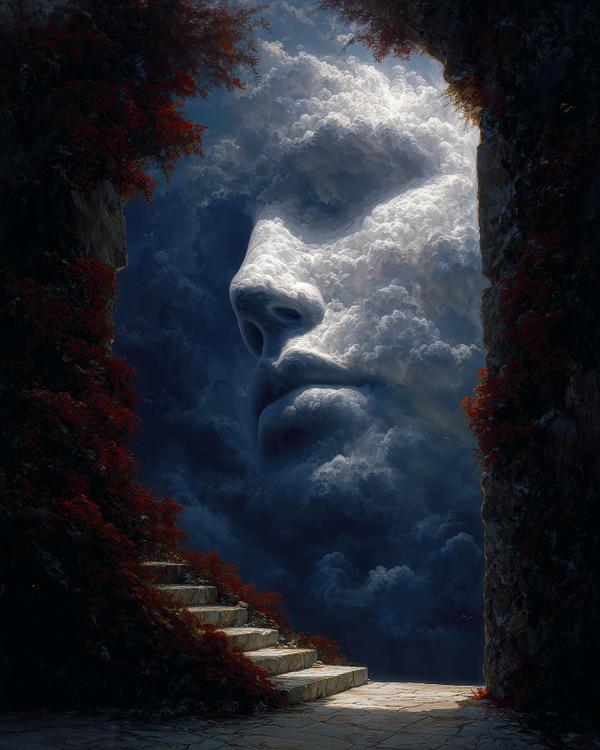
A canyon doorway draped in red leaves. Stone steps that feel like an invitation. And a human face built entirely out of storm-blue clouds, nose and lips shaped by light.

A full winter moon glowing like a lamp, blue mountains fading into mist, and Santa’s sleigh cut out in silhouette above a sea of clouds. Twist: the “stars” are actually the town below, twinkling like a blanket of candles.
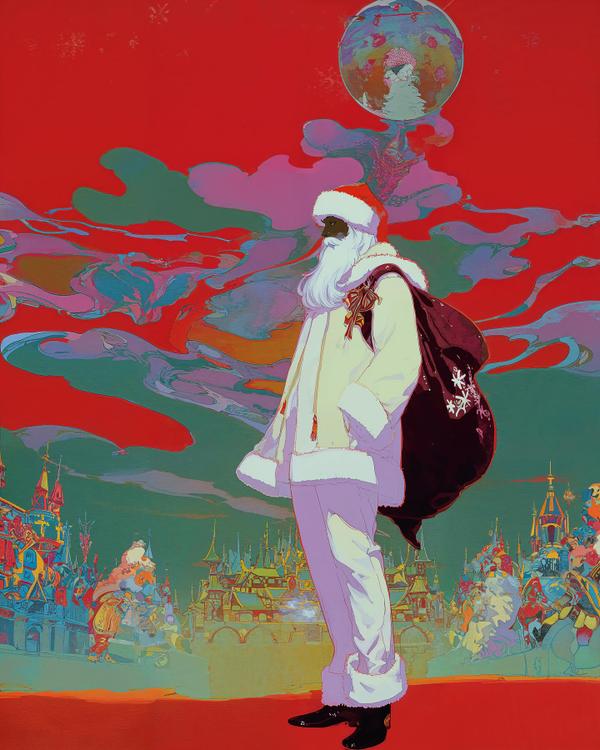
A lipstick-red sky with faint snowflakes. Cotton-candy clouds in teal and mauve. A white-suited Santa carrying a black sack stamped with a snowflake. The twist? He’s strolling past a whole fantasy city like it’s just another Tuesday shift.
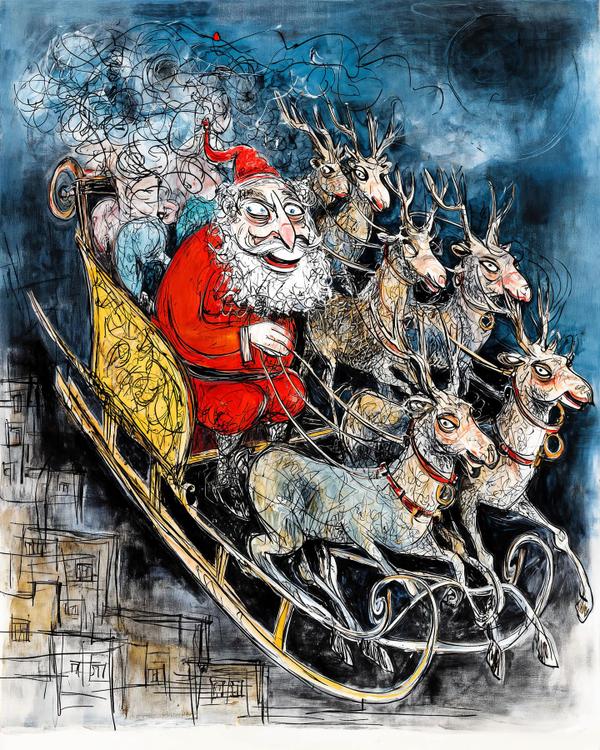
Three things you might’ve missed: the spaghetti-smoke scribbles behind the sleigh, the reindeer’s side-eye (every single one), and that sketchy city grid dropping away below. Now here’s the weird part: it’s not cozy. It’s Chagall-at-100mph.
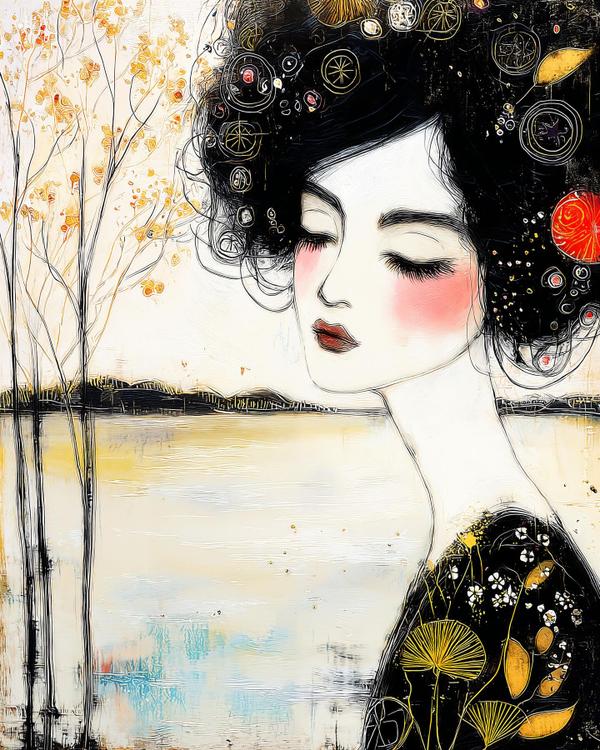
Inky black curls peppered with little gold “compass” wheels. One ember-red rose glowing like a signal flare. Skin so pale it reads like porcelain under soft, museum light.
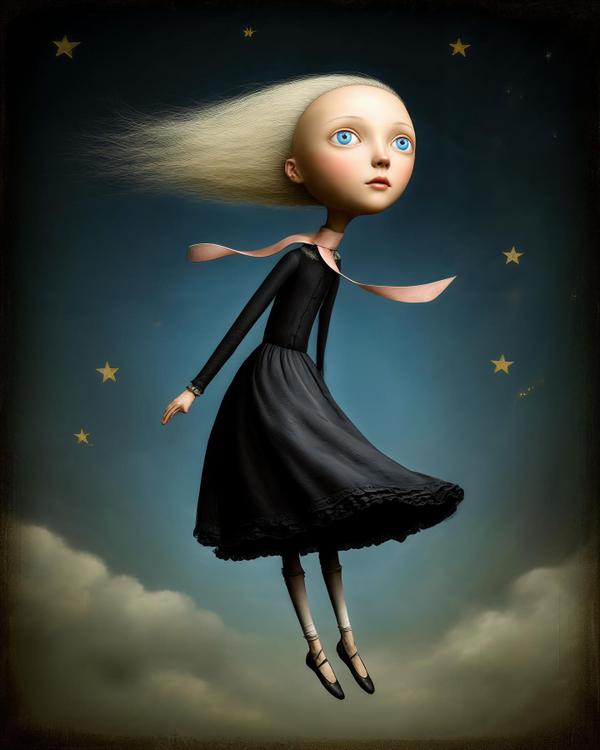
A bald little moon-head with electric blue eyes. Hair blown straight back like a comet tail. A pink ribbon scarf doing figure-eights in midair while gold stars just… hang there.
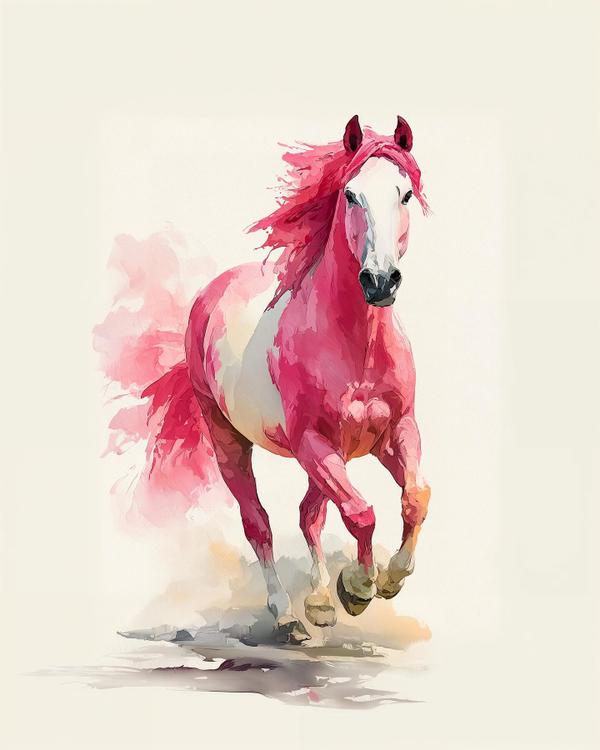
This is what happens when a racehorse runs straight through a cotton candy machine and doesn’t slow down.
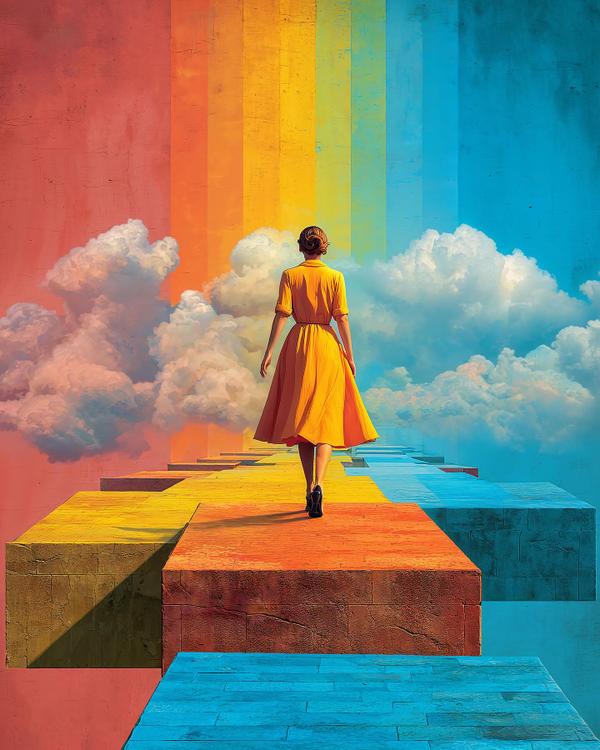
Ever feel like your to-do list is so long you might as well start walking into the sky?
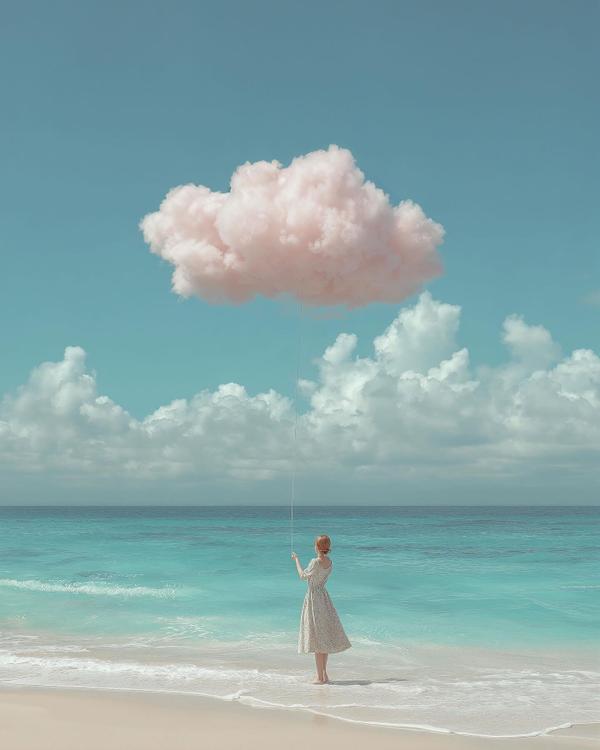
Some people bring snacks to the beach. She brought weather.

Ever seen a cloud so poetic it could flirt back? This one’s basically the sky’s love letter—signed in vapor, sealed with sunlight. A heart-shaped cloud floating against an evening sky? That’s not weather; that’s emotional architecture.
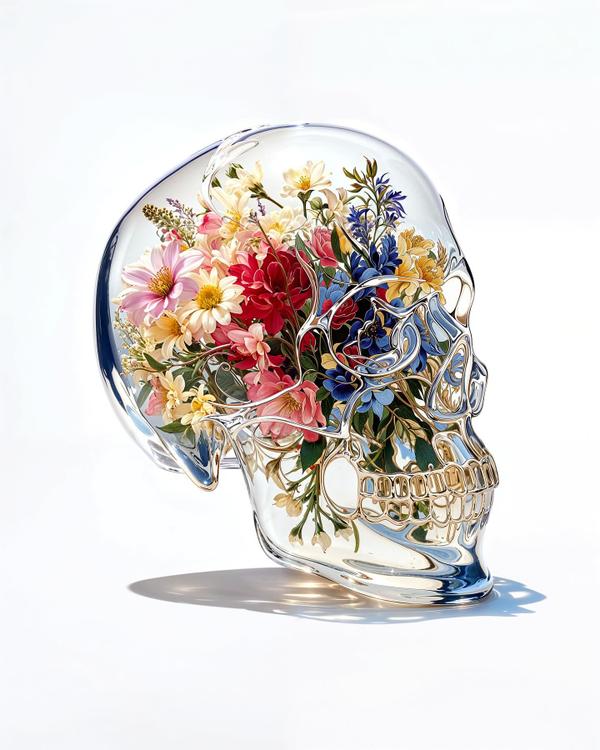
This piece looks like Damien Hirst finally embraced spring cleaning and traded formaldehyde for flower food.
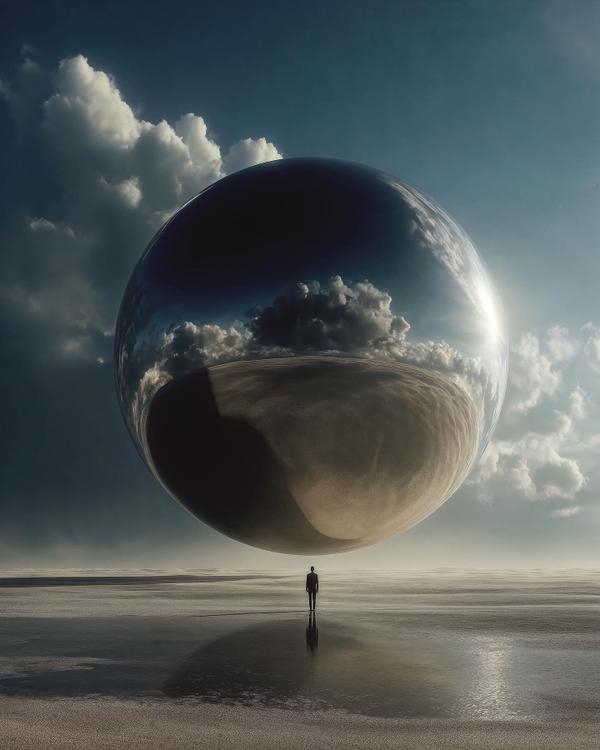
Imagine walking across an endless desert—your throat dry, your shoes caked with dust—and suddenly, you bump into this: a massive mirrored sphere floating like a planet that forgot it was supposed to stay in orbit. One lone figure stands beneath it, looking like they just stumbled into a Denis Villeneuve director’s cut of Dune. This work is pure sci-fi sublime. The desert setting instantly evokes Arrakis, but instead of sandworms, we get a surreal, godlike orb that doubles as a cosmic mirror. The reflection of clouds bending across its curve calls back to Anish Kapoor’s Cloud Gate (aka “The Bean”), except instead of selfies in Chicago, it’s existential dread in the outer rim. Art-historically, you can feel the DNA of René Magritte’s surrealism—the way he’d drop impossible objects into everyday skies just to mess with your sense of logic. There’s also a dose of James Turrell’s skyspaces, where perception itself becomes the subject. Add a pinch of minimalist monumentality à la Donald Judd, and you’ve got sci-fi sculpture with philosophical swagger. What makes it powerful? Scale. That tiny human reminds you that in the face of technology, nature, or intergalactic destiny, we’re… really, really small. It’s the same trick Kubrick pulled in 2001: A Space Odyssey with the black monolith—reduce humanity to an ant in the shadow of the infinite. Fun fact you’ll want to drop at dinner: Frank Herbert, the author of Dune, was inspired by real-world ecological studies of sand dunes in Oregon. So the “desert planet” wasn’t pulled from thin air—it was an actual scientific obsession that morphed into a myth. So, is this art or a recruitment poster for the Bene Gesserit? Either way, it’s gorgeous, it’s eerie, and it whispers: the spice must flow.
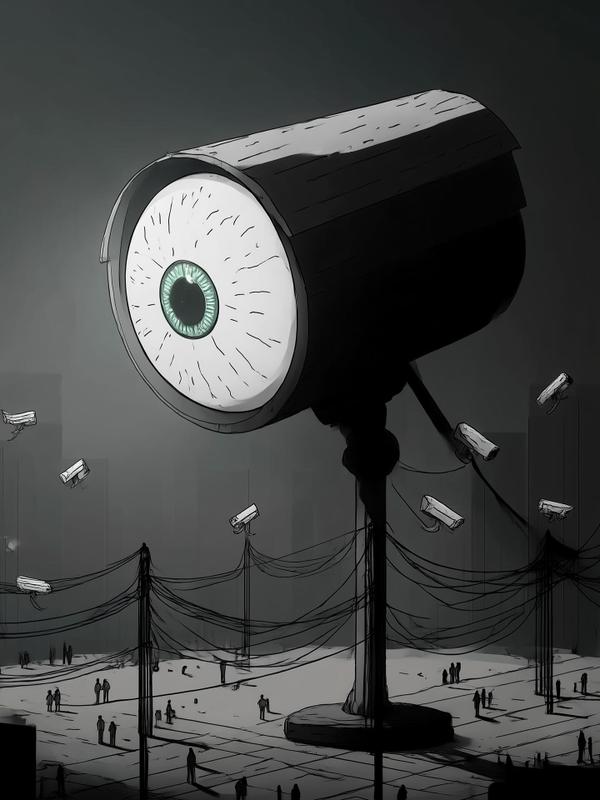
Imagine if Orwell’s 1984 binge-watched Black Mirror and decided to get a hardware upgrade. That’s what we’ve got here—a giant CCTV camera with an unblinking human eye, looming over a gray city like it skipped leg day but maxed out on paranoia. Smaller cameras buzz around like obedient metal gnats, and every shadowed figure below looks like they just Googled something they shouldn’t have. Visually, this feels like a mashup of George Grosz’s biting social critique, the moody dystopia of Zdzisław Beksiński, and the graphic starkness of comic-book noir artists like Frank Miller. The palette’s desaturated—cold, oppressive—because color would almost feel… too free. And here’s where art meets reality: In 2025, an independent audit found the FBI misused surveillance databases 278,000 times to query data on American citizens, including political donors and protestors. The NSA’s PRISM program? Still vacuuming up phone and internet records—yes, even yours—without a warrant. Legally, agencies are supposed to follow strict protocols. In practice? Think more “Ask forgiveness, not permission.” Fun fact you won’t find in a museum brochure: London is the most surveilled city outside of China—over 600,000 cameras. That’s one lens for every 14 residents. This piece isn’t just about being watched—it’s about being known in ways you never consented to. And that eye? It doesn’t blink. It doesn’t sleep. It just… records. Lesson: In art, scale amplifies emotion. By making the camera monumental, the piece taps into the same psychological trick used in propaganda art—size equals power, and power equals control. So next time you pass under a camera, give it a little wave. Just know—it’s waving back. Why This Should Freak You Out Imagine a world where your medical records, income, immigration status, or protest participation are all in one digital fortress—accessible by a private billionaire or political operator with no warrants required. That’s not science fiction anymore. It’s right here.
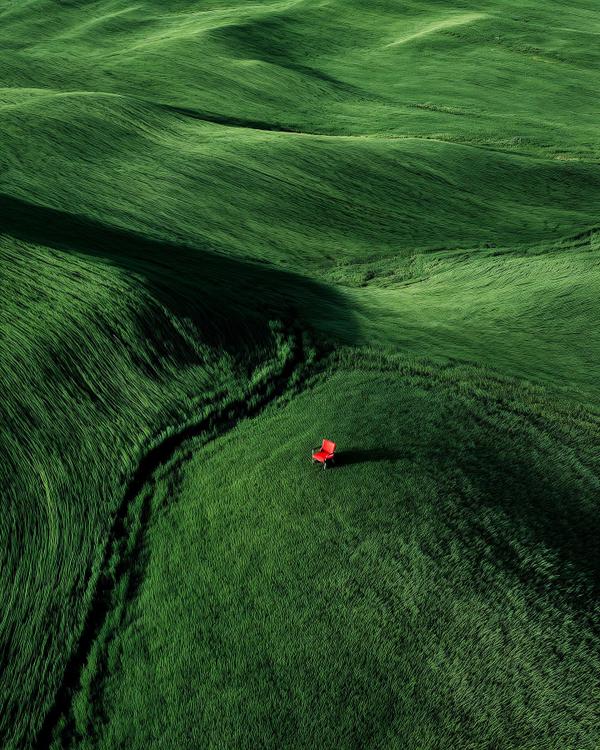
Ever wonder what happens when your comfy chair rage-quits city life? It packs its mid-century legs, hikes into the countryside, and claims its emotional-support hill. No Wi-Fi. No notifications. Just pure chlorophyll serenity. This piece lounges between Surrealism and Conceptual Minimalism — where René Magritte meets Andreas Gursky. The composition flips the usual hierarchy: instead of landscape as background, the land is the main character, and the lone red chair is a punchline whispered in color. That crimson-on-green clash? Straight from color theory’s complementary wheel of chaos. Red and green are opposites, so when they meet, sparks fly — like your eyes after staring too long at your phone. It’s visual tension disguised as peace. The smooth, wave-like grass almost feels painted — echoing Hiroshi Sugimoto’s Zen seascapes or David Hockney’s hyper-lush hills. But the real genius is restraint: one chair, one world, infinite quiet. Fun fact: Our brains process red faster than any other hue. That’s why it’s used for stop signs, fire trucks, and… apparently, existential furniture. So here’s the lesson hiding in plain sight: you don’t have to move mountains to find calm. Sometimes you just need to place a bright red reminder that stillness is allowed.
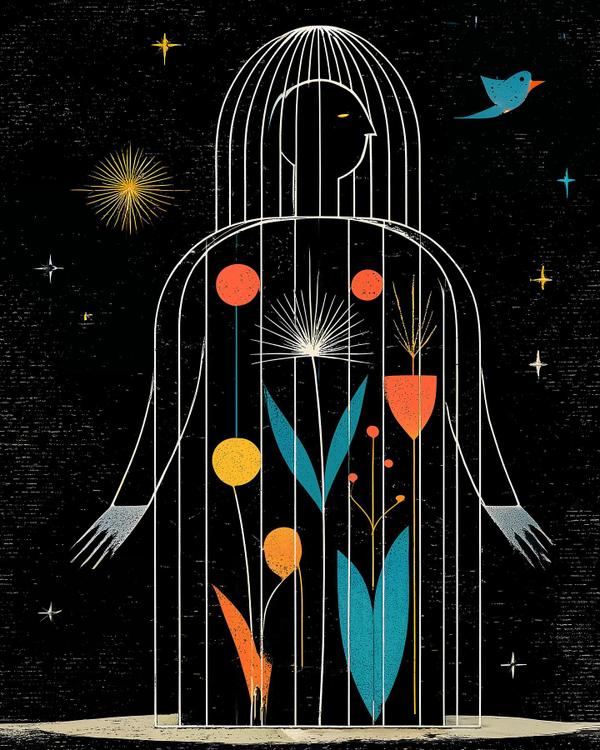
This piece takes the human silhouette, wraps it in cage bars, and fills it not with bones but with wildflowers and starlight. It’s giving Paul Klee meets Saul Bass—a mix of mystical symbolism and sleek mid-century poster vibes. The flat planes of color, the off-kilter geometry, the punchy orange and teal? Straight out of the Modernist graphic design playbook. The cage-as-body metaphor, though—that’s pure Surrealism’s moody cousin. Why it works: the bars are confining, but the plants inside are growing tall, stretching toward the stars like they didn’t get the memo about being trapped. And then, floating in the cosmic black, there’s one tiny blue bird flying free—because of course there is. It’s the visual equivalent of your friend telling you to “just manifest freedom” while you’re stuck on hold with Comcast. Influences: * Paul Klee (playful mysticism + spiritual geometry) * Saul Bass (bold poster design, limited palettes, cosmic simplicity) * Joan Miró (that sense of childlike space-meets-symbol magic) * Plus a sprinkle of Surrealist allegory à la Magritte (the cage isn’t a cage, it’s you). Fun fact you’ll want to repeat: In the 1950s, psychologists actually used art therapy with cage imagery to explore people’s feelings of freedom vs. constraint. Basically, if you drew a cage with a bird inside, you were stressed. If you drew one open with a bird outside, you were thriving. This image? It’s both—trapped but blooming. So yeah, next time someone asks “How are you?”—just send them this picture.
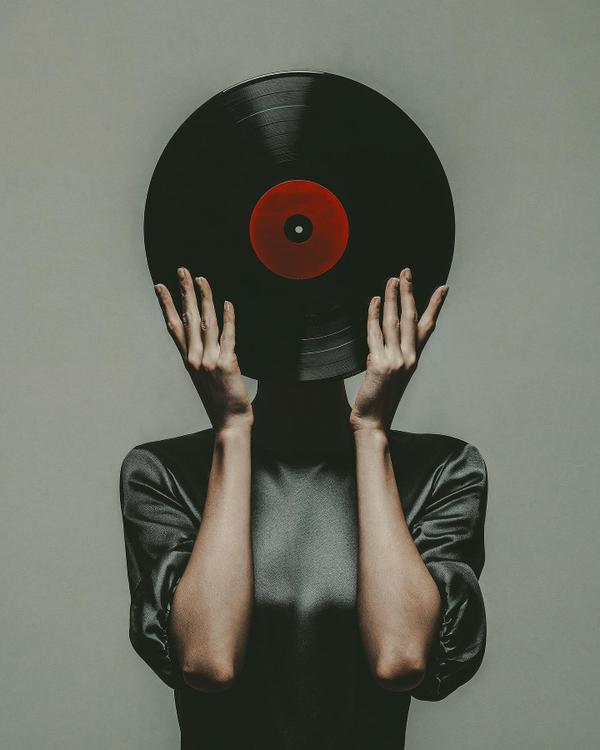
Ever wonder what happens when your Spotify algorithm eats your face? Here it is. A body in satin sleeves, but where the head should be—bam, a vinyl record. It’s bold, absurd, and perfectly deadpan. Think of it as identity remixed: are you what you look like, or what you listen to? The aesthetic is sharp, high-contrast minimalism—just a figure, a disc, and a muted backdrop. It feels like a lost photograph from the 1930s avant-garde, when artists were obsessed with swapping out body parts for objects. The vibe: Man Ray had a baby with Vogue Italia. Art Influences This is pure Dada spirit—nonsense elevated to the profound. Artists like Man Ray and Hannah Höch loved mixing the human form with found objects, poking fun at modern life while making us rethink reality. Fast-forward to today, and you’ll see echoes in contemporary conceptual portraitists like Erwin Wurm (known for his “One Minute Sculptures” that turn people into objects) and even Cindy Sherman’s playful disguises. Fun Fact You’ll Want to Repeat The word “album” originally meant a blank book for autographs or drawings. When records started being sold in bound sets, they borrowed the name. So every vinyl record you’ve ever played is, technically, a kind of “portrait album.” This piece nails that idea: the face is gone, the record stands in, and suddenly you’re looking at music as identity—spinning endlessly, track after track.
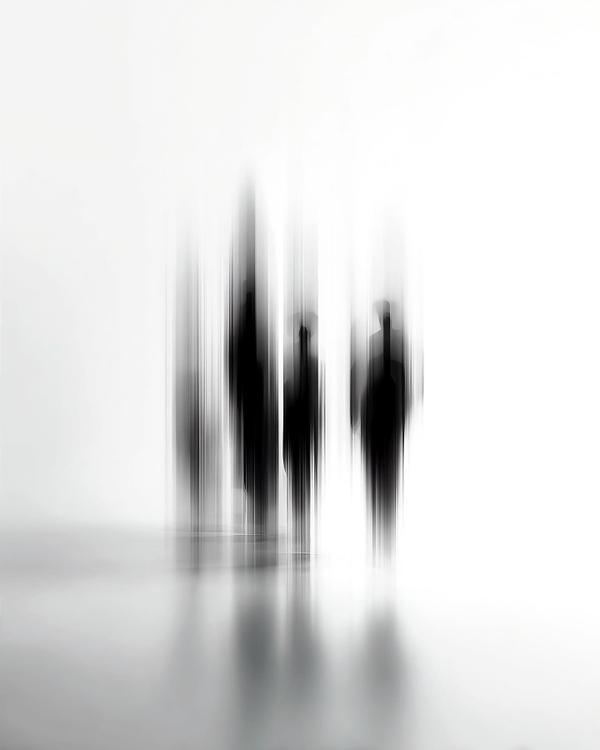
If a group chat tried to manifest IRL, it would look like this—everyone present, nobody fully here. What you’re seeing is motion turned into paint, a monochrome shimmer where figures stretch like taffy and time gets smudged. Stylistically, it’s where Futurism (Giacomo Balla’s love of speed) shakes hands with Gerhard Richter’s blur, high-fives Giacometti’s elongated souls, and nods to photographers like Hiroshi Sugimoto and Alexey Titarenko, who sculpt silence and crowds with time. The trick isn’t filters—it’s duration. A longer “shutter” (or its digital cousin) lets the subject move while the sensor keeps watching. Translation: one frame, many instants. That’s why these people read as echoes instead of portraits. Notice the huge negative space: the bright field isn’t empty; it’s a stage that lets tiny value shifts and ghost-reflections carry the drama. Your brain finishes the forms using Gestalt closure—we see “people” from very little information because we’re wired to connect the dots. Mini lesson: * Motion blur = compressing time into a single image. * Figure/ground: the more breathing room around the subject, the louder the subject feels. * Vertical streaks cue “up/down” movement, adding tension even when the figures barely drift. Fun fact: Movies run ~24 frames per second because of persistence of vision—your visual system stitches still images into motion. Blur taps the same quirk: your eyes love linking moments that never actually overlapped. So, mood check: it’s not loneliness—it’s liminality. That in-between place where you’re leaving one moment and not quite in the next. Hover there for a second. Let the edges soften. The calendar can wait.
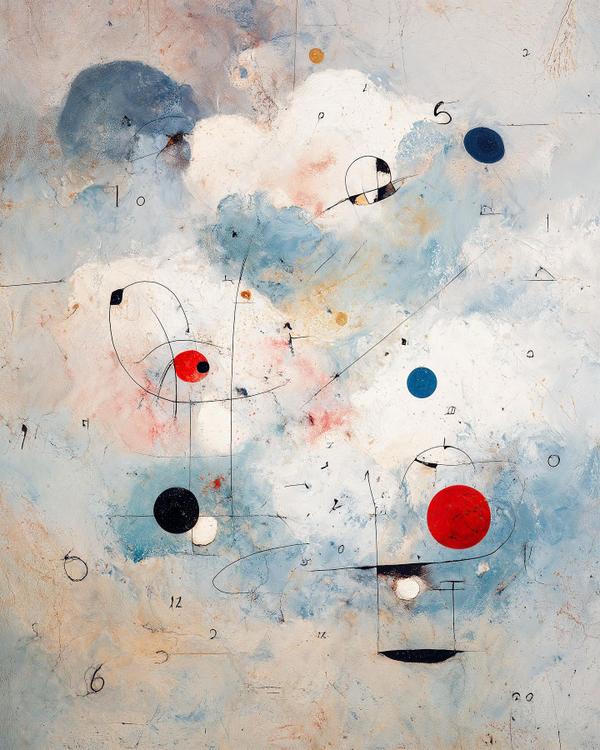
Today’s piece floats in that sweet Miró zone: an airy sky of chalky blues and milky whites, pricked with primary-color planets (those hot red and deep navy disks) and stitched together by hairline, wandering lines. The marks loop, pause, and double back like a curious bird’s flight path—classic Joan Miró grammar: dots, stars, moons, tiny ladders, and signs that feel half-alphabet, half-astronomy. Here’s the trick he taught the 20th century: automatism. Instead of planning every detail, start with stains and smudges, then “discover” forms by following the line. That’s why the composition feels both playful and inevitable—like the picture drew you first. The limited palette (primary pops against soft sky tints) keeps the chaos musical rather than messy; call it biomorphic abstraction—organic shapes behaving like happy microbes in zero gravity. Look closely at the micro-scratches, numbers, and notations. They read like a private star map: not scientific data, but the instructions for how to daydream properly. Fun fact: Miró once said he wanted to “assassinate painting”—wipe out the old rules so something freer could breathe. During WWII he made his intimate “Constellations” series on small sheets he could carry while on the move—tiny universes that fit in a suitcase. Moral: when life feels heavy, give your ideas less gravity. Let the line wander; the cosmos will meet it halfway.
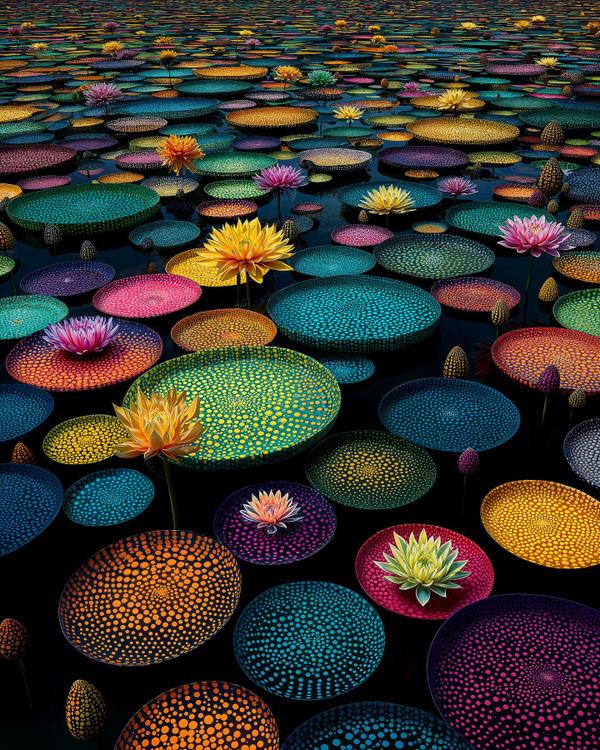
This piece is basically Impressionism on psychedelics. You’ve got the bones of Monet’s Water Lilies — that dreamy pond landscape — but reimagined through Kusama’s lens of infinite dots, patterns, and colors so bold they practically shout “your retinas belong to me now.” Kusama has long been obsessed with repetition and infinity — polka dots, mirrored rooms, endless fields of pumpkins. She calls it self-obliteration, the idea that through immersion in patterns, you dissolve into the universe. Here, the lily pads don’t just float, they radiate like cosmic mandalas, turning the pond into a galaxy of color. Notice how the dots aren’t random — they ripple out in gradients, mimicking natural light and water distortion. It’s a collision of chaos and control, organic forms disciplined into hypnotic order. That’s why your brain keeps zooming in like you’re about to find the “play” button on a trippy music video. Factoid to casually drop at brunch: Yayoi Kusama voluntarily checked herself into a psychiatric hospital in Tokyo, where she still lives and creates today. Her art isn’t just style — it’s survival. She literally paints to keep herself alive. So yes, this pond is pretty. But it’s also a meditation on infinity, the fragility of self, and what happens when art swallows you whole. In other words, it’s Monet reimagined by someone who replaced the French countryside with the inside of their own kaleidoscopic mind.
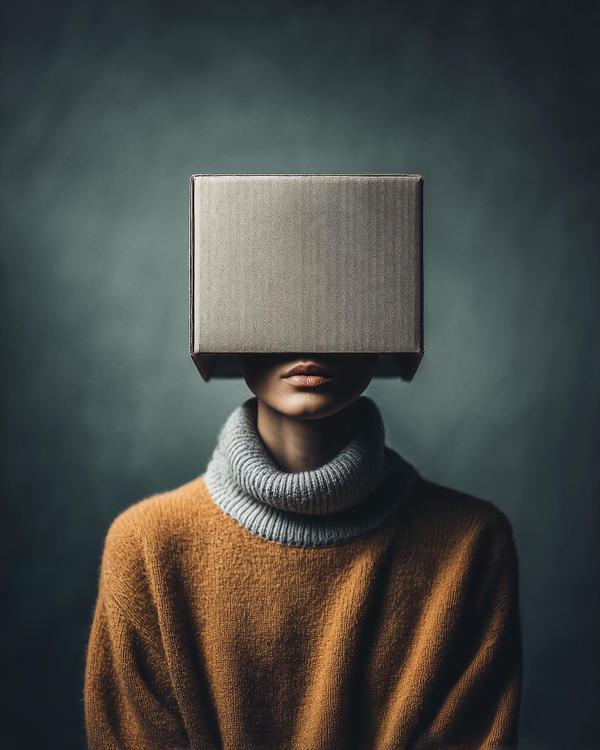
We always hear “think outside the box.” Cute. Inspiring. But this portrait flips the cliché on its head—literally. Here, the subject wears the box like a crown of conformity, a helmet of limitations, or maybe just the world’s least immersive VR headset. Minimalist, moody, and with a punchline you can’t unsee—it’s basically Magritte meets Ikea. Art Style & Influences: The stark lighting and muted tones borrow from Dutch Golden Age portraiture, where shadows were as important as subjects. But the surreal twist—replacing a face with an object—comes straight from the Surrealist tradition. Think René Magritte’s The Son of Man (the apple-face guy) or the conceptual experiments of Man Ray in photography. It’s the kind of image that makes you laugh, then makes you think… then makes you laugh again when you realize the model can’t see a thing. Concept Breakdown: This is conceptual portraiture, a style where props tell the story. The box isn’t just cardboard—it’s a metaphor. Instead of celebrating originality, it’s showing the suffocating weight of conformity, or maybe the comfort of staying inside boundaries. Call it the reverse TED Talk. Fun Facts to Drop in Conversation: * The phrase “thinking outside the box” comes from a 1970s puzzle where you had to connect 9 dots with 4 lines. Spoiler: the only way to solve it was to draw outside the square they formed. * Surrealists weren’t just painters—they were obsessed with objects. Salvador Dalí designed a fully functional lobster-shaped telephone in 1936, proving anything (yes, even seafood) could be art. * In psychology, the “box” is a metaphor for cognitive biases—mental shortcuts that limit creativity. So yeah, this photo is also an accidental psych lecture in a turtleneck.
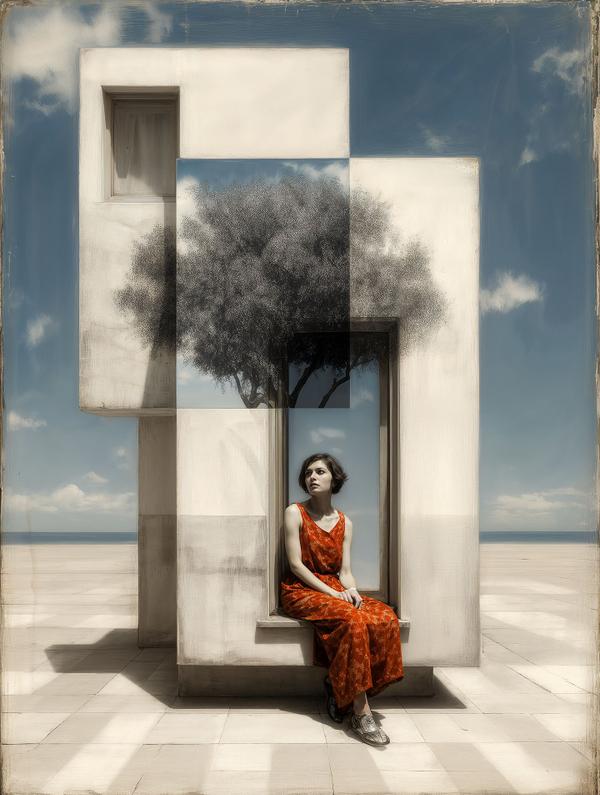
Ah yes, behold—another architectural fever dream where gravity took a coffee break and geometry got artsy. We’ve got a surrealist daydream that feels like René Magritte accidentally binge-watched Minecraft tutorials. The woman in the bold red dress sits inside what looks like a half-finished monument to minimalism—part window, part sculpture, part existential waiting room. Above her? A tree that’s half-there, half-not, like it’s auditioning for a role in Inception. Here’s the fun bit: This style riffs on Surrealism—think Magritte’s impossible juxtapositions (“is that a tree in the wall or the wall in the tree?”) and Giorgio de Chirico’s dreamlike plazas where time feels paused at 3 p.m. forever. But it’s also got a clean, modern edge, like contemporary architectural minimalism smashed into the uncanny calm of hyperrealist digital art. The shadows are crisp, the sky is too perfect, and the whole thing whispers, “Yes, life is confusing, but at least it’s well-composed.” Fun fact you’ll want to drop at brunch: Magritte once painted an entire series of windows where the “view” lined up perfectly with the scene outside—making you question whether you were looking through glass or at a painting. This piece feels like a cheeky nod to that trick, but with a modern twist: it’s Photoshop for the subconscious. The red dress is the wild card here—it cuts through all the beige and blue like a punctuation mark, a reminder that amid all this dream-logic geometry, there’s still a human stuck waiting for… well, something. (Godot? Wi-Fi? Who knows.) So, is this art about isolation, perspective, or just the world’s fanciest bus stop? Doesn’t matter—it caught you trying to figure it out.
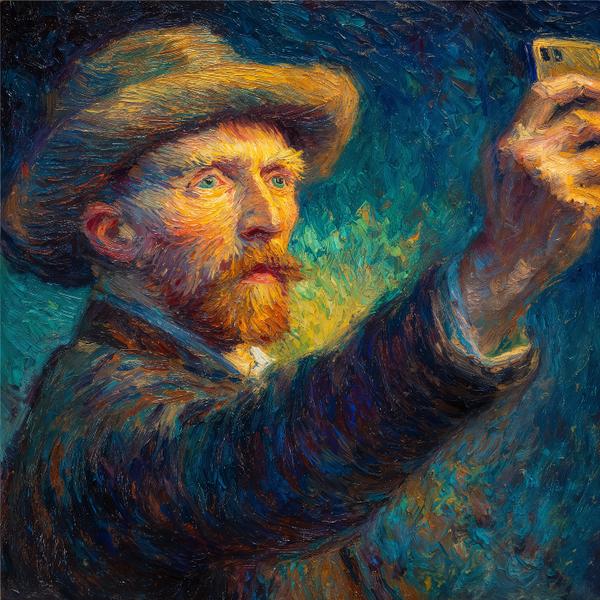
Move over, influencers—Vincent was doing self-portraits before ring lights were cool. But here, our post-Impressionist legend seems to have time-traveled straight into the age of Instagram… and yes, he’s taking a selfie. The swirling brushstrokes, thick impasto, and electric color palette are straight out of Van Gogh’s playbook—think Self-Portrait with a Straw Hat meets Starry Night, but with the added glow of a smartphone screen.
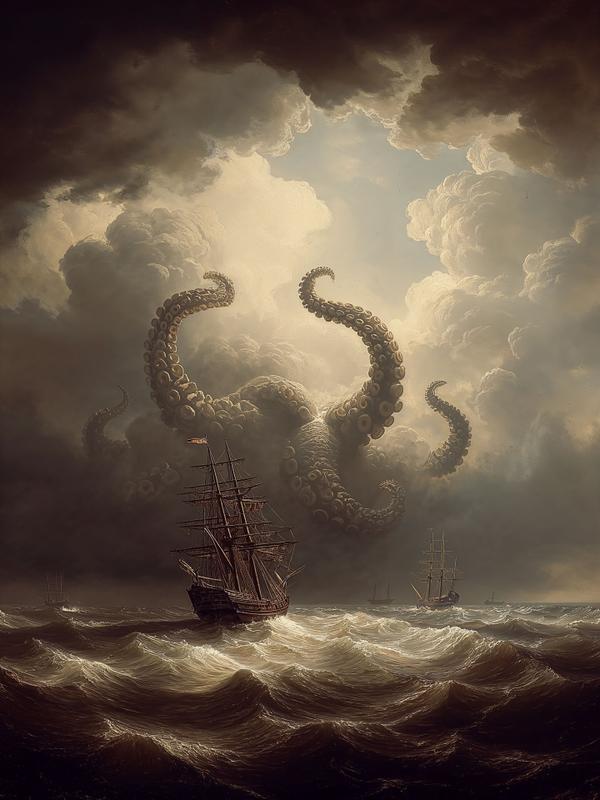
If you’ve ever thought your inbox was overwhelming, imagine sailing into this inbox—eight arms, each the size of a cathedral, answering you all at once. This stormy scene feels like J.M.W. Turner took a painting vacation with Caspar David Friedrich, then let H.P. Lovecraft write the guestbook. The lighting? Pure Romanticism—sunlight punching through clouds like heaven itself wants a better view of the drama. The ships? Classic 18th–19th century merchant vessels, perfect fodder for the ocean’s worst Yelp review: “One star. Got eaten.” The Kraken’s roots? Not just sailor’s gossip. In Norse sagas, this giant sea beast was said to lurk off Norway and Greenland, big enough to be mistaken for an island. Early accounts claimed its tentacles could drag a whole ship under… but the real terror? The whirlpool it created when it dove. (Think: Nature’s blender, set to ‘doom.’) Fun fact you’ll want to drop at a party: In 1782, the Danish bishop Erik Pontoppidan wrote that the Kraken could be “a mile and a half wide.” Another report? An entire Spanish ship vanished without a trace in calm seas—no storm, no distress call, just gone. Cue the monster theories. Why do we love stories like this? Because the ocean is basically space, but wetter—vast, uncharted, and holding secrets we’d rather meet in myth than in person. And honestly, a good sea monster makes reality feel just a little more magical… or at least more exciting than cargo logs.
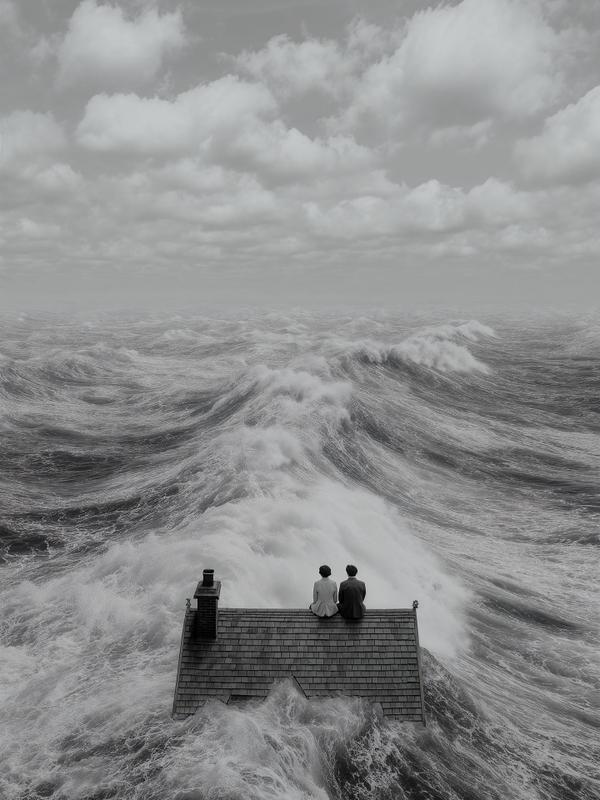
Two figures sit quietly on the peak of a roof, gazing at an endless, raging ocean. The waves swell like living creatures, swallowing the horizon. It’s calm intimacy in the middle of a catastrophe—part surreal dream, part climate warning. This piece carries the eerie, staged precision of Sandy Skoglund, whose photographs turn the ordinary into the uncanny, and the apocalyptic mood of Lars von Trier, whose films often leave you wondering if the world is ending—or already has. Here, the domestic (a roof) is placed in the wildly unnatural (an infinite sea), creating an emotional paradox: safety and danger, love and doom, all in one frame. It’s also a haunting nod to global warming—a literal visualization of rising seas. Right now, the ocean is swallowing about 1.2 inches of coastline every year in places like Louisiana—that’s a football field of land every 100 minutes. In Jakarta, the crisis is so severe the government is moving the entire capital, the largest planned city relocation in history. And the North Atlantic? It just recorded its highest surface temperature in over 1,000 years. Warm water means stronger storms—think “blockbuster disaster movie,” but without the credits rolling when the lights come up. Fun (and terrifying) fact: if all the ice on Earth melted, global sea levels would rise about 230 feet. That’s enough to drown entire cities and redraw the map of the world. The ocean has already absorbed over 90% of the excess heat trapped by greenhouse gases. That’s like putting a pot of water on the stove, never turning the heat down, and waiting for the boil. This image plays with scale and staging in a way that forces us to stop scrolling and sit with the uncomfortable truth: climate change isn’t a far-off plot twist—it’s already in Act II.
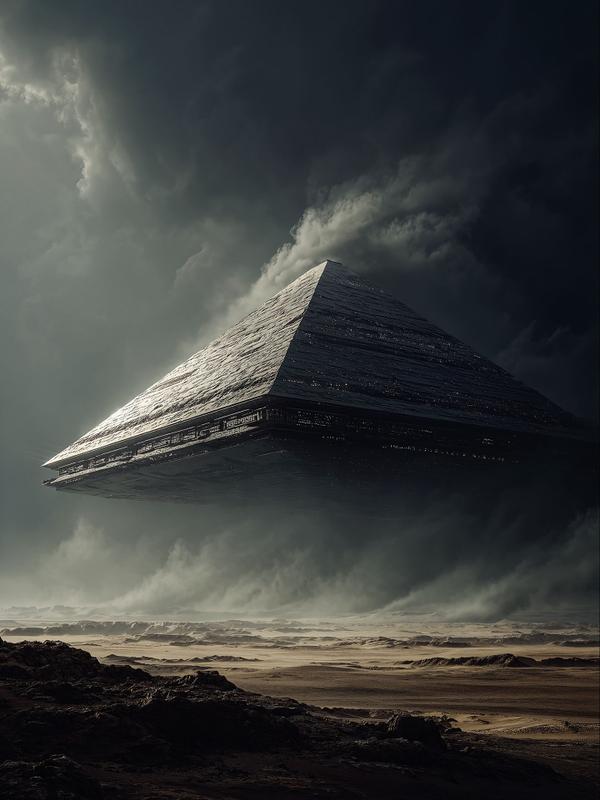
So the ancient aliens finally updated their GPS… and it turns out the Great Pyramid wasn’t just a tomb—it was the parking brake. Imagine this: you’re out in the desert, trying to capture a moody sunset shot, and instead—boom—a pyramid casually detaches from the Earth and floats into a thundercloud like it’s late for a cosmic brunch. This creation dares to answer the age-old conspiracy with a follow-up question: What if the pyramids weren’t built by aliens... but were actually their ships? The pyramid shape isn’t just iconic—it’s timelessly aerodynamic. That symmetrical geometry has fascinated architects, mystics, and now... interstellar engineers? Visually, this piece taps into sci-fi surrealism—blending the mystique of ancient architecture with futuristic scale and atmosphere. It’s moody, mysterious, and just grounded enough to make you wonder: what if? Fun Pyramid Facts to Drop at Brunch: * The Great Pyramid of Giza was once covered in white polished limestone that reflected the sun so intensely, it was said to shine like a “gem.” Basically, ancient Egypt’s version of a solar-powered disco ball. * It’s aligned almost perfectly with true north—with less than 1/15th of a degree of error. Not bad for a civilization without GPS... or was it? * The Great Pyramid was the tallest man-made structure in the world for over 3,800 years. Basically, the original skyscraper—no elevator needed. So next time someone says, “The pyramids were built with primitive tools,” just show them this and say: “Or maybe they were just docked.”
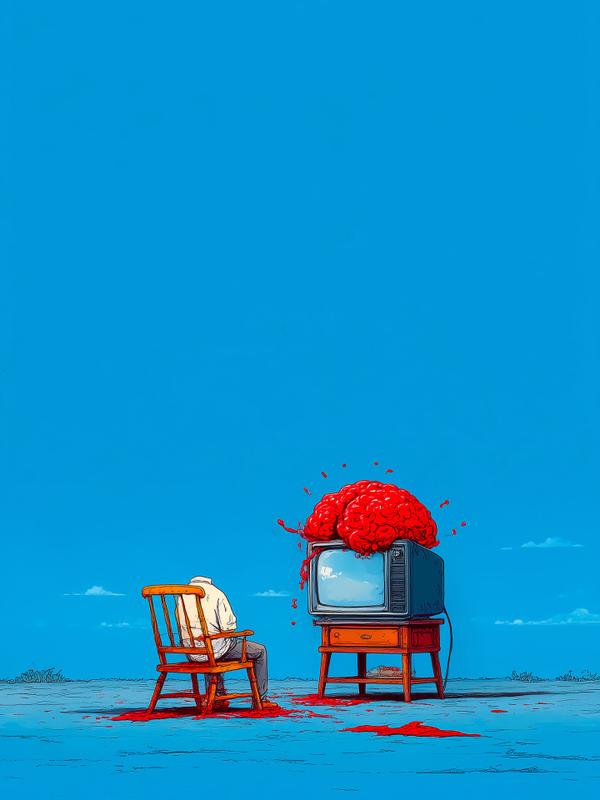
Inspired by: MTV’s Liquid Television (1980s) Medium: AI-generated nostalgia overdose Back when MTV still played music and “Liquid Television” was melting minds in the best way, this is what your mom meant when she said, “Too much TV will rot your brain.” In this dystopian Saturday morning cartoon of a scene, our headless viewer sits—probably still wondering if Beavis ever found meaning. The TV? It’s done its job. Brain? Fully extracted. Mission: accomplished. Fun Fact: The phrase “TV rots your brain” wasn’t just suburban panic—it’s been loosely backed by research. Excessive screen time can mess with attention, cognition, and even empathy. Bonus trivia: MTV’s Liquid Television helped launch Æon Flux and Beavis and Butt-Head. Safe to say, it shaped a generation… or at least liquefied their frontal lobes.
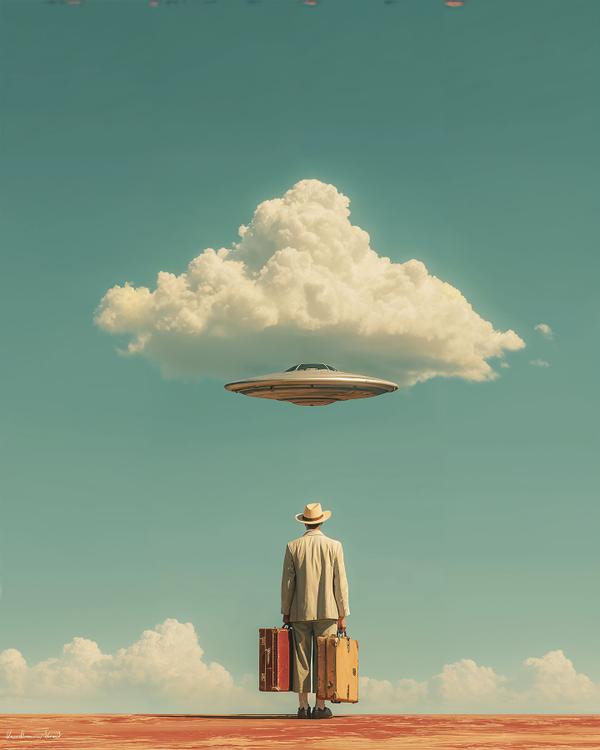
He packed light: one suitcase for nostalgia, the other for curiosity. The rooftop? Just a runway for bigger dreams. And the UFO? Right on time. As always, aliens appreciate punctuality. This piece floats somewhere between Slim Aarons’ cinematic jet-set chic and Harriet Lee-Merrion’s quietly surreal minimalism—a love letter to the absurdly elegant. It’s a postcard from a parallel universe where abduction is just another mode of luxury travel. Art History Byte: The clean lines and surreal juxtapositions pay homage to artists like Giorgio de Chirico and Magritte, who mastered the art of making the bizarre feel normal and the normal feel… off. It’s surrealism with a passport and a press suit. Remember: style doesn’t stop at Earth’s orbit. Dress well. Beam up.
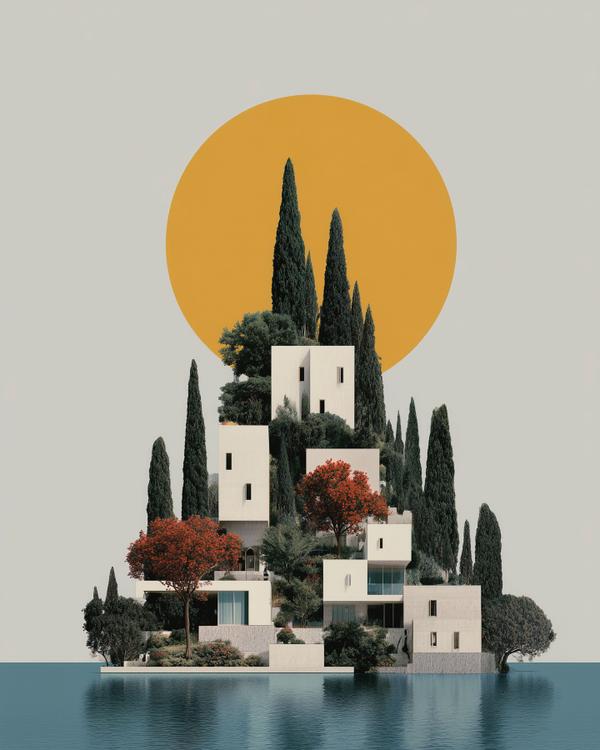
Now look at this piece: a minimalist Mediterranean fantasy. Cubist-inspired architecture climbs like a dream from the sea, hugged by cypress trees and kissed by an orange sun. It’s like Santorini had a love child with a Bauhaus architect at a Fellini film set.
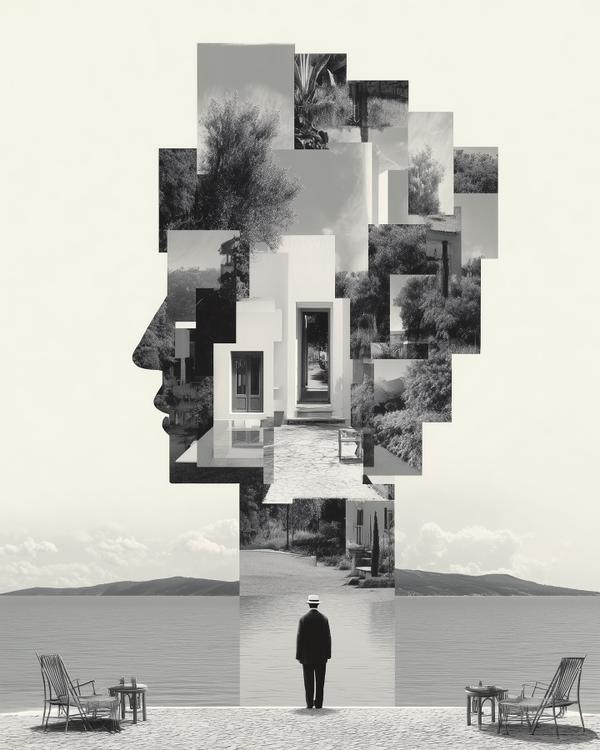
Is it a head? A house? A dream? A Dada dilemma? Today’s artwork is a collage of contradictions — part modernist puzzle, part Grecian daydream, and all held together with the philosophical glue of Dada. The silhouette of a head — constructed from fragmented black-and-white photographs — contains multitudes: Whitewashed Mediterranean walls, Olive trees whispering mythology, Infinite doors suggesting escape or entrance (your choice), And one lone figure staring out to sea like he misplaced time itself. Zoom in and you’ll find: * A tribute to Greek island life (Santorini got sliced!) * The cubist echoes of Picasso on a vacation, * And that unmistakable Dada spirit — absurd, profound, and a little bit cheeky. Bonus: Those empty chairs by the sea? They’re either waiting for you or for someone who never arrived. Either way, bring sunscreen and an existential question. Art Tip of the Day: Collage isn’t just cut-and-paste — it’s reconstruction. Use fragments of your world (photos, textures, memories) to build something entirely new. It’s less about rules, more about rhythm.
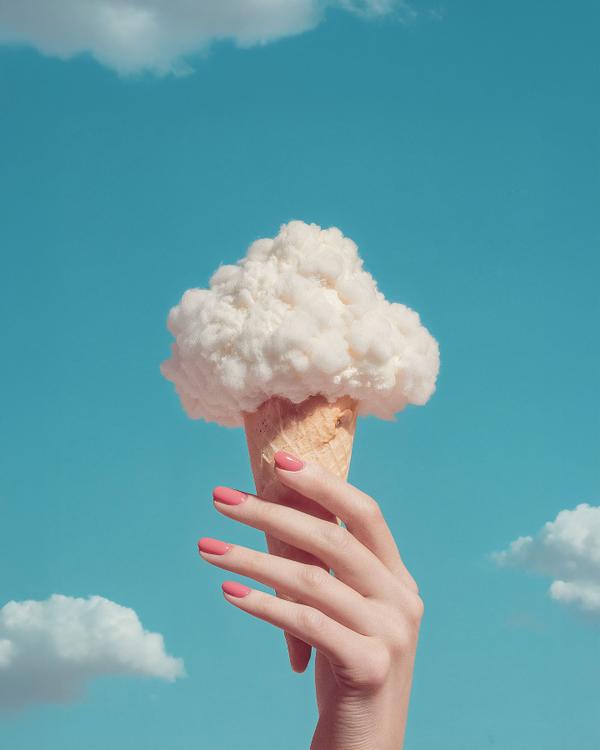
When reality gets sticky, dip into the surreal. This airy concoction blends conceptual minimalism with a spoonful of pop surrealism — think Wayne Thiebaud meets Magritte at a gelato stand in the sky. The cloud-as-ice-cream motif plays with visual metaphor and scale, inviting you to savor the absurd sweetness of imagination. It’s not about eating the sky — it’s about seeing the everyday through a softer, fluffier lens. Zero calories. 100% whimsy.
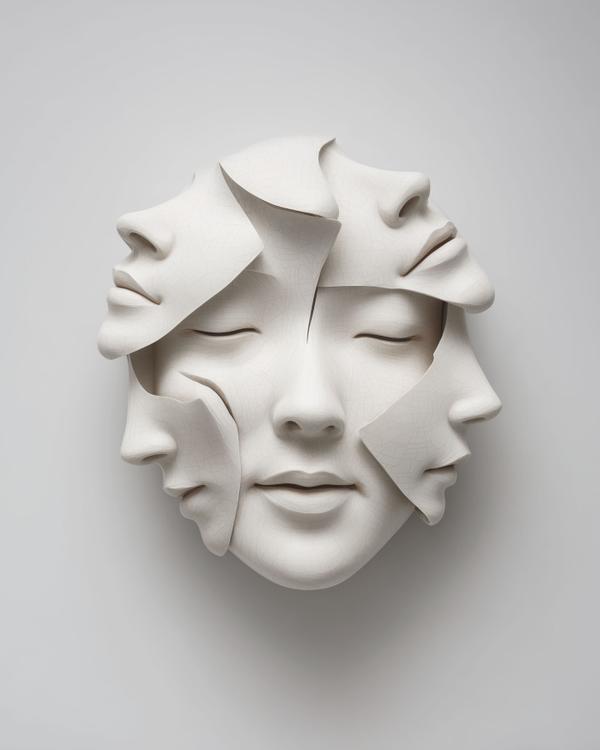
Created in the surreal style of Johnson Tsang, this porcelain-like face fractures reality—literally. Each shard spins off into its own serene expression, whispering the idea that we’re never just one self, but many. Calm, contemplative, fragmented, whole—all at once. Tsang is a Hong Kong artist known for bending clay (and minds) with dreamlike, hyperreal sculptures that blend human forms with metaphysical concepts. This piece channels his essence—soft yet sharp, poetic yet precise. Fun Fact: Tsang often sculpts in white porcelain to emphasize emotion without distraction—letting shadows and form do all the storytelling.
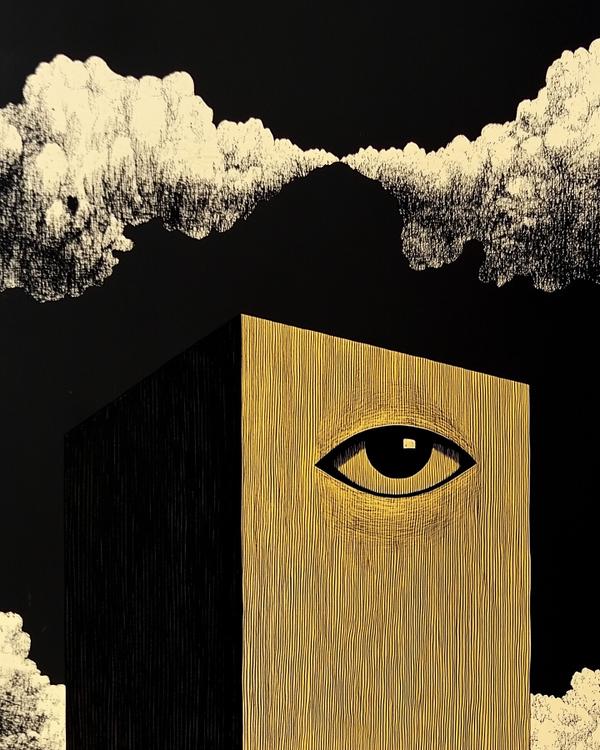
Style: Surrealism x Minimalist Symbolism Let’s get schooled (the fun way!): * Minimalism: Notice the stark lines, the monochromatic palette, and the utter lack of extraneous detail? That’s Minimalism whispering, “Less is more, darling.” It’s about reducing art to its essential elements, letting form and shadow do the heavy lifting. Think clean, crisp, and a little bit… aloof. * Surrealism: But wait, what about those eyes? That unexpected, dreamlike gaze staring back from an impossible cutout? Hello, Surrealism! This movement, championed by folks like Salvador Dalí (minus the melting clocks, in this case), aimed to unlock the power of the unconscious mind. It’s all about juxtaposing ordinary objects in extraordinary ways to create a sense of wonder, unease, or outright bizarreness. It’s when your brain goes, “Huh? But also… YES.” So, we’ve got the disciplined structure of Minimalism meeting the wild imagination of Surrealism. It’s like a perfectly organized dream. Sometimes the most mysterious door is the one with no handle.
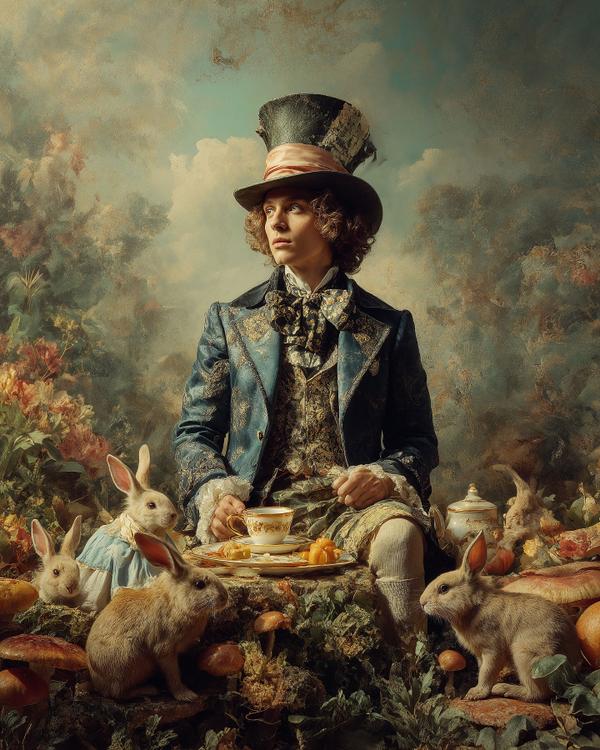
Apparently, you’d get a tea party with impeccable lighting, emotionally complex rabbits, and a hat that deserves its own Renaissance chapel. Part Botticelli, part bonkers — 100% late for something.